

The hardest part of chasing a fast-moving small stock is spotting the setup before one of those sharp small-cap moves is already underway.
That’s what Tim Sykes aims to solve with the Supernova Indicator, a simple tool from Millionaire Publishing that flags a Supernova signal when specific conditions line up.
In this Supernova Indicator review, I’ll share what I found after testing the system and working through its extensive training, including what stood out and where expectations should stay realistic.
>> Get Tim Sykes’ Supernova Indicator Now <<
What Is Supernova Indicator?
Supernova Indicator turns Tim Sykes’ 20-plus years of small-cap pattern recognition into an 18-line TradingView scanner that monitors tight floats, abnormal volume, and breakout confirmation simultaneously. At a one-time $19.99 price, lifetime code access plus training and trading guides create a notably accessible entry point.
The proprietary three-part Supernova framework is backed by Sykes’ reported $7+ million in audited trading profits and 70%+ historical win rate. Historical setups include HOLO from roughly $1.50 to $98.40 and LAES from $0.49 to $10, though these are exceptional case studies rather than typical results.
Supernova Indicator is purpose-built for volatile small-cap and micro-cap trading, so it is best suited to active traders comfortable monitoring fast-moving setups. The scanner identifies qualifying conditions, but entries, exits, position sizing, and risk management still require personal judgment.
Supernova Indicator is a TradingView-based stock scanner built around Tim Sykes’ approach to finding fast-moving small-cap and micro-cap stocks before the biggest part of a move unfolds.
The main attraction is what Tim calls his “18 Lines of Code” Supernova Strategy, which automates the same checklist he spent more than 20 years refining by hand.
Once added to TradingView, the tool watches for three conditions at once: the Ignition Scan, Volume Trigger, and Breakout Confirmation.
When all three line up, it flashes a Supernova signal on the chart.
In addition, members also get a Supernova Masterclass, a 90-second setup walkthrough, signal cheat sheets, and a Style Guide that helps adapt the approach to different entry styles and risk tolerances.
The cool thing is the simplicity of it all: there’s no need to sift through endless charts or learn complicated software.
The indicator does all the heavy lifting, and your job is to decide whether to give the setup it outputs any attention.
Next up, let’s dig a little deeper into how it all works.
>> Try Tim Sykes’ Supernova Indicator Today <<
 What Is Inside Tim Sykes’ “18 Lines of Code” Supernova Strategy?
Tim Sykes built his “18 Lines of Code” strategy around a timing problem that shows up constantly in fast-moving small caps.
Moving averages, RSI, MACD, and Bollinger Bands can all confirm momentum, but confirmation often arrives after a stock has already started running.
By then, a 100% or 200% move may be well underway, and you’ve already missed out on those profits.
Tim wanted something that could flag the setup earlier.
His answer was an 18-line Pine Script for TradingView that looks for the conditions he associates with Supernova stocks before the crowd fully arrives.
The idea is to catch the warning signs while the stock still has room to move.
HOLO and the Supernova Signal in Action: What a Real Setup Looks Like
When it comes to trading small caps, Tim’s one of the best out there.
 He’s carefully honed his strategy over the last 20 years, seeing big increases in his investments on stocks the rest of us have never heard of.
His approach is admittedly at odds with most of what I’ve been taught over the years, but that’s not a bad thing at all.
The Supernova Indicator puts all of these insights within our reach and follows the very same setups that made millionaires out of several of Skyes’ students.
In just one example, HOLO was sitting near $1.50 with a market cap below $100 million and a tiny float.
Volume then surged roughly 400% above its 200-day average while the price remained near that level. After that, HOLO broke above consolidation with accelerating momentum.
The stock later reached $98.40.
This may be an exceptional case, but it shows exactly what Tim means by a Supernova: limited supply, sudden demand, and momentum arriving in a very specific order.
>> Claim Tim Sykes’ Supernova Indicator Access <<
The 18 Lines Only Care About Three Things
What blows my mind is that the code does not read earnings reports or try to decide whether a company deserves to exist five years from now.
Instead, it checks for three specific conditions.
 The Ignition Scan looks for low-market-cap stocks with small floats, often under $100 million, because a limited share supply can react sharply when buyers arrive.
The Volume Trigger watches for volume running several hundred percent above normal before the price has already exploded.
The Breakout Confirmation then waits for price to clear resistance with momentum, accelerating volume, and buying pressure behind the move.
One signal by itself is not enough. A tiny float can remain dead. Heavy volume can fade. A breakout can fail.
When all three converge, the indicator flashes SUPERNOVA.
That is the entire logic behind the 18 lines: find the tightly wound stock, catch the abnormal demand early, then wait for price to confirm that the move has started.
 Why Tim Wants This Scanner Running Right Now
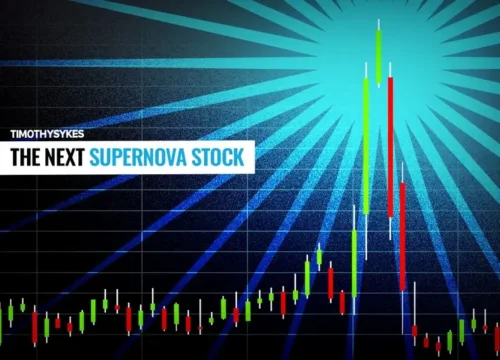
Tim sees the current small-cap and micro-cap market as unusually active.
Volatility, interest-rate shifts, sector rotations, and fast-moving capital can all push money into tiny stocks with limited floats.
When that happens, there may not be enough shares available to absorb the demand without a sharp price reaction.
The financial appeal is getting these setups onto your screen before they become obvious, then using clear entry and exit rules instead of chasing whatever is already trending.
The 18-line scanner, signal research, and training are all available through Supernova Indicator, so you need to subscribe if you want Tim’s complete process for finding and handling these setups.
Since Sykes packs more than an indicator into his service, let’s unpack everything you get as a member.
>> Unlock Tim Sykes’ Supernova Indicator <<
What You Get With Tim Sykes’ Supernova Indicator
Supernova Indicator pairs the 18-line scanner with practical training built around the same Supernova rules Tim Sykes follows himself.
The idea is to give you both the alert and enough context to know what you are looking at when one appears.
The Supernova Indicator TradingView Code
The centerpiece is the actual 18-line Pine Script that Tim says took months to refine from his own pattern-recognition rules.
It runs inside TradingView and scans for all three Supernova conditions at once: the Ignition Scan, Volume Trigger, and Breakout Confirmation.
When the three converge on the same stock, SUPERNOVA flashes directly on the chart.
There’s no separate software to download or a specialized data feed to deal with.
Once activated, you can use the script while pulling up micro-cap and small-cap tickers with the tight floats Tim targets.
Access is permanent, with no renewal fee, monthly subscription, or hidden charge attached to the code.
>> Start With Tim Sykes’ Supernova Indicator <<
 Supernova Video Masterclass

The Supernova Video Masterclass goes well beyond showing you where to paste the code.
Tim teaches the complete system behind the alert, including why Supernova stocks can explode, the checklist he uses before a move develops, and the time of day he searches for these setups.
He also covers the profit targets he aims for and the exit criteria he follows once he is in a position.
I especially appreciate that last step because Tim says many people hold too long, give back gains, or let small losses grow.
His approach is to recognize when the setup has stopped working and get out rather than wait for the stock to recover.
The Supernova Signal Cheat Sheets
The Supernova Signal Cheat Sheets are one-page visual guides for the three conditions behind every alert.
Each page uses annotated real-chart examples to show what Tim is looking for and why a setup qualifies.
They also show false flags, which can resemble a Supernova at first glance but lack the full structure needed for the signal.
That distinction is useful because a low-float stock, a volume spike, or a breakout can all appear on their own without producing the kind of move Tim wants.
I’d suggest printing the sheets and keeping them beside your screen as a trading checklist until the Ignition Scan, Volume Trigger, and Breakout Confirmation become easier to recognize without referring back to the examples.
>> Join Tim Sykes’ Supernova Indicator Today <<
90-Second Install Walkthrough
The 90-Second Install Walkthrough is a nice boon for setting up your Supernova Indicator correctly – especially if you’ve never worked with charting platforms before.
It shows the entire TradingView setup on screen rather than leaving you to figure it out from written instructions.
You’ll see how to set up a TradingView account, open a chart, and put in the 18 lines of code.
Once that is done, the indicator begins monitoring the chart for all three Supernova conditions. Tim also shows what the first alert looks like when it appears.
There is no programming involved, and the process is designed for someone who may never have used a charting platform before.
 Buy & Sell Timing Rules

The Buy & Sell Timing Rules deal with a part of Supernova trading that most services leave you to figure out on your own: when to act.
Tim teaches the specific times of day when he looks for Supernova setups because these moves can develop quickly around changes in volume and momentum.
The training also connects entry timing with the profit targets he watches and the exit conditions that tell him a move is losing strength.
I appreciate that Tim is open about selling early at times, but he considers that preferable to holding too long and turning a winner into a loser.
>> Access Tim Sykes’ Supernova Indicator Now <<
Supernova Indicator 60-Day Money-Back Guarantee
Supernova Indicator comes with a 60-Day Money-Back Guarantee, giving you two full months to test the scanner, run it across different stocks, or paper trade the signals.
If it is not a good fit, you can contact the U.S.-based support team for a full refund with no questions asked.
You can also keep the indicator code, masterclass, and cheat sheets afterward.
I reviewed Supernova Indicator from top to bottom, and these are the strongest pros and the few softer drawbacks that stood out.Pros and Cons
Pros
Cons
>> Get The Supernova Indicator From Tim Sykes <<
Tim Sykes’ Supernova Indicator Track Record and Past Performance
Tim Sykes backs the Supernova Indicator with several striking historical examples.
HOLO moved from about $1.50 to $98.40 in one week after all three Supernova signals aligned. BMR went from roughly $6 to $34 within hours, while LAES climbed from $0.49 to $10, a 1,940% move.
NITO, YIBO, DGNX, BFRI, CPOP, and CAR are also past setups that produced sharp gains.
His broader record adds more context.
Sykes has more than $7 million in audited trading profits and a historical win rate slightly above 70%.
Unlike some platforms I’ve reviewed, Tim doesn’t claim perfection or hide his losses, and that speaks volumes.
His approach depends on cutting failed setups quickly and keeping successful trades larger than unsuccessful ones.
The examples above are historical case studies, not typical results, and actual outcomes depend on entry, exit, position size, and market conditions.
>> Try The Supernova Indicator With Tim Sykes <<
How Much Does Supernova Indicator Cost?
Supernova Indicator is currently available for a one-time payment of $19.99, with no monthly subscription, renewal fee, or recurring charge.
The package includes the 18-line TradingView code, Supernova Getting Started Masterclass, 90-Second Install Walkthrough, Signal Cheat Sheets, and Supernova Style Guide.
I expect this price point to rise in the very near future into the hundreds of dollars, so this isn’t something you want to sit on if you’re interested.
>> Start Using Tim Sykes’ Supernova Indicator <<
Is Tim Sykes’ Supernova Indicator Worth It?
The strongest case for Supernova Indicator is how simply Tim Sykes turns his three-part Supernova setup into a practical TradingView tool.
Instead of scanning endless charts manually, the indicator watches for tight floats, unusual volume, and breakout confirmation before flashing a Supernova signal.
If you’re interested in fast-moving small-cap stocks, that means there’s plenty of value here.
You get lifetime access to the code, the Video Masterclass, signal cheat sheets, timing rules, and setup training without an ongoing subscription.
No indicator can remove the risk from volatile small caps, so discipline still matters.
Still, this Supernova Indicator review lands on a positive verdict because the one-time price, focused training, and 60-day guarantee make it a low-cost way to learn Tim’s Supernova framework.



 Tags:
Tags: