


Tim Plaehn stayed away from IPOs for years because newly public companies rarely pay dividends and, in his words, “aren’t worth owning.”
He says a new breakthrough now allows him to collect monthly cash from them, but I’m curious about what caused the shift.
In this Tim Plaehn IPO Dividends review, we joined ETF Income Maximizer to see whether the income strategy holds up, and if it’s worth signing up for.
>> Get Tim Plaehn’s IPO Dividends For $49 <<
What Is Tim Plaehn’s ETF Income Maximizer and How Does It Work?
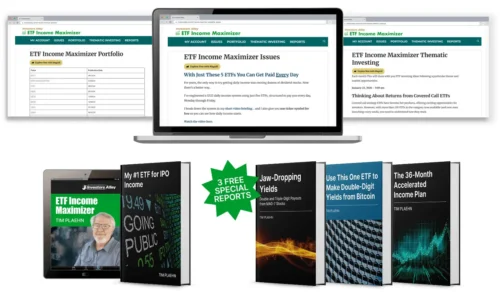
ETF Income Maximizer delivers a full year of Tim Plaehn’s income ETF research for just $49, including monthly fund recommendations, income estimates, and a complete research archive. The IPO Dividends offer adds a featured ETF targeting 20% annualized distributions, three bonus reports, and complimentary Magnifi AI access. Plaehn’s featured IPO income ETF reportedly generated $1,104 in June 2026 distributions on a $60,000 position. His strategy combines income-generating ETFs with exposure to major market indexes, offering a way to pursue monthly cash flow without trading options or purchasing individual IPO shares. ETF Income Maximizer specializes in income generation rather than maximizing stock price appreciation. Distributions fluctuate, and certain income ETF strategies sacrifice some upside potential in exchange for cash payouts, making the service better suited to investors prioritizing recurring income over aggressive growth.
ETF Income Maximizer is Tim Plaehn’s monthly research service at Investors Alley, and it focuses on one type of investment: income ETFs.
These funds turn assets that pay little or nothing, like big tech stocks, gold, or a stock index, into regular cash payouts.
Each month, Plaehn picks one income ETF and estimates how much it could pay you.
Members also get his list of favorite income ETFs, a monthly education piece, an archive of every past pick, and a few extras we’ll get to below.
There are no options to trade, no leverage, and no jumping in and out of positions.
Plaehn’s IPO Dividends bundle is the current way into the service, and it comes with a single-income ETF tied to an index that can add mega-IPOs, like OpenAI or Anthropic, within weeks of their debut.
Knowing how much excitement these big tech plays are generating right now, I had to poke further into the opportunity.
>> Join ETF Income Maximizer For Just $49 <<
 How Does Tim Plaehn’s IPO Dividends Strategy Generate Monthly Income?

SpaceX raised $75 billion in June, the largest IPO in history, and OpenAI and Anthropic are next in line.
The first half of 2026 brought $251 billion in new offerings, topping 2021’s record midyear.
AI and digital infrastructure companies make up about 35% of global IPOs, and aerospace, defense, and space firms are driving a second wave.
 Almost none of these names will pay a dividend for years.
That’s a real problem if your portfolio pays your bills, and it’s the gap IPO Dividends sets out to fill.
Trillion-Dollar Debuts, Zero-Dollar Dividends
Several Magnificent 7 companies went public in deals under $500 million back in the 1980s and 1990s.
Today’s candidates stay private until they’re worth hundreds of billions, and a few have raised enough money to put their valuations near $1 trillion.
More than 800 venture-backed companies already sit above $1 billion, but by listing day, early backers have captured much of the climb.
If you rely on income, every move from here costs you something.
Buying a trillion-dollar debut means owning a stock that pays nothing. Selling options on it requires broker approval and experience most of us struggle with.
Sadly, staying in a 3% dividend stock turns $60,000 into $1,800 over a full year, which is hardly enough to keep day-to-day expenses in check.
Meanwhile, hedge funds are cashing in on the same rally you’re watching from the sidelines.
>> Unlock Plaehn’s #1 ETF For IPO Income <<
A $50 ETF Tied to the Index Where New Giants Land
The bridge is a type of fund that barely existed five years ago: the income ETF.
Its manager “rents out” the holdings to generate cash, while you simply own shares in a regular brokerage account.
The fund behind IPO Dividends trades for about $50 a share and pays a 20% annualized distribution.
Plaehn’s 2026 “IPO Income” calendar shows a check every month, and June’s came to $1,104 on a $60,000 position. That’s more than seven months of what the 3% stock pays.
New Nasdaq rules can fast-track mega-cap debuts into the Nasdaq-100 within 15 trading days, so a fund tied to a top index can hold a company like OpenAI soon after it lists.
The money is following. Morningstar counted 72 new income ETFs in 2025, and BlackRock expects the category to reach $650 billion by 2030.
Collecting From the IPO Wave Without an IPO Order
 IPO Income turns the year’s biggest listings into a monthly deposit.
There’s no allocation to request, no options account, and no guessing which debut will pop.
One $50-a-share fund does the work, and each payout can cover a bill or buy more shares for a bigger check the next month.
The ticker, expected income, and reinvestment steps are reserved for ETF Income Maximizer members, so joining is the only way to get Plaehn’s pick.
That said, you’re getting more than info on a single ETF here. Let’s look at everything a membership includes.
>> Start Tim Plaehn’s IPO Income Strategy Today <<
IPO Dividends Features: Monthly ETF Picks, Income Portfolio, and Research
Signing up unlocks a full year of Plaehn’s income ETF research, plus a few tools for putting it to work.
A Full Year of ETF Income Maximizer
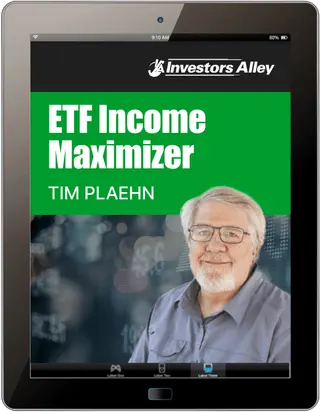 Membership runs for 12 months and covers every monthly recommendation, research update, and bonus report Plaehn publishes in that time.
Investors Alley bills ETF Income Maximizer as the only service in America built entirely around income ETFs, and the focus is tight.
There are no options trades, no chart reading, and no market-timing calls.
The approach is buy-and-hold: pick a fund, own it, and collect the payouts.
With a goal of doubling or tripling the income of traditional dividend stocks, the draw here is quite clear.
Plaehn does a solid job of keeping everything easy to understand, even if you haven’t dabbled much in ETFs before.
>> Claim IPO Dividends At 50% Off <<
Monthly Issue: ETF of the Month
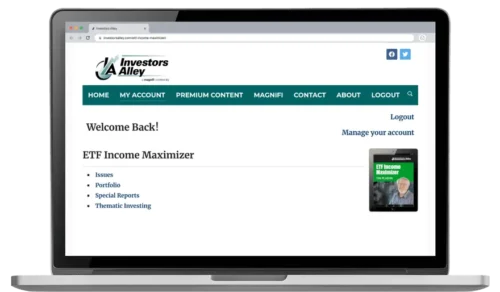
Each month, Plaehn names the one income ETF he’d buy next and estimates how much monthly income it could generate.
One fund per issue keeps things manageable. Instead of sifting through a dozen tickers, you get a single idea and the reasoning behind it.
The income estimate is the practical part, since it shows roughly what a position might pay before you commit money.
Those estimates rest on the fund’s current price and latest payout, and both move.
You’ll get the full picture before you ever head to your brokerage account, but I always double-check the distribution to make sure the research still lines up.
Income ETF Portfolio
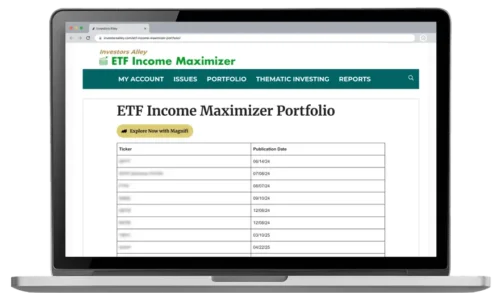 The portfolio is Plaehn’s full list of favorite income ETFs, kept in one place so you can see everything he currently likes.
His research reaches well beyond IPO income to any area with the potential to generate serious cash.
He has covered ETFs that pay out from Tesla, Amazon, and Netflix shares, none of which pay a dividend, along with a gold fund that pays every Friday.
That range lets you spread income across different assets instead of leaning on one fund.
Position sizes aren’t spelled out, so treat the list as a menu and decide for yourself how much goes into each fund.
Members-Only Portal and Research Updates
Everything lives in a members-only portal: every past recommendation, special report, and research update, organized so you can quickly trace a fund’s history.
Access is immediate, so new members get the full archive on day one, not just issues published after you join.
I find myself spending a lot of time here.
Income ETFs change their payouts, and reading Plaehn’s original write-up next to his later updates shows whether a pick still holds up.
Don’t expect text alerts or a fixed update schedule, though. It’s research you read at your own pace.
>> See Tim Plaehn’s 20% Income ETF Pick <<
Monthly Education and Customer Support

Each month also brings an education piece built around one theme or strategy in the income ETF world.
It’s especially useful if you’re new to these funds, because two ETFs with the same yield can generate that cash in very different ways.
Support is live and U.S.-based, available five days a week, and handles subscription questions such as access, billing, renewals, and refunds.
That said, don’t expect to get any personal investment advice.
The research is educational, so decisions about how much to invest and which funds fit your situation stay with you.
Magnifi AI Access
 Members also get free access to Magnifi AI, which Investors Alley values at $132 a year.
It pulls your investment accounts into one dashboard, runs real-time portfolio and market analysis, lets you chat with its AI as often as you like, and builds custom portfolios.
You can also use it for commission-free trading.
I like to log in and hunt for high-paying ETFs while seeing how my holdings fit together.
On the back end, it takes a lot of the emotion out of decisions that can easily trip us up.
Being able to chat with AI at a moment’s notice to think through things is also a huge plus.
>> Get ETF Income Maximizer At Half Price <<
IPO Dividends Bonuses: 20% ETF, MAG-7 Income, and Gold Payouts
Joining now also gives you access to the following bonus reports at no extra cost:
Featured Report: My #1 ETF for IPO Income
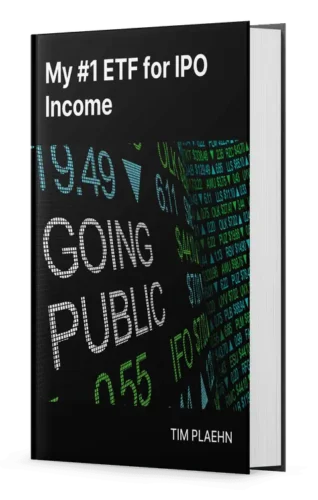 The whole IPO Dividends offer is built around this report.
It names the income ETF behind Plaehn’s IPO Income strategy, a roughly $50-a-share fund tied to a major index and paying up to 20% a year in monthly distributions.
Tim explains why he believes the fund is positioned to keep paying yields that high, and exactly how much income to expect each month.
You’ll also learn how to buy it in any brokerage account, reinvest the payouts to grow your income over time, and why you don’t need to take part in an IPO to profit.
>> Access Tim Plaehn’s IPO Income Report Now <<
Bonus Report #1: Jaw-Dropping Yields: Double and Triple-Digit Payouts From MAG-7 Stocks
Tesla has never paid a dividend on its common stock, and Amazon doesn’t pay anything either.
This report covers Plaehn’s top picks for turning Magnificent 7 giants like Tesla, Amazon, and Apple into monthly income machines through income ETFs.
He has tracked a Tesla-linked fund at a 65% annualized distribution and an Amazon fund at 40%. Read it for the mechanics, not just the yields.
These funds typically give up some upside when the stock rallies hard in exchange for steady cash, so know that trade before buying.
It’s a nice way to participate in the latest tech craze, and Tim lays everything out in clear English.
Bonus Report #2: My #1 Gold ETF for Income
Gold pays no interest and offers no dividends, yet Plaehn calls this strategy the easiest way he’s found to earn income from it.
There’s no need to trade mining stocks or deal with gold’s volatility.
The featured gold income ETF has a 46% annualized yield, paid in cash every Friday, which he calls his “Friday Golden Payments.”
Inside, you’ll see the exact ticker and everything you need to start collecting.
It adds a non-stock income source next to the IPO fund, which can be a powerful diversification angle.
Bonus Report #3: The 36-Month Accelerated Income Plan
This report is a three-year roadmap for turning a modest investment into a meaningful monthly income stream using only income ETFs.
Plaehn frames the targets in everyday terms: enough to cover a mortgage, a car payment, or even an early retirement.
I’d use it to decide how much of each payout to reinvest early on and when to start spending it.
Run the plan with lower payouts than the best months show. If it still covers your goal, you’re on solid footing.
Thinking about the future is important, but there’s certainly something to be said about handling your monthly payments without batting an eye.
>> Collect Monthly Income With Tim Plaehn <<
ETF Income Maximizer Refund Policy: 365-Day Money-Back Guarantee
 ETF Income Maximizer comes with a 365-day risk-free trial.
If the research isn’t for you at any point in year one, contact the customer service team for a full refund, no questions asked.
You’ll even get to keep every report you’ve received as a thank you for giving the service a try.
After putting ETF Income Maximizer to work through the IPO Dividends offer, here are my top pros and cons.Pros and Cons
Pros
Cons
>> Join Tim Plaehn’s ETF Income Maximizer Today <<
IPO Dividends Track Record and Past Performance
Plaehn is the lead income and dividend analyst at Investors Alley, where he also edits The Dividend Hunter and Monthly Dividend Multiplier.
Before that, he worked as a stockbroker, Certified Financial Planner, and F-16 instructor pilot.
As far as member testimonies go, Alan has followed his picks since about 2017, and Don credits him with bailing them out during the COVID crash.
The IPO income fund’s 2026 calendar shows roughly $1,000 for each distribution from February to July, indicating the real possibly of repeat performance.
Take all that with a grain of salt because it’s info I pulled straight from the promo, but it’s promising nonetheless.
How Much Does ETF Income Maximizer Cost?
Through the IPO Dividends offer, ETF Income Maximizer costs $49 for the first year, down from its regular $99. That’s 50% off, or less than 14 cents a day.
The price covers 12 months of research, the featured IPO income report, all three bonus reports, and free Magnifi AI access.
After the first 12 months, the subscription renews automatically at $99 a year.
When you sign up, you’ll also see the option for one-time upgrade: five more years of ETF Income Maximizer for $297.
It’s effectively a 40% discount, saving $198 compared with paying $99 a year if you’re ready to commit long-term.
>> Get Paid From IPOs With Tim Plaehn <<
 Is Tim Plaehn’s IPO Dividends Offer Worth It?
After going through every part of it for this Tim Plaehn IPO Dividends review, I think it’s a strong fit for income-minded individuals who want a simple way to tie their portfolio to the IPO wave without buying pricey new stocks or trading options.
For $49, you get a clear idea, a named fund, and a year of monthly income ETF research. The 365-day refund lets you judge the research with little risk to your subscription fee.
There’s nothing set in stone here, as is the case with any investment strategy, but I like the foundation that the strategy stands on.
Our advice: Read Plaehn’s report, check the fund’s own numbers, and size your position so a lower payout wouldn’t hurt.
Ready to see the fund Plaehn picked? Claim the IPO Dividends offer and get “My #1 ETF for IPO Income” with your ETF Income Maximizer membership.



 Tags: