

Tim Sykes has some bold performance claims attached to his name, from millions in personal profits to XGPT picks that later posted triple-digit peak moves.
The real question is whether those numbers reflect a repeatable edge or simply the best examples from a much muddier record.
In this Tim Sykes Letter performance claims review, I’ll break down Tim’s track record, student success stories, XGPT results, and past calls to see what the figures actually reveal.
 What Performance Claims Are Connected to The Tim Sykes Letter?
 What Performance Claims Are Connected to The Tim Sykes Letter?
The Tim Sykes Letter’s track record has several layers, and it’s essential to judge each one differently.
Tim Sykes boasts roughly $7.9 million in personal trading profits across more than 20 years in the market.
He also became a millionaire at age 22 after starting with money from his bar mitzvah.
If that wasn’t enough, his education business claims more than 50 millionaire students.
XGPT adds another set of positives. Tim’s system identified 40 stocks that later reached triple-digit peak gains during its 2024 development period alone. Those claims are impressive, but that still doesn’t mean you can drop them in as guarantees.
Tim Sykes’ Personal Track Record
Tim’s own market history gives the service its strongest foundation.
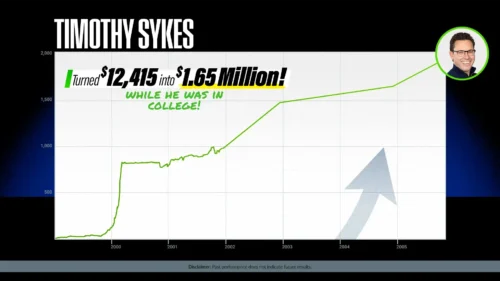
He says he started with roughly $12,000 of bar mitzvah money and grew that account into millions by focusing on penny stocks, fast-moving catalysts, and small-company setups – all while still in school.
His 385-page Complete Penny Stock Course references more than $6 million in trading profits, but I’ve seen figures putting the total in the $8 million range.
Tim did not build his record from one lucky trade. He has spent more than two decades dealing with volatile stocks, thin liquidity, sudden news, and sharp reversals.
Of course, that does not mean The Tim Sykes Letter produced $7.9 million for members, but it does tell me that Tim has real experience in the exact corner of the market he covers.
For a small-stock research service, that background makes a difference.
What Do the XGPT Performance Claims Really Mean?
XGPT is Tim’s patent-pending AI forecasting system built around his penny stock strategy.
Members receive two or three forecasts each month, along with the reason for the setup, a target price, a confidence score, and guidance for evaluating the idea.
The headline claim is that XGPT identified 40 triple-digit peak movers during development in 2024.
Several examples help put that figure into context. Elevation Oncology reached a peak move of 130%.
Rail Vision later climbed as high as 311%. MicroCloud Hologram is tied to a 359% peak move.
Those numbers show that XGPT surfaced highly volatile stocks before major runs, but these numbers indicate best-case scenarios.
A stock identified at $2 that later reaches $6 posts a 200% peak gain. A member who buys at $2.50 and sells at $4 earns 60%. Another person who enters after the first spike may lose money.
The strongest case for XGPT is not that every alert produces a triple-digit return. Its value is the filtering process.
Thousands of low-priced stocks trade at any given time, and most do not deserve attention. XGPT helps narrow the field to a smaller list of names that match Tim’s preferred setup.
Tim Sykes’ Millionaire Student Claims
Tim says his education business has helped create more than 50 millionaire students.
Tim Grittani is the clearest example. He began with about $11,500 and grew the account to more than $16 million over 10 years.
That result is extraordinary, but don’t look past the fact that it took him a decade to get there.
Grittani’s growth did not come from buying a subscription and copying a few alerts.
It involved years of study, execution, reinvested gains, setbacks, and gradual improvement.
Tim is clear that trading is difficult and risky. He stresses the need for study, planning, and discipline.
That honesty helps. The student stories show that Tim’s framework has produced exceptional outcomes for a small group of committed people.
 Tim Bohen’s Past Stock Calls
 Tim Bohen’s Past Stock Calls
Lead trainer for StockstoTrade, Tim Bohen, adds another performance layer to the Tim Sykes Letter through his weekly video updates.
One example is Tesla in 2019, which later offered the chance to make around 11 times the initial investment.
Other highlighted calls include Workhorse before a 2,568% peak move, NIO before 3,489%, and FuelCell Energy before a rise as high as 9,396%.
Those numbers are striking, but like most successes, describe the stocks’ maximum moves after Bohen highlighted them.
That distinction does not erase the value of the calls. Finding a stock before a major run is useful, even when someone captures only part of the move.
Bohen’s record suggests he has a good eye for active sectors and momentum names.
How to Read Newsletter Performance Claims Correctly
Performance claims become easier to judge once you separate the numbers into the right categories.
 Peak Gain vs. Realized Gain
 Peak Gain vs. Realized Gain
A peak gain shows the highest price a stock reached after it was highlighted. A realized gain shows what someone actually earned between buying and selling.
The first measures the size of the opportunity, while the second measures the result.
Two people can follow the same stock and finish with opposite outcomes because their timing, position size, and exit decisions differ.
One Big Winner vs. the Full Record
A 1,000% stock move can dominate an advertisement, but it does not show how every other recommendation performed.
Seeing a service’s full record captures winners, losers, flat positions, entry dates, exit dates, and holding periods. Without that wider picture, standout examples show upside potential rather than overall consistency.
Personal Results vs. Member Results
Tim’s $7.9 million in personal earnings belong to Tim. Tim Grittani’s $16 million follows the same philosophy.
Their results reflect personal decisions, account sizes, experience, and years of execution. Neither figure tells us what the average member earned.
Development Results vs. Live Forecasts
XGPT’s 2024 examples came from its development period. Those numbers are important because they show the system detected patterns before large moves.
However, live forecasts will carry more weight over time because they include real delivery dates, changing market conditions, and actual decision points for members.
Position Size, Liquidity, and Holding Period
A stock can rise 200%, but the gain means little without also including the capital involved.
Small stocks can also have thin liquidity and wide bid-ask spreads. Fast reversals can make it difficult to exit near the quoted price.
Time matters too. A stock doubling in three days demands a very different approach from one doubling over five years.
These limits do not make the headline figures useless. They simply show what each number proves.
Is the Tim Sykes Letter Track Record Credible?
Yes, my research clearly indicates that the Tim Sykes Letter is credible. That said, the strongest case comes from the full picture rather than the largest percentages.
Tim brings more than 20 years of experience and reports millions in personal profits.
His student examples show that a small number of committed people have produced exceptional long-term results.
XGPT has identified several stocks before triple-digit peak moves, while Tim Bohen has highlighted companies that later became major momentum stories.
The figures become misleading only if you treat them as typical member returns.
The educational side also helps explain why a stock deserves attention instead of asking them to follow alerts blindly.
No system removes execution risk, but The Tim Sykes Letter gives a much more structured starting point than searching for penny stocks alone.
 Final Takeaway
 Final Takeaway
The Tim Sykes Letter performance claims include several strong reasons to pay attention: Tim’s $7.9 million in personal profits, more than 50 millionaire students, 40 XGPT triple-digit peak movers, and several major stocks highlighted by Tim Bohen.
None of those numbers promises what will happen in your account.
The service makes the most sense for people who want Tim’s small-stock research, XGPT forecasts, and a framework for studying fast-moving opportunities.
Join for the screening, analysis, and education, not because you expect to capture the full peak move of every stock.
That realistic approach gives you a better chance of using The Tim Sykes Letter the way it was meant to be used.

 Tags:
Tags: