

Your money matters, and what you pay for a research service has to make sense.
It makes no sense to shell out your hard-earned cash only to receive research and recommendations that don’t land, which is why I spend so much time reviewing the services presented to me.
Pricing, renewal costs, and upgrade offers can influence whether a subscription makes sense long term.
This Near Future Report pricing guide breaks down the real subscription cost, available discounts, renewal expectations, and how optional upgrades fit into the Brownstone Research ecosystem so you can make a fully informed decision.
 How Much Does The Near Future Report Cost Today?
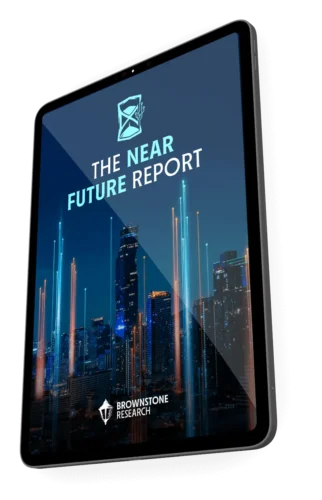
The normal annual cost of The Near Future Report is $499.
Not bad, but the current promotion tied to the AI Trojan Horse campaign brings that down to just $179 for the first year.
That represents a 65% reduction from the stated value and places the effective monthly cost just south of $15.
The subscription covers twelve monthly research issues, which means you receive at least one new technology-focused recommendation each month.
The cost also includes access to the model portfolio, weekly updates, and the full research archive.
Positioning the entry price below $200 places it within the lower range of technology research subscriptions, especially when compared with premium advisory services that often cost several times more.
Understanding The Current Discount Offer
The difference between the $499 stated value and the $179 entry price reflects how research publishers typically structure customer onboarding.
Lower introductory pricing reduces the barrier to trying a research service while allowing readers to determine whether the research style aligns with their expectations.
This approach is common across subscription publishing because long-term subscribers represent the foundation of the business model.
Costs usually jump closer to the retail price in subsequent years, which is no surprise, but it’s nice to be able to get started for a cheaper rate.
 What Happens When Your Subscription Renews?

For The Near Future Report, year two currently comes at a discounted rate of $199, still a welcome deviation from the retail price.
Renewal notices typically arrive before billing occurs, allowing you time to decide whether to continue.
I can’t blame a service for requiring such rates, considering the ongoing cost of maintaining research coverage.
Sectors covered within constantly evolve, and someone needs to take the time to find new opportunities and stay relevant.
Is The Near Future Report A One-Time Payment?
The subscription operates on an annual basis rather than as a lifetime purchase.
Your membership covers twelve months of research access, after which you’ll have to renew to continue service.
It follows the same guidelines as any other subscription, like a phone plan or streaming service, so the concept makes perfect sense.
Here, monthly research releases, combined with updates, create a continuing flow of analysis rather than a fixed information product.
You may see some standalone reports come your way while you’re a member, but receiving new recommendations every month helps the subscription approach make sense.
Are There Any Upsells After Joining?
The nice thing about Near Future Report is that it’s an all-inclusive package.
There aren’t any “gotchas” or last-minute upgrade prompts the team throws at you; everything within the service really does come included in that subscription price.
That said, within the Brownstone Research ecosystem, additional research services exist beyond the entry-level publication.
I wasn’t bombarded with purchase requests or anything like that, but just be aware that they’re out there in case you think you’re missing out.
Entry-level publications generally function as the foundation, while higher-tier services expand into more concentrated research areas.
 Understanding The Brownstone Research Product Ecosystem

Publishers like Brownstone Research typically offer multiple products, and why wouldn’t they?
It doesn’t make sense for most companies to have just a single item for sale, and that’s no different here.
Entry-level services introduce research methodology and technology themes, while advanced services provide more targeted analysis.
Within this structure, The Near Future Report functions as the starting point.
It focuses on broad megatrends such as artificial intelligence expansion, semiconductor growth, robotics development, and computing infrastructure.
Additional services may narrow the focus toward specific sectors within those broader themes.
This structure allows readers to begin with a lower-cost entry point while maintaining the flexibility to explore deeper research later.
Why Research Services Use Introductory Pricing
Introductory pricing exists because research publishing depends on subscriber relationships rather than one-time purchases.
Offering a reduced first-year cost allows readers to evaluate whether the research fits their needs before committing to full pricing.
Technology research especially benefits from this approach because technological adoption takes time.
Artificial intelligence expansion alone includes infrastructure such as more than 8,000 projected data centers globally.
Following these developments requires ongoing coverage rather than short-term analysis.
Lower entry pricing allows readers to observe how research evolves alongside these developments.
 Why Renewal Pricing Is Higher

Renewal pricing typically reflects the full cost of maintaining ongoing research coverage.
Continuous analysis requires tracking industry developments, monitoring technological progress, and publishing updated research.
All that takes time and manpower, and Brownstone Research has to cover that somehow.
They’re very clear about what services traditionally cost, and there’s no mention of the introductory rate extending beyond year one.
I wasn’t surprised in the least to see this approach, and the current renewal rate still isn’t near the retail price.
How Near Future Report Pricing Compares To Similar Research Services
Technology research pricing varies widely depending on specialization.
Entry-level newsletters often range between $100 and $500 annually, while specialized advisory services frequently exceed $1,000 per year.
Positioning The Near Future Report at $179 places it toward the accessible end of the pricing spectrum.
This reflects its role as a broad technology research publication rather than a niche advisory focused on a single sector.
This pricing also aligns with its role as a starting point within a larger research ecosystem.
Readers interested in emerging technology trends gain access to ongoing research without the higher costs associated with more specialized services.
Ways Members Typically Maximize Their Subscription Value
Technology research tends to deliver the most value when followed consistently rather than treated as isolated reading.
Monthly issues introduce themes, while updates track how those themes develop as markets evolve.
The research archive adds additional context by allowing readers to revisit earlier analysis. Access to every previously published issue and report creates a historical view of how technology narratives develop over time.
I don’t find myself investing in every recommendation they make, but I do follow The Near Future Report’s instructions pretty much to a “T” when I do.
Pricing Transparency And Risk Protection
The low price point comes with a 30-Day Ironclad 100% Money Back Guarantee, allowing new subscribers to evaluate the research approach before making a long-term commitment.
It’s not terribly long, but you’ll have time to review the monthly research issue, examine the model portfolio, and explore the research archive.
Having a refund window removes much of the hesitation associated with trying a research subscription for the first time.
Guarantee policies also function as trust signals within the research industry.
Offering refund protection shows confidence in the research while giving you flexibility to decide whether the service meets expectations.
Final Thoughts On Near Future Report Pricing
Understanding how pricing works helps remove uncertainty when evaluating research subscriptions.
The combination of discounted entry pricing, predictable renewal structure, and refund protection creates a clear entry path for anyone interested in technology-focused analysis.
Positioning the first-year cost at $179 keeps the entry barrier relatively low compared to many technology research services.
If you want to invest in artificial intelligence infrastructure, semiconductor growth, and computing expansion, this pricing structure offers a manageable starting point.
Those interested in Jeff Brown’s technology research can explore The Near Future Report as a structured entry point into ongoing analysis focused on the infrastructure trends shaping the next phase of digital growth.

 Tags:
Tags: