

Could the artificial intelligence boom on Wall Street be setting up AI stocks, and the wider market, for a brutal reversal?
Jim Rickards warns that heavily financed AI companies, hidden risks in pension funds, and soaring data-center debt could lead to an 80% market decline, a case he lays out in The AI Black Paper for Strategic Intelligence readers.
In this AI Black Paper review, I’ll examine his warning, the strategy, and whether the research here offers real value.
>> Get Jim Rickards’ AI Black Paper Today <<
 What Is Strategic Intelligence? Jim Rickards’ Monthly Complexity Theory Research Service From Paradigm

Strategic Intelligence is Jim Rickards’ monthly financial research service, built around his work in complexity theory, geopolitical shifts, and global capital flows.
Each issue looks at major risks forming across the economy and then connects those threats to practical ways that we can protect and grow wealth.
Rickards also shares actionable market intelligence on assets that could rise while weaker areas fall, which gives the service a broader scope than a standard stock newsletter.
Members receive six monthly dossiers, along with research on vulnerable AI-related stocks, defensive assets, a potential crash hedge, physical gold, and selected defense opportunities.
The current featured idea is The AI Black Paper, which focuses on Rickards’ warning that the artificial intelligence boom could end in a sharp market reversal.
Let’s see what all the fuss is about.
Strategic Intelligence combines Jim Rickards' macroeconomic research with actionable investment ideas focused on protecting wealth during major market shifts. For just $49, subscribers receive six months of research, six bonus reports, and a 90-day money-back guarantee, making it a compelling value for contrarian investors.
Rickards supports his AI bubble thesis with complexity theory, geopolitical analysis, and historical market parallels while highlighting his previous calls on the 2008 financial crisis, Brexit, COVID-19, and major political events. The included reports also reveal his personal $1 million defensive allocation strategy.
Strategic Intelligence is designed for investors interested in macroeconomic trends and defensive positioning rather than frequent stock trading. Its contrarian approach may appeal most to long-term investors willing to evaluate broader market risks before making portfolio decisions.
>> Join Strategic Intelligence With Jim Rickards <<

Inside Jim Rickards’ AI Bubble Set to Pop Presentation: Circular Financing, the Minsky Moment, and an 80% Decline Warning
Jim Rickards builds the entire case around one uncomfortable idea: artificial intelligence can change the world and still become a disastrous investment bubble.
AI stocks now carry an outsized share of market gains, while companies across the sector keep spending at a pace that profits aren’t keeping up with.
 That leaves retirement accounts, index funds, and pension money tied to a boom that may not need much bad news to reverse.
Gloom and doom aside, there is potential upside here, but it requires spotting that break early, cutting exposure to the weakest areas, and owning assets that can benefit when the selling begins.
Where There’s Smoke, There’s Fire
The artificial intelligence bubble isn’t the first we’ve ever seen, but if Rickards is right, it could certainly be the biggest.
Some 80% of the gains the market has seen over the last few years is tied directly to this sector, and AI expenditures measure up to 92% of GDP growth.
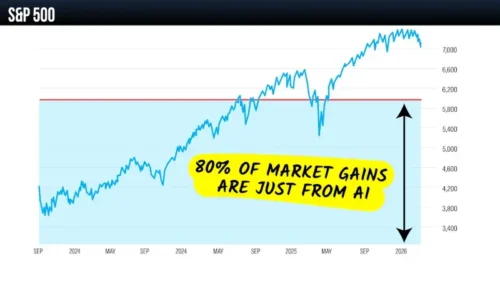 That’s a lot of eggs in one basket, if you ask me.
What’s even scarier is that these big companies are absolutely burning through their cash reserves.
Many of these ventures don’t have the slightest idea how to turn a profit – now, or at any point in the future.
As impactful as technology is right now, a bubble burst could have powerful, lasting effects.
Those of us caught unaware will receive the brunt of that impact, and that’s simply not somewhere anyone wants to be.
What’s happening beneath the surface, though, to send AI in this direction?
>> Access The AI Black Paper Research Now <<
Circular Financing May Be Inflating Demand
The main weak point here is the flow of money between the same companies driving the AI boom.
Nvidia invests in startups that later buy Nvidia chips. OpenAI supports Oracle data center projects, while Oracle directs capital back toward OpenAI.
 These arrangements can produce real business activity, but they can also make sales look stronger when much of the money keeps moving around the same closed network.
Even this concept isn’t anything new – the exact same process transpired before the dot-com boom fell apart.
The current AI buildout operates on a much larger scale, with expensive valuations resting on rapid adoption, endless infrastructure spending, and future profits that remain uncertain.
A slowdown in any one of those areas could expose how much demand comes from this cyclical pattern instead of paying end users.
The Hype-to-Profit Gap: Why a Single Slip Could Trigger a Dot-Com-Scale Market Drop and 15-Year Recovery
With any bubble, a single needle prick can lead to a catastrophic burst.
There are a lot of companies that, with one slip-up, could very well be that needle.
While no one can predict what the aftermath would look like, I need only remind you that it took 15 years to recover from the dot-com fiasco.
It’s important to use this time to protect what’s yours, but Rickards also makes it clear that not every stock will fall during this time.
In fact, it’s still entirely possible to make money during a bubble burst if you play your cards right.
Jim has taken the time to identify both sides of this coin, and he shares his research inside the AI Black Paper bundle that’s part of his Strategic Intelligence service.
Join me as I look into everything included with a subscription.
>> See Jim Rickards’ AI Bubble Strategy <<
What Is a Minsky Moment? The Three-Stage Debt Cycle Behind Rickards’ AI Crash Warning
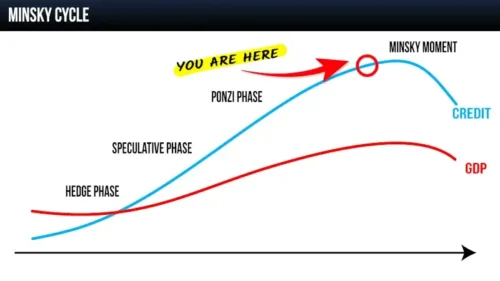 Financial markets often become the riskiest when everything seems to be going well.
Economist Hyman Minsky believed markets move through three stages: hedge finance, where borrowers can easily repay their debts; speculative finance, where they can make interest payments but must refinance the principal; and Ponzi finance, where borrowers rely on rising asset prices just to stay afloat.
As confidence grows, borrowing and risk-taking increase, making the system more fragile.
Eventually, a single event can shatter that confidence, triggering a wave of selling, tighter credit, and falling prices.
That sudden tipping point is known as a Minsky Moment…and it’s exactly what Rickards thinks is happening in AI now.
What Comes With Strategic Intelligence: Full AI Black Paper Bundle Breakdown
Here’s everything this bundle provides and where its limitations lie.
 6 Months of Strategic Intelligence
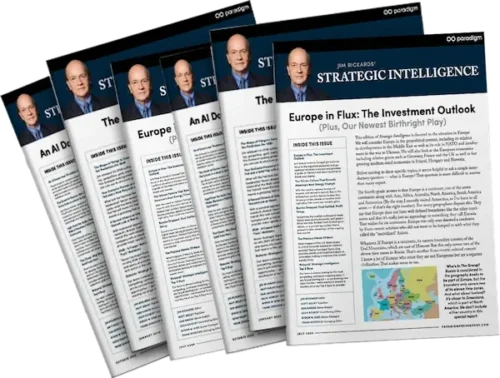
The six-month subscription to Rickards’ flagship service nets you one private Strategic Intelligence dossier each month.
Rickards uses a rather unique complexity theory to connect geopolitical shifts, capital flows, policy decisions, and market stress with specific assets that may fall or rise.
Even though artificial intelligence is the current focus, the buck doesn’t stop there. Jim isn’t afraid to pursue any sector that shows signs of cracks or prominent growth.
There’s no need to be an expert in any of these topics, either. Rickards takes challenging concepts and makes them easy to understand so you can not only follow along but make educated decisions about investing.
 Customer Service Team

Paradigm’s customer service team deserves merit for any issues you may have when using the service.
Tech glitches happen from time to time, making it essential to have a crew you can contact to work through them in a timely manner.
There’s nothing I hate more than signing up for something and not being able to use it to the fullest.
Keep in mind that his customer service team can’t talk to you about personal financial advice, but they will answer questions about the service and billing matters.
>> Discover The AI Black Paper Blueprint <<
AI Black Paper Free Bonus Reports: Six Research Packages Covering Crash Defense, AI Losers, Gold, and Battlefield AI
These six reports follow Rickards’ plan to avoid getting caught in the possible AI bubble burst. They come free with the purchase of a Strategic Intelligence subscription.:
 FREE Special Report #1: AI Fallout: The Biggest AI Losers to Remove From Your Portfolio Immediately

Obviously, a bubble burst is going to torpedo several stocks cruising at current highs, and we don’t want to be there when that happens.
Rickards doesn’t limit the list to Nvidia, Oracle, or other obvious Big Tech names. Instead, he focuses on less visible companies tied to AI spending, data center financing, and debt structures that could unravel when confidence fades.
You’re not just getting names here, either. There’s a full breakdown of why each company made this list and where its shortcomings lie.
There are also tips on how to check personal portfolios and retirement accounts for AI stocks, data center CDOs, and other concentrated exposures, and then decide what to trim before losses spread.
FREE Special Report #2: The AI Black Paper Blueprint: My Personal Million-Dollar Roadmap for Navigating and Profiting From This Crisis
Once you have those weak positions out of the way, you’ll want to know where the good investments are.
Rickards has placed more than $1 million of his own money in specific assets he expects to rise as AI stocks fall, giving you a direct look at how he is preparing for an AI cataclysm.
It sounds far-fetched, but there were big gainers during the dot-com collapse even as the S&P 500 lost one-third of its value.
I see no reason for a different scenario to play out here.
You’ll get these names, tickers, and why Jim predicts great things for these stocks in this quick read.
>> Get Jim Rickards’ Latest Market Warning <<
 FREE Special Report #3: AI Meltdown Insurance: How to Profit From the Coming Crash
The third guide covers a leveraged position designed to increase in value as the market declines.
Jim compares the setup with crisis trades used by Michael Burry, Jamie Mai, and John Paulson before the 2008 crash.
Burry reportedly made $100 million personally, Mai turned $110,000 into $80 million, and Paulson earned $4 billion for himself, all in a matter of a few years.
Rickards’ version doesn’t require shorting stocks or buying on margin, so there’s no fancy footwork you need to learn here.
With Jim predicting upwards of a 600% return, it’s just one more way to set yourself up appropriately should an AI meltdown take place.
FREE Bonus Report #4: Trump’s AI Arsenal: How Investing in A.I. Superweapons Could Turn $1,000 Into $162,000
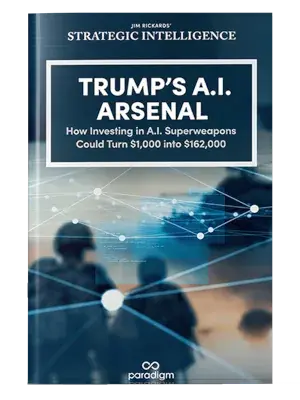
Commercial AI may be overfunded, but Rickards sees a different setup in defense.
Military agencies already spend on surveillance, autonomous systems, battlefield intelligence, and long-range weapons, giving selected companies a clearer source of demand.
The report names Rickards’ preferred battlefield AI companies for the next decade.
One featured stock works with Elon Musk’s SpaceX on Starshield, an early-warning network connected to Trump’s Golden Dome defense system.
Another develops an AI-powered drone capable of striking targets up to 3,000 miles away.
The $162,000 projection is highly speculative, though the government-backed demand case is more concrete than many consumer AI stories.
>> Explore Strategic Intelligence Before AI Falls <<
FREE Bonus Report #5: The Perfect Physical Gold Portfolio

Rickards has long been bullish on gold, and this report shows his plan for physical allocation of the yellow metal.
This truly is direct metal holding and not mining shares, because bullion may remain useful during currency stress, geopolitical conflict, money printing, or a broader loss of faith in the U.S. dollar.
You don’t need a huge investment to get involved here, either, as Jim breaks down how to split assets for the best coverage.
There’s a lot more direction here than “buy gold”, and I really appreciate that.
FREE Bonus Report #6: How to Make Your Home Your Personal Fortress

Former CIA operative Jason Hanson prepared the final guide for those of us concerned about personal security during a severe economic downturn.
Hanson has received the CIA Exceptional Performance Award twice and now teaches civilians safety methods drawn from intelligence work.
His instructions cover protecting a home during the day or at night, setting up a household “defense HQ” for a few hundred dollars, and responding when armed intruders enter.
It’s an interesting segue from the other bonuses on this list, but if an AI crash leads to difficult times, it would be good to be as prepared as possible.
>> Access Jim Rickards’ Defensive Portfolio Plan <<
 Refund Policy: 90-Day Unconditional Full Money-Back Guarantee, Keep All Materials

The subscription comes with a 90-day unconditional 100% money-back guarantee.
You can review the research, read the special reports, and cancel within the first three months for any reason.
Paradigm’s customer service team will issue a full refund, and you may keep the reports and any Strategic Intelligence issues already received.
After reviewing the service, these were the strongest benefits and the few drawbacks worth noting.Pros and Cons
Pros
Cons
>> See What Jim Rickards Recommends Now <<
Jim Rickards’ Track Record: 2008 Crisis Warning, 468% Gains During Bank Collapses, COVID-19 Selloff Alert, and More
Jim Rickards points to several major calls to support the credibility of Strategic Intelligence.
He says he warned U.S. officials about the 2008 financial crisis two years early, later testified before Congress, and helped his readers capture gains as high as 468% while banks collapsed.
His research also claims early warnings on Brexit, Donald Trump’s 2016 and 2024 victories, the Ukraine war, and COVID-19, including a market selloff alert issued three weeks before the crash.
It’s rare to have someone with so much clout share details about economic issues, and Rickards’ past calls reflect how connected he is.
How Much Does the AI Black Paper Cost?
The current AI Black Paper deal costs $49 for six months of Strategic Intelligence, down from the regular $199 six-month price.
That works out to roughly $8 per month, or less than $0.28 per day, for six monthly issues plus all six special reports.
I find this a fair price for the research, as a single recommendation can earn you the amount back and then some.
You’ll want to check on renewal costs before your six months are up, as there’s no guarantee that you’ll keep the same price point at that time.
>> Join Jim Rickards’ Strategic Intelligence Today <<
 Is Jim Rickards’ AI Black Paper Offer Worth It?

Based on this AI Black Paper review, it’s a solid offer for anyone who’s uneasy about the current AI boom and wants a contrarian view before making portfolio changes.
Jim Rickards connects the artificial intelligence boom with data center debt, pension exposure, stretched valuations, and weak profit visibility across several AI companies.
The AI Black Paper also goes beyond warnings by outlining defensive assets, a crash hedge, and selected opportunities that may benefit from market stress.
At $49, six months of Strategic Intelligence plus six reports offers solid value, especially with the 90-day guarantee.
You’ll still want to back Rickards’ findings up with your own research, but the logic here is hard to refute.
I’d check it out early if you want to stay ahead of the curve and keep your finances safe from what could be the biggest financial catastrophe of our era.



 Tags:
Tags: