

It feels like there are more services than grains of sand on the seashore that claim to identify stellar stocks, but few actually live up to expectations.
Danelfin’s AI system analyzes more than 10,000 stock features each day with a goal of helping you find the best investment opportunities, but how does it handle when put to the test?
In this Danelfin review, I’ll examine whether the service’s scoring system delivers useful insight and whether the platform deserves a place in your research process.
>> Get Started With Danelfin Today <<
 What Is Danelfin?
Danelfin turns more than 10,000 daily stock and ETF features into simple 1-to-10 AI Scores, rankings, Trade Ideas, and forecasts. Its combination of technical, fundamental, sentiment, and risk analysis gives investors a powerful quantitative research system without requiring them to process the underlying data themselves. Danelfin’s historical results give its AI Score meaningful credibility. U.S. stocks rated 10/10 generated +21.05% average annualized alpha over three months in its historical analysis, while its backtested Best Stocks Strategy returned +376% from January 2017 through June 2025. Danelfin is best suited to investors who want an active, data-driven research process rather than ready-made monthly stock picks. Its AI Scores evolve with new market data, and advanced features such as Trading Parameters and deeper Alpha Signals require higher-tier plans.
Danelfin is an AI-powered stock research platform built to help users find promising stocks and ETFs without spending hours sorting through market data on their own.
Its main attraction is the AI Score, a 1-to-10 rating that estimates how likely a stock or ETF is to outperform its benchmark over the next three months.
Behind that number, the platform analyzes more than 10,000 daily features drawn from technical, fundamental, sentiment, and risk data.
Members can also explore stock and ETF rankings, Trade Ideas, AI Price Forecasts, portfolio tools, sector analysis, and Investment Themes.
There’s even a Best Stocks Strategy that uses Danelfin’s highest-rated opportunities to build a rules-based portfolio.
Add all these tools together, and you’ve got the foundation of a system for not only finding ideas but tracking how they change over time
>> Try Danelfin’s AI Stock Research <<
Who Is Behind Danelfin?
 Danelfin isn’t built around a single market personality. Instead, it comes from a team with backgrounds in physics, engineering, data analytics, software, artificial intelligence, and asset management.
That mix shows in the platform because the whole service revolves around turning complex market data into something easier to work with.
The project first took shape as an R&D effort in 2016 before the company was officially founded in Barcelona in 2018. By 2019, its AI model was ready to predict stock alpha, and the first stock analytics platform followed in 2020.
While there’s no mention of a singular person responsible for the company’s rise, it’s clear that this project took an entire team to get off the ground.
That same crew is responsible for the platform’s steady development over the years, which gives it more substance than tools that seem to appear overnight.
Is Danelfin Legit?
Yes, I consider Danelfin a legitimate stock research platform.
 The company has been developing its technology for years, clearly identifying Danelfin Technologies, S.L. as the owner of the service, and publishes detailed information about its methodology, pricing, legal terms, and investment limitations.
Its user base also has some size behind it.
At last count, more than 150,000 people use the platform, and the company was recognized as the Best Financial Research Company at the Benzinga Global Fintech Awards.
What I appreciate more than the award, though, is how clear Danelfin is about its stock-identifying process.
Nowhere does it claim these picks are guaranteed results, setting correct expectations right out of the gate.
>> Explore Danelfin’s Top AI Stocks <<
How Does Danelfin Work?
Once you get inside Danelfin, the basic idea is easy to follow even though the technology behind it is anything but simple.
The platform analyzes stocks and ETFs every day using more than 900 indicators, ultimately generating over 10,000 individual features for each security.
These inputs span technical, fundamental, sentiment, and risk-related data.
The AI then studies which features have historically led to positive or negative alpha.
For U.S. securities, it learns from the latest 252 market days, while European stocks use a 500-market-day window.
Those signals move through hundreds of decision trees, with the final result averaged into a probability score.
Thankfully, you never need to work through any of that yourself.
The platform turns the process into rankings, AI Scores, Alpha Signals, Trade Ideas, forecasts, and portfolio tools that are much easier to read.
That’s the real appeal here. Danelfin handles the heavy data crunching in the background while leaving you with information you can actually use.
 Danelfin AI Score Explained
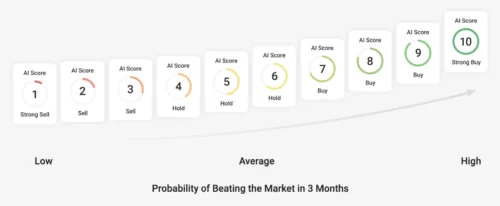
Every covered stock or ETF receives a rating from 1 to 10 based on its estimated probability of beating the relevant market benchmark over the next three months.
For U.S. stocks and ETFs, that benchmark is the S&P 500 Total Return Index. European stocks are measured against the STOXX Europe 600.
Danelfin treats scores from 7 to 9 as Buy ratings, while a 10 earns a Strong Buy rating within its Score Evolution framework. Scores from 1 to 3 sit on the weaker side of the scale.
I love having these immediate snapshots, as they’re a good indicator of whether I should dig deeper or set the stock aside for now.
That said, a 9 or 10 doesn’t automatically mean I want to own the stock, but it tells me the AI sees stronger-than-average conditions worth investigating.
From there, I can check other scores and signals within the system to back up that original assessment.
>> Unlock Danelfin’s AI Stock Scores <<
Danelfin Features: What the Platform Includes Across Every Plan
Danelfin has much more going on than its headline AI Score.
Once I started digging into the platform, I found several tools that make it easier to discover ideas, compare opportunities, and monitor positions without relying on a single rating.
Stock and ETF Rankings
 Rankings are one of the easiest ways to use Danelfin when I’m looking for fresh ideas.
The platform covers U.S. stocks, major European stocks, and U.S.-listed ETFs, then sorts them by AI Score so stronger-rated names rise toward the top.
I can also drill into sectors, industries, investment themes, and stocks within specific market groups.
You can also narrow ETF rankings by focus, asset class, and strategy.
Danelfin assigns predictive AI Scores, plus Technical, Fundamental, and Sentiment Scores, to sectors and industries, which helps me identify stronger areas of the market before I start comparing individual securities.
The Free plan limits rankings and reports to the Top 10, while paid plans make them unlimited. Sector, industry, and Investment Theme access also expands beyond the small free-plan sample once you upgrade.
Trade Ideas
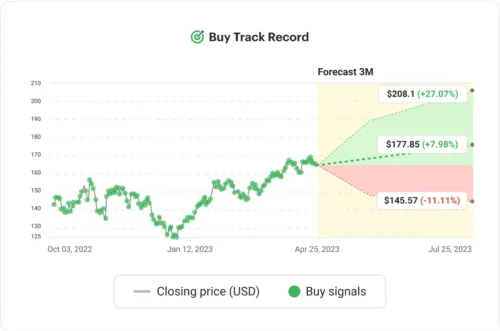
Trade Ideas are more selective than the regular rankings because Danelfin looks for securities where its AI signals have shown a stronger historical record since 2017.
A long trade idea needs at least a 60% historical win rate after Buy or Strong Buy signals. Short ideas work in reverse, requiring at least a 60% historical loss rate after Sell or Strong Sell signals.
You can also switch between one-month, three-month, six-month, and one-year horizons, review past signals directly over the price chart, and compare those signals with the AI’s expected forecasts for each period.
Access scales with the plan. Free members get the Top 2 Long ideas, Plus gets the Top 25, and Pro and Elite remove the Long-idea limit.
Short ideas stay limited to just the Top 1 until you reach the Elite plan.
>> Start Researching Smarter With Danelfin <<
AI Price Forecasts
AI Price Forecasts add another layer once I’ve found a stock or ETF worth examining.
Danelfin produces forward-looking estimates for one month, three months, six months, and one year, which lets me compare shorter-term expectations against a broader outlook.
They’re most useful when paired with Score Evolution and Alpha Signals rather than just viewing them on their own.
A forecast might look attractive, but I still want to see whether the AI Score is strengthening, weakening, or being pulled in opposite directions by technical and fundamental data.
Plus, Pro, and Elite include unlimited forecasts, while the Free tier is more restricted. Like every predictive feature here, these estimates are probabilities rather than guaranteed future prices.
Portfolio Tools
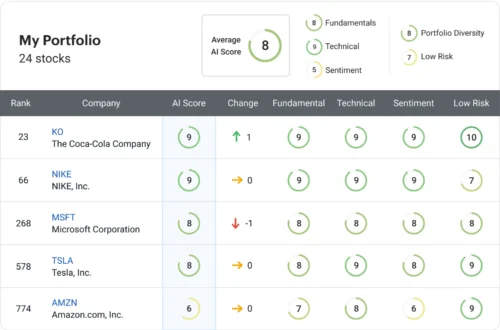 The portfolio section is one of the more useful parts of Danelfin because it helps after I’ve already chosen what to own.
You can put any stock or ETF in the system into your portfolio, and Danelfin will give it an AI Score alongside other key metrics.
There’s also a Portfolio Diversity Score, which gives me a quick read on whether my holdings are reasonably spread out or becoming too concentrated.
Daily upgrade and downgrade alerts are especially useful for maintaining a balanced portfolio, as they show when the AI’s view of an existing holding changes.
Paid users can automatically synchronize U.S. broker accounts and upload portfolios in bulk, while higher plans add CSV exporting.
Portfolio capacity, though, depends heavily on the membership.
Free allows one portfolio with five holdings, Plus expands to three portfolios with 25 holdings each, Pro allows 10 portfolios with 50 holdings each, and Elite removes those limits.
>> Discover Danelfin’s Highest-Rated Stocks <<
Trading Parameters
Trading Parameters exist for the point where I’ve finished researching an idea and want more structure around what to do next.
This Pro-and-Elite feature provides AI-powered Buy, Hold, and Sell signals along with individual AI-driven trading guidance.
What I like is that these signals sit beside the rest of the analysis rather than replacing it.
I can still compare the overall AI Score, its supporting subscores, Alpha Signals, and price forecasts before deciding whether my setup makes sense.
It stands to reason that these are based on probability rather than certainty, but having these parameters is one more decision-making reference when finalizing your plan.
Free members only receive a limited number of AI-powered signals each month, while paid plans remove that restriction.
Danelfin API
The API gives advanced users a way to bring Danelfin’s predictive data into their own software, spreadsheets, models, or internal research systems.
It covers U.S.-listed stocks and ETFs, major European stocks, historical daily AI Scores since 2017, rankings, trade ideas, best-stocks strategy data, trading parameters, AI price forecasts, and track record information.
You’ll get everything in JSON format for programmatic use, but you can safely ignore this feature if you don’t have the background for it.
Should you use this feature, there are four API tiers to choose from. Free includes 500 calls per month; Basic allows 2,500; Expert offers 10,000; and Max increases that to 50,000.
>> See What Danelfin’s AI Finds <<
Advanced AI Tools
 One of the more unusual additions is Danelfin’s MCP server, which lets compatible AI assistants work directly with its stock and ETF data through natural-language prompts.
It supports tools such as Claude Code, Cursor, and Codex, so I can ask an assistant to rank stocks, screen securities, inspect AI Scores, or test score-based strategies without learning a separate command system.
Coverage is broad, with more than 15,000 stocks and ETFs, including 5,000+ U.S. stocks, 4,000+ U.S. ETFs, and 6,000+ European stocks.
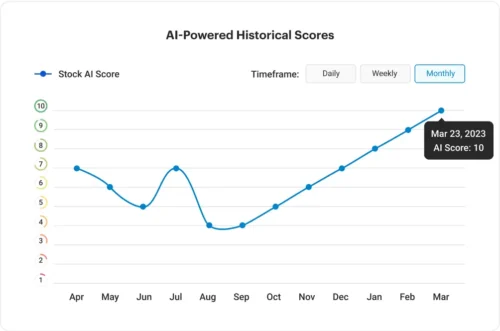
It also supports daily historical AI Scores going back to 2017.
Multi-factor screening is particularly interesting because I can combine rules, such as looking for stocks with an AI Score of at least 8 and a Low Risk Score of at least 7, rather than relying on one metric alone.
Historical backtesting is built into the same setup, making it possible to test how score-based ideas would have behaved across earlier market periods.
Mobile App
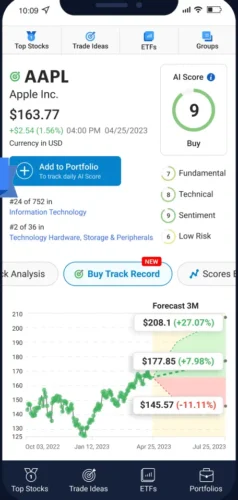 Danelfin also offers a mobile app through both the Apple App Store and Google Play Store.
The app provides the same core analytics, features, and financial data available through the website, so I can check scores, rankings, and portfolio information without being tied to a desktop.
Push notifications also fit naturally alongside the platform’s upgrade and downgrade alerts, making the mobile version more useful for ongoing monitoring than I initially expected.
The app can request access to device features such as notifications, the camera, and photo library, with permissions managed through the phone’s settings.
>> Put Danelfin’s AI To Work <<
Does Danelfin Really Work?
After spending time with Danelfin, I decided to judge it by determining whether its highest-rated stocks have historically outperformed its lowest-rated ones.
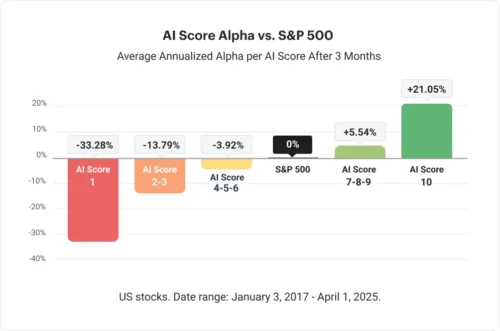
For U.S. stocks between January 3, 2017, and April 1, 2025, securities carrying a 10/10 AI Score produced +21.05% average annualized alpha after three months versus the S&P 500.
Stocks rated 1/10 came in at -33.28% average annualized alpha. The study covered 2,072 trading days and more than 11.6 million observations.
European stocks showed a similar pattern. Score 10 names generated +35.40% average annualized alpha, while Score 1 stocks posted -11.75% against the STOXX Europe 600.
U.S.-listed ETFs followed the same general trend, with Score 10 ETFs recording +12.80% average annualized performance after three months compared with just +0.26% for Score 1 ETFs.
It’s evident that not every 10/10 stock wins, but the data suggests the AI has historically done a solid job separating stronger setups from weaker ones.
>> Access Danelfin’s Stock Rankings Today <<
Danelfin Best Stocks Strategy Performance
The Best Stocks Strategy builds an equally weighted portfolio of 25 U.S.-listed stocks, giving us an even better idea of what Danelfin’s scoring system looks like when used inside an actual portfolio framework.
To qualify, a company generally needs a proven Buy Signal, a low risk score of at least 5, and average three-month trading volume above 100,000 shares.
From there, Danelfin selects the five sectors with the highest average AI Scores and then chooses five stocks from each.
The team reviews the portfolio every three months to make sure holdings still meet the criteria, while equal weighting is restored every 12 months.
From January 3, 2017 through June 9, 2025, the Best Stocks Strategy produced a reported +376%, compared with +166% for the S&P 500.
Danelfin also says the simulated portfolios experienced lower drawdowns than the index during the test period.
That is impressive performance, but I want to keep one thing clear: these are backtested results.
They show how the strategy would have performed using historical data, not what every member actually earned.
>> Explore Danelfin’s Trade Ideas Now <<
 How Accurate Is Danelfin?
I wouldn’t judge Danelfin by asking whether every high-scoring stock goes up, because this isn’t what the AI Score claims to do.
Instead, the system estimates the probability of a stock or ETF outperforming its benchmark over the next three months.
For me, accuracy comes down to whether the score consistently separates stronger candidates from weaker ones.
To that end, U.S. stocks rated 10 outperformed their benchmark by a wide margin on average, while 1-rated stocks moved in the opposite direction.
European stocks and U.S. ETFs show the same broad pattern.
Furthermore, score evolution shows how the rating changes over time, while fundamental, technical, sentiment, and low risk scores provide extra context.
Alpha Signals then let me see which specific factors are supporting or hurting the model’s view.
That makes Danelfin much more useful as a research filter.
I can use the AI Score to find ideas, then decide for myself whether the data behind the rating makes sense.
>> See Danelfin’s Latest AI Scores <<
What I Like About Danelfin
The biggest thing I like about Danelfin is how it makes a huge amount of stock data easier to work with.
I don’t have to compare hundreds of technical, fundamental, and sentiment indicators manually just to decide whether a stock deserves more attention.
The AI Score gives me a quick starting point, and I can dig deeper when something looks interesting.
The explainable AI setup is another major plus, showing positive and negative Alpha Signals and ranking them by relevance.
That makes it much easier to understand why the AI likes or dislikes a security.
I also like that the platform works across multiple stages of the research process.
Rankings help me discover ideas. Trade Ideas narrow things down based on historical signal performance.
AI Price Forecasts add another layer of context, while portfolio alerts help me monitor what I already own.
That combination gives Danelfin more staying power than a basic stock screener.
>> Start Using Danelfin’s AI Today <<
Where Danelfin Could Be Better
The biggest drawback I noticed is that Danelfin can be almost too dynamic for someone who wants a set-it-and-forget-it approach.
AI Scores update as new market data comes in, which is exactly what an adaptive system should do.
Still, that means a stock carrying a strong rating today may look different later.
I see that as a useful signal rather than a flaw, but it does mean you need to keep an eye on their holdings.
Another limitation is that some of the best tools require higher membership tiers.
Full technical, fundamental, and sentiment Alpha signals are limited to Pro and Elite, while unrestricted short trade ideas and historical AI score downloads are mainly reserved for Elite.
Beginners can quickly grasp the basics of scoring, but tools like Alpha signals, trading parameters, sector scoring, and historical analysis take some time to learn.
I don’t think any of these issues take much away from the platform, though.
Most come from Danelfin offering more data and flexibility than a simple stock-picking service.
>> Get Danelfin’s Latest Stock Insights <<
Who Is Danelfin Best For?
I think Danelfin works best for people who still want to make their own decisions but would rather not spend hours sorting through raw market data.
It’s especially useful if you like quantitative research.
The platform can narrow thousands of stocks and ETFs into a much smaller list of high-scoring candidates, then give you enough supporting data to decide which ones deserve a closer look.
I can also see it fitting well with anyone who already owns several securities and wants help monitoring them.
Daily upgrades and downgrades, portfolio scores, broker synchronization, and the Portfolio Diversity Score make it easier to keep tabs on multiple positions from one place.
More experienced users have room to go deeper with Trading Parameters, CSV exports, historical AI Scores, API access, and multi-factor screening.
On the other hand, someone who only wants one ready-made stock recommendation each month may prefer a traditional research newsletter.
Is Danelfin Easy to Use?
Considering what Danelfin is doing in the background, I found the core platform surprisingly easy to follow.
The 1-to-10 AI Score gives me an immediate read on a stock or ETF without forcing me to understand the machine-learning process behind it.
From there, the platform adds more detail in layers.
Rankings help me find candidates, color-coded Alpha signals show what is helping or hurting a score, and score evolution makes it easy to see whether the AI’s view has improved or weakened.
That structure works well because I can stop at the level of detail I’m comfortable with.
A newer user might focus on AI Scores, rankings, and portfolio alerts.
Someone with more experience can move into fundamental, technical, sentiment, and low-risk scores, trade ideas, trading parameters, historical data, and API tools.
The mobile app also carries the same core analytics and financial data as the website, so I’m not limited to checking the platform from a desktop.
There is a learning curve if you want to use everything.
Still, Danelfin does a good job of hiding the complexity until you actually want to see it, which is exactly how a data-heavy research platform should feel.
>> Explore Danelfin Plus Today <<
 Danelfin 30-Day Money-Back Guarantee and Free Trial

Danelfin gives new paid subscriptions a 30-day money-back guarantee, starting from the date you first sign up.
As long as you drop out during that first month, the platform will return every penny of your membership fee.
Cancellation outside of that window stops the next renewal, but paid features remain available through the current billing period.
There’s also a 14-day free trial for the paid plans, allowing you to see these features before laying down a dime.
After reviewing Danelfin in detail, these were the strongest advantages and the few limitations that stood out most.Pros and Cons
Pros
Cons
>> See Danelfin’s Best Stocks Strategy <<
How Much Does Danelfin Cost?
Danelfin currently has four plans, starting with Free at $0 forever.
It includes the daily Top 10 stocks newsletter, 10 stock or ETF reports per month, Top 10 rankings, one five-position portfolio, limited AI Score explainability, and the Top 2 Long Trade Ideas. That’s enough to test the platform before paying.
The Plus plan costs $22 per month when billed annually at $264 per year, saving $84 versus monthly billing.
It adds unlimited reports and rankings, broker syncing, three portfolios with up to 25 holdings each, all AI Score Alpha Signals, unlimited AI Price Forecasts, and the Top 25 Long Trade Ideas.
Pro costs $59 per month on the annual plan, or $708 per year, which saves $240.
It includes everything in Plus, then adds Trading Parameters, CSV exports, 10 portfolios with up to 50 holdings each, full Fundamental, Technical, and Sentiment Alpha Signals, and unlimited Long Trade Ideas.
At the top, Elite costs $134 per month when billed annually at $1,608 per year, saving $540.
It includes everything in Pro plus unlimited Short Trade Ideas, unlimited portfolios and holdings, historical daily AI Scores going back to 2017, priority support, and the Expert API with 10,000 calls per month.
The annual option currently carries a 25% discount off those listed prices, while two-year plans advertise savings of 40%.
>> Join Danelfin And Research Smarter <<
 Is Danelfin Worth It?

After using Danelfin and digging into the way its scoring system, forecasts, trade ideas, and portfolio tools work together, I think the platform offers solid value for anyone who wants data to play a bigger role in stock research.
The main appeal is the AI Score. It offers a fast way to narrow down ideas, while the deeper tools let me move into advanced market analysis when I want more context.
That makes Danelfin feel more complete than a basic stock screener.
You can stop at the toolset that makes more sense for your investment strategy, allowing Danelfin to meet the needs of a wide range of users.
Price points feel reasonable for what they offer, and both the free trial and money-back guarantee allow you to test the waters before committing to anything.
If you’re coming to this Danelfin review looking for an AI stock research platform, I’d say it is worth considering if you want help finding and comparing opportunities without giving up control of the final decision.



 Tags:
Tags: