


Newer investors often enter the market with plenty of enthusiasm, but very little structure, which can make every buy, sell, and market dip feel harder than it should.
That is where Fry’s Investment Report becomes interesting.
Eric Fry, Senior Investment Analyst at InvestorPlace, combines detailed stock research with a clear “Sell This, Buy That” approach that helps you understand not only where opportunities may be forming but also which holdings could be losing strength
In this guide, I’ll explain whether Fry’s Investment Report is a practical fit for newer investors, where it helps most, and what you should know before joining.
What Makes an Investment Newsletter Beginner-Friendly?
A beginner-friendly newsletter should do more than hand you a ticker and tell you to buy.
You need to understand what the company does, why its outlook looks promising, what could go wrong, and when the original case may no longer hold up.
The pace matters too. Several new trades each week can overwhelm someone who is still learning position sizing, valuation, and risk management.
Eric Fry generally focuses on one main recommendation each month, though a second idea may appear when conviction is high.
That gives you enough time to study the business before making a decision.
Clear follow-up guidance completes the picture.
The newsletter, model portfolio, alerts, research archive, and risk tools create an organized process you can follow without having to watch the market all day.
 Is Fry’s Investment Report Easy for Newer Investors to Follow?
 Is Fry’s Investment Report Easy for Newer Investors to Follow?
Each monthly issue explains the company behind the recommendation and the larger force that could drive its growth.
Fry considers business fundamentals, competitive advantages, valuation, sector conditions, and wider economic trends.
His current areas of focus include AI infrastructure, robotics, advanced computing, energy demand, and capital rotation.
These subjects can sound technical, but he connects them to real companies and practical market needs.
The optical fiber example illustrates his approach well: AI data centers may require up to 10 times more cable than traditional facilities, turning an abstract
AI trend into a concrete infrastructure opportunity.
You may need to look up a few concepts, but you learn why each stock earned attention rather than copying a symbol with no context.
Why “Sell This, Buy That” Can Help Newer Investors
Finding a stock to buy often feels exciting. Deciding what to sell tends to be much harder.
Beginners may keep a familiar company long after its outlook weakens because selling feels like admitting a mistake.
Fry’s “Sell This, Buy That” method treats the decision differently. He compares a vulnerable holding with another company that may offer a stronger risk-to-reward setup.
Amazon, Tesla, and Nvidia serve as examples facing fresh pressure from tariffs, Chinese EV competition, and in-house chip development, respectively.
The alternative side looks toward less obvious businesses supporting AI data centers, warehouse automation, and rising electricity demand.
Fry’s robotics research, for example, covers an industry projected to reach $24 trillion.
 The Model Portfolio Keeps Everything Organized
 The Model Portfolio Keeps Everything Organized
The private model portfolio brings Fry’s active recommendations into one dashboard.
You can check entry points, price targets, current valuations, performance, and suggested exits without searching through months of emails.
That setup matters for newer investors because a company may have looked attractive when first recommended, but earnings, competition, or valuation can change.
The portfolio clarifies which ideas remain active and which have been closed. I see this as the most practically useful feature in the package.
Past issues are also available so you can revisit the original reasoning behind any position.
Note that the portfolio is a research model, not a personal allocation plan.
You decide how much capital to commit based on your own goals and risk tolerance.
 Trade Alerts Help Members Stay on Track
 Trade Alerts Help Members Stay on Track
A good stock idea can change before the next monthly issue arrives.
Fry and his team monitor open positions and send alerts when members need to consider buying, selling, or adjusting a holding.
Additional market updates explain how economic developments and sector shifts may affect the portfolio, saving you from interpreting every headline on your own.
The alerts also help reduce two common mistakes: selling during an ordinary pullback out of fear, or holding through a worsening setup because you never revisited the original reason for buying.
You still place your own orders and decide whether each move fits your situation.
The benefit is having updated direction rather than being left on your own after the first recommendation.
 TradeStops Basic Supports Better Risk Habits
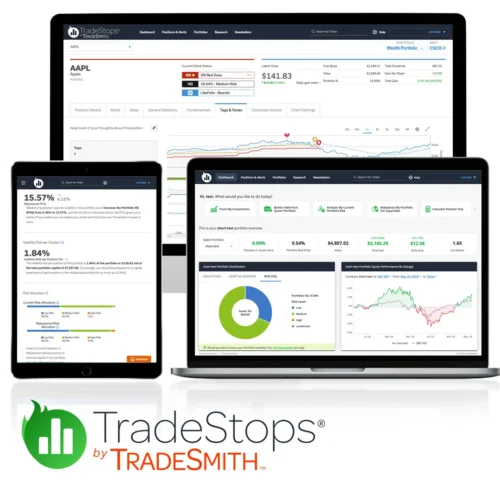 TradeStops Basic Supports Better Risk Habits
A six-month subscription to TradeStops Basic is included with membership.
The tool syncs with your brokerage account for real-time position tracking, calculates suggested position sizes based on personalized risk levels, and applies the Volatility Quotient (VQ) to help you set data-driven exit strategies for any recommendations you follow.
I appreciate that the VQ provides an objective signal rather than a gut reaction: it separates normal price movement from a decline that actually deserves action, which is one of the hardest skills for newer investors to develop on their own.
TradeStops cannot predict every reversal or prevent losses.
Its real value is replacing emotional reactions with a more consistent risk-management process.
If you prefer not to receive the tool, you can opt out at checkout.
Eric Fry Brings Decades of Market Experience
A newer investor should know who is leading the research before committing to any service.
Eric Fry has more than 30 years of experience across global markets.
He spent nearly two decades specializing in international equities, followed by about ten years in professional portfolio management, and won the Portfolios with Purpose competition in 2016.
His historical record includes 41 recommendations that reportedly reached peak gains above 1,000%.
A 2015 Bitcoin recommendation created the opportunity for gains of up to 200 times for those who held through its rise.
Those figures represent standout outcomes rather than normal expectations, and past results cannot guarantee future performance.
Even so, Fry’s long career gives you an experienced framework to learn from.
 Where Newer Investors May Struggle
 Where Newer Investors May Struggle
Fry’s Investment Report is accessible, but it is not a complete course on investing basics.
Someone opening a brokerage account for the first time may still need to learn the market and limit orders, diversification, taxes, and position sizing.
Many recommendations also target growth industries. AI, robotics, and emerging technology can produce sharp price swings when expectations change.
There is no active community forum or member chat, so anyone who prefers group discussion will not find it here.
Day trading and options are not central to the service either. The picks normally follow longer-term trends and may remain open for years.
Personalized financial advice is not included.
Fry cannot account for your individual income, debt, age, or portfolio.
Who Is Fry’s Investment Report Best For?
The service suits newer investors who understand that stocks can lose value and are willing to read the research before acting.
It should appeal most to those who prefer longer-term growth over rapid trading and have an interest in AI, robotics, infrastructure, and broad economic trends.
The one-or-two idea monthly pace is manageable for anyone who cannot monitor markets full-time.
The model portfolio, weekly updates, alerts, and TradeStops access also suit those who want more discipline around selling and risk.
Complete beginners should learn basic brokerage functions first: how to place an order, what a limit order does, and how to read a basic balance sheet.
Once those foundations are in place, Eric Fry’s guidance becomes considerably easier to use responsibly.
Is the Cost Reasonable for a Newer Investor?
The introductory membership runs $49 for six months, down from the regular $499 price, and includes monthly issues, weekly market updates, the model portfolio, archived research, trade alerts, five special reports worth at least $1,400 combined, and a complimentary six-month TradeStops Basic subscription.
A 90-day money-back guarantee gives you time to judge the research and tools.
If you cancel within that window, you keep the reports already received at no extra cost.
I rate this as one of the more generous trial arrangements in the newsletter space.
The membership renews every six months at $49 unless you cancel at least one day before the renewal date.
To cancel or ask a question, contact the customer service team at 800-219-8592 or feedback@investorplace.com.
Final Verdict: Is Fry’s Investment Report Good for Newer Investors?
Yes, Fry’s Investment Report can be a strong choice for newer investors who want organized research and a manageable long-term strategy.
Its biggest strengths are the detailed monthly analysis, clear model portfolio, timely alerts, and TradeStops risk tools.
Eric Fry’s “Sell This, Buy That” method also teaches an important lesson: removing a weakening position can matter just as much as finding the next promising stock.
The service does not remove risk, provide personal financial planning, or guarantee profitable results.
Beginners still need sensible position sizes and basic market knowledge.
For someone ready to move beyond random stock tips and follow a more disciplined process, Fry’s Investment Report offers a practical next step at $49 for six months with a 90-day guarantee behind it.

 Tags:
Tags: