

If you’ve ever looked at a stock chart and felt like you were staring at a foreign language, you’re not alone.
Many new investors open a chart, see dozens of lines, bars, numbers, and indicators, then immediately wonder if stock trading is only for professionals. The good news is that reading a stock chart is much simpler than it first appears.
At its core, a stock chart is just a visual story of what a stock’s price has been doing over time. Once you understand a few basic concepts, you can quickly identify trends, spot important price levels, and gain a clearer understanding of how investors are reacting to a stock.
You do not need advanced technical analysis skills to get started. In fact, learning a handful of chart-reading basics can help you understand market behavior far better than relying on headlines alone.
Let’s break down exactly what you need to know.
 What Is a Stock Chart?
 What Is a Stock Chart?
A stock chart is a graphical representation of a stock’s price movement over a specific period of time.
Think of it as a map that shows where a stock has been and where it is currently trading. Instead of reading rows of numbers, investors can quickly visualize whether a stock is rising, falling, or moving sideways.
Every stock chart contains two essential pieces of information. The horizontal axis represents time, while the vertical axis represents price. As the stock’s price changes throughout the day, week, month, or year, those movements are plotted on the chart.
Stock charts are used by investors and traders alike because they make it easier to identify patterns and trends that might otherwise be difficult to see.
Why Stock Charts Matter for Investors
Price is one of the most important pieces of information in the stock market.
A company’s financial statements tell you about its business, but a chart tells you how investors currently feel about that business. When millions of buyers and sellers make decisions every day, their collective actions create recognizable trends on a chart.
Learning how to read a stock chart helps you answer basic questions. Is the stock moving higher over time? Is it struggling to gain momentum? Are buyers becoming more aggressive, or are sellers taking control?
Even long-term investors who focus on company fundamentals often use charts to better understand market sentiment and timing.
Understanding the Most Common Chart Type: Candlestick Charts
When you first begin studying charts, you’ll encounter something called a candlestick chart.
Candlestick charts are the most widely used chart style among traders and technical analysts because they provide a large amount of information in a simple format.
Each candlestick represents price activity during a specific period of time. Depending on your chart settings, that period could be one minute, one hour, one day, or even one week.
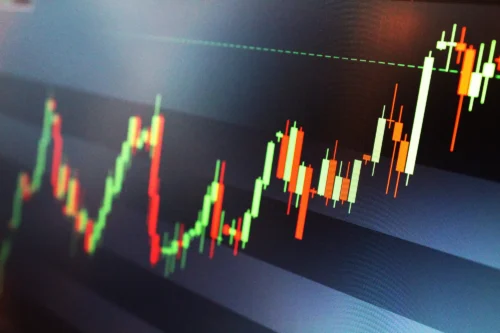
Every candlestick shows four key prices. It displays where the stock opened, where it closed, the highest price reached, and the lowest price reached during that period.
When a stock closes higher than it opened, the candlestick typically appears green or white. When it closes lower than it opened, the candlestick usually appears red or black.
The thick portion of the candlestick is called the body. The thin lines extending above and below are known as wicks or shadows. These show the highest and lowest prices reached during that trading period.
Over time, a series of candlesticks creates a visual picture of buying and selling activity.
 How Trends Tell You the Market’s Direction
 How Trends Tell You the Market’s Direction
One of the first things experienced investors look for on a chart is the trend.
A trend simply describes the general direction a stock is moving.
When prices are consistently making higher highs and higher lows, the stock is considered to be in an uptrend. This suggests buyers are generally in control.
When prices are making lower highs and lower lows, the stock is in a downtrend. In this case, sellers are exerting greater influence.
Sometimes a stock moves within a relatively narrow range without establishing a clear direction. This is often called a sideways trend or consolidation period.
Understanding trends helps simplify chart reading because it allows you to focus on the bigger picture rather than becoming distracted by every short-term price movement.
Support and Resistance: The Most Important Price Levels
Support and resistance are among the most important concepts in technical analysis.
Support is a price area where a stock tends to find buyers. When prices fall toward support, demand often increases, making it more difficult for the stock to continue declining.
Resistance works in the opposite way. It is a price area where sellers tend to become more active. As prices approach resistance, upward momentum often slows.
Imagine a stock repeatedly bouncing near $50 before moving higher. That area may become a support level because buyers consistently step in around that price.
Likewise, if a stock repeatedly struggles to rise above $70, that area may become resistance because sellers appear willing to sell there.
Support and resistance levels are not exact numbers. They are better viewed as zones where buying or selling pressure frequently appears.
Why Trading Volume Adds Important Context
Price tells you what happened. Volume helps explain how much conviction was behind the move.
Volume measures the number of shares traded during a specific period.
When a stock rises on heavy volume, it suggests a larger number of investors participated in the move. This can make the price movement appear more meaningful.
When prices rise on very low volume, the move may have less strength behind it.
The same principle applies to declines. A sharp drop accompanied by unusually high volume often indicates stronger selling pressure than a decline occurring on light volume.
Many traders use volume as a confirmation tool because it helps reveal whether a price move is attracting widespread participation.
 How Moving Averages Help Simplify Trends
 How Moving Averages Help Simplify Trends
Stock prices move constantly. This can make charts appear noisy and difficult to interpret.
A moving average helps smooth out those short-term fluctuations.
A moving average calculates the average price over a specific period and plots it as a line on the chart. Common examples include the 50-day moving average and the 200-day moving average.
When a stock remains above a moving average, it often suggests underlying strength. When it trades below an important moving average, it may indicate weakness.
Many investors use moving averages to identify the overall direction of a trend without becoming distracted by daily price swings.
Moving averages are not perfect predictors. Instead, they act as tools that help simplify complex price data into an easier-to-follow trend signal.
How Technical Analysts Use Charts
Technical analysis is the practice of studying price and volume data to evaluate potential market opportunities.
Rather than focusing primarily on financial statements or earnings reports, technical analysts examine charts for clues about investor behavior.
This approach is used by many professional traders, research firms, and market newsletters.
For example, technically oriented services such as Jeff Clark Trader and Primary Trend frequently analyze chart patterns, moving averages, trend strength, support levels, resistance levels, and volume activity when evaluating stocks. Their goal is to identify situations where price action may signal emerging opportunities or increased risk.
Whether or not an investor follows a specific newsletter, understanding basic chart analysis makes it easier to evaluate the reasoning behind these types of market commentaries and reviews.
 How to Put the Pieces Together
 How to Put the Pieces Together
The easiest way to read a stock chart is to approach it in a consistent order.
Start by identifying the overall trend. Determine whether the stock is generally moving higher, lower, or sideways.
Next, look for important support and resistance areas. These levels often influence future price behavior.
Then examine volume. Ask whether recent price moves are occurring with strong participation or relatively little activity.
Finally, review key moving averages to see whether they support the broader trend.
As you gain experience, these observations become second nature. Instead of seeing a collection of random lines and candles, you’ll begin seeing a coherent story about buyer and seller behavior.
Common Misconceptions and Key Terms
Many beginners assume stock charts can predict the future with certainty. They cannot.
Charts help investors understand probabilities and market behavior, but no chart pattern guarantees a particular outcome.
Another common misconception is that technical analysis is only useful for short-term traders. In reality, many long-term investors use charts to help understand trends and market sentiment.
A few key terms are worth remembering. A candlestick represents price activity during a specific time period. Volume measures the number of shares traded. Support is an area where buyers often emerge. Resistance is an area where selling pressure tends to increase. A moving average smooths price data to make trends easier to identify.
Once these concepts become familiar, reading charts becomes significantly less intimidating.
Frequently Asked Questions
What is the easiest stock chart for beginners to learn?
Candlestick charts are generally considered the easiest and most useful chart type for beginners. They provide more information than simple line charts while remaining relatively easy to understand.
How long does it take to learn how to read stock charts?
Most beginners can learn the basic concepts in a few hours. Becoming comfortable identifying trends, support levels, resistance levels, and volume patterns usually takes several weeks of regular practice.
Can stock charts predict future prices?
No. Stock charts cannot predict future prices with certainty. They help investors identify trends, patterns, and probabilities based on historical market behavior.
What is the difference between technical analysis and fundamental analysis?
Fundamental analysis focuses on a company’s financial performance, earnings, revenue, and business prospects. Technical analysis focuses on price movement, volume, and chart patterns.
Should long-term investors use stock charts?
Yes. Even investors who primarily focus on fundamentals can benefit from understanding trends, support levels, resistance levels, and market sentiment through chart analysis.
Final Thoughts
Learning how to read a stock chart is one of the most valuable skills a new investor can develop.
The process becomes much less intimidating when you focus on the essentials. Candlestick charts show price activity. Trends reveal direction. Support and resistance highlight important price zones. Volume confirms the strength of a move. Moving averages help simplify market behavior.
You do not need dozens of indicators or advanced trading strategies to understand what a chart is telling you. By mastering these core concepts, you’ll be able to look at a stock chart with greater confidence and gain a clearer view of how the market is responding to a stock.
Like any investing skill, chart reading improves with practice. The more charts you study, the easier it becomes to recognize the stories they are telling.

 Tags:
Tags: