

Many people know AI is changing the stock market, but far fewer know which stocks could benefit and which ones may get left behind.
That’s where Marc Chaikin’s latest prediction gets useful: Frontier AI, he argues, could force a major rotation out of weaker names and into companies with stronger money flow, infrastructure exposure, and supply-chain positioning.
If you are trying to figure out which side of that rotation your portfolio is on, this guide breaks down exactly how the Chaikin Power Gauge connects that forecast to real buy-and-sell decisions.
I find this particular call more grounded than most AI predictions you will see in financial media.
 What Is Marc Chaikin Predicting?
 What Is Marc Chaikin Predicting?
Marc Chaikin believes Frontier AI could split the stock market into two groups: companies built for the next AI economy and companies that may lose ground as capital moves elsewhere.
His warning starts with a difference many people miss. The AI most of us use today still waits for prompts.
It answers questions, drafts text, and helps with basic tasks.
Frontier AI is a different category entirely. It can reason, plan, and act with far less human input.
Marc calls this AI’s “Jump to Lightspeed” moment, and the name fits: this is not an upgrade to the current technology, it is a different class of it.
If you are trying to picture what that means for your portfolio, Marc’s system flagged Nvidia in 2014 before a 45,000% run.
He is not saying the next one repeats that. He is saying that this is what early positioning into a structural AI shift can look like.
The window to get positioned early is now.
Why Frontier AI Matters to Today’s Market
Frontier AI matters because access is not being distributed evenly. Eleven companies currently control it. That is not a typo.
Marc says this more advanced AI is concentrated among only 11 tech companies, along with major banks and government-linked groups.
 That lopsided access is what transforms a technology story into an investment opportunity.
Some businesses will use Frontier AI to automate faster, reduce costs, and scale before competitors understand what changed.
You could own a company right now that looks perfectly safe (strong brand, loyal following, solid past returns) and still be on the wrong side of this rotation.
Marc’s Tesla and Magna contrast is the clearest example.
Tesla has the brand but faces demand problems, delayed robotaxi timelines, and internal capital being siphoned toward SpaceX.
Magna deploys Nvidia’s autonomous-driving platform across 80 major manufacturers and gets paid every time that technology goes into a vehicle.
Fame does not survive a bearish Power Gauge rating.
How the Chaikin Power Gauge Supports the Prediction
The Chaikin Power Gauge is what separates Marc’s prediction from being just another market opinion. It gives the Frontier AI thesis a specific, repeatable decision-making filter you can apply to any ticker.
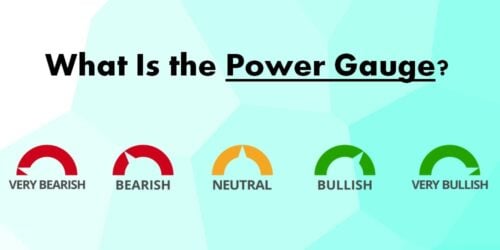
The system rates more than 5,000 stocks as Bullish, Neutral, or Bearish using a 20-factor breakdown across four categories: Financials, Earnings, Technicals, and Experts.
I find the Experts category especially valuable in this particular environment.
It tracks what insiders, analysts, and large institutional investors are actually doing with real money, not what they are saying on earnings calls.
In a market where Frontier AI access is being quietly handed to a small group of connected companies, that institutional money flow tends to show up in the data before it shows up in headlines.
The 20-factor composite is what separates this from a screener or a newsletter gut call.
It is also why Marc’s system has caught moves that other people only noticed after the fact.
Why Marc Looks at Stocks to Buy and Stocks to Avoid
 Most stock research services tell you what to buy.
Marc’s Frontier AI work treats the sell side with equal seriousness, and I rate that as one of the most practically useful things about his approach.
It is easy to build a bull case for AI. It is harder to name specific sells and back the warning with actual data.
The Power Gauge has delivered on both sides.
It turned Bullish on Tesla in 2024 before the stock nearly doubled in five months, then went Bearish again, ahead of much of that move reversing.
Both calls, same system.
If you had followed both signals, you would have captured the upside and avoided giving it back.
That is the part most people underestimate: knowing when to get out of a stock is at least as important as knowing when to get in, and the Power Gauge handles both.
What Past Power Gauge Signals Say About Marc Chaikin’s Process
Marc Chaikin’s track record gives the Power Gauge enough verifiable history to take the methodology seriously rather than treat it as promotional noise.
Backtesting showed Bullish ratings on at least 8 of the top 10 stocks of the year every year since 2016, across bull markets, bear markets, and everything in between.
The 2022 energy examples are the clearest real-money illustration: PBF Energy before a 242% gain, EQT before a 120% gain, and Permian Basin Royalty Trust before a 566% run, all while the broader market was down roughly 10%.
The warning side is equally striking. Marc published a Bearish stock list in December 2024 at a moment when markets felt euphoric.
Within five months, those names were down 23% on average. Celsius down 27%. Westlake down 33%. Estée Lauder down 36%.
Three names most people felt comfortable holding.
The Phathom Pharmaceuticals example is the one I keep coming back to: the Power Gauge turned Bullish three days before the FDA granted exclusive drug rights.
The stock rose 114% in ten days.
The system did not know the announcement was coming. It saw the money moving before the news broke.
How Frontier AI Changes Stock Selection
Marc’s Frontier AI prediction changes not just which companies he favors, but what kind of company deserves attention at all.
The most interesting names are often not the obvious ones.
Frontier AI does not run on good press releases.
It needs faster data movement, power grids, copper, fiber, transformers, and specialized hardware.
Marc’s Oracle/Fabrinet comparison makes this concrete.
Oracle committed massively to data centers for today’s AI buildout.
Marc argues Frontier AI requires a different architecture, which could make that bet work against Oracle rather than for it.
Fabrinet builds the physical backbone on which AI data travels on: transceivers, photonic systems, and fiber optics.
It carries nearly $1 billion in cash with zero long-term debt.
I see this as the sharpest illustration of Marc’s thesis: one company bet on yesterday’s AI, the other is building what tomorrow’s AI needs.
The energy math adds further weight: meeting future AI power demand could require 330 Hoover Dam plants, 30 Three Gorges Dam plants, or more than 650 nuclear reactors each year through 2040.
 How the Prediction Connects to Power Gauge Report
 How the Prediction Connects to Power Gauge Report
Power Gauge Report is where Marc turns this Frontier AI prediction into monthly research with specific stock names, ratings, and exit guidance.
Subscribing gives you a full year of new stock recommendations, monthly market analysis, model portfolio updates, trade alerts, and direct access to the Power Gauge Rating system, where you can check more than 5,000 stocks yourself.
A big-picture AI thesis is only useful if you can do something actionable with it.
Each monthly pick is filtered through the Power Gauge and reviewed by Marc’s team before it gets to you.
When it is time to exit, you receive a sell alert, because a Bullish rating today does not mean the stock stays Bullish forever.
What I appreciate most is that the Power Gauge access is not limited to Marc’s monthly pick.
You can run any ticker you already own through the system, check names on your watchlist, and see what the 20-factor composite currently says about them.
That turns this from a newsletter into a research infrastructure you can actually use on your own terms.
 Is Marc Chaikin’s Prediction Worth Taking Seriously?
 Is Marc Chaikin’s Prediction Worth Taking Seriously?
Yes. And not because the Frontier AI thesis sounds good. It is specific, tied to a real filtering system, and backed by a documented track record of catching both sides of market moves.
Marc is not claiming AI is important in a general sense. He is arguing that Frontier AI creates a measurable rotation, and the Power Gauge gives you a concrete way to see which side your holdings are on before the story becomes obvious to everyone else.
The data makes the case stronger.
Marc’s research highlights Nvidia before a 45,000% run, PBF Energy before a 242% gain, EQT before a 120% gain, Permian Basin Royalty Trust before a 566% move, and Bearish stock warnings that later fell nearly 23% on average.
Past results do not guarantee future performance, and these are selective highlights.
What they establish is a clear process for catching strength and weakness early.
You just need a system that helps you stop holding the wrong stocks while the market figures out what changed.

 Tags:
Tags: