

If you’ve ever heard investors say that compound interest is the secret to building wealth, you might have wondered what makes it so powerful. At first glance, it sounds like just another financial term; something experts throw around when discussing retirement accounts, dividend stocks, or investing strategies.
The truth is much simpler.
Compound interest is one of the easiest concepts to understand once someone explains it clearly. More importantly, it is one of the most important ideas in personal finance, because it shows how money can grow over time without requiring constant effort.
Whether you’re saving for retirement, investing in stocks, or simply trying to understand how wealth is built over decades, compound interest is a concept worth learning. Once you understand how it works, you’ll start to see why experienced investors focus so much on patience, consistency, and reinvesting their earnings.
 What Is Compound Interest?
 What Is Compound Interest?
Compound interest is the process of earning interest not only on your original money but also on the interest you’ve already earned.
To understand why this matters, imagine depositing $1,000 into an account that pays 10% annual interest.
After one year, you would earn $100 in interest. Your balance would grow to $1,100.
If the account used simple interest, you would continue earning $100 each year because interest would only be calculated on the original $1,000.
With compound interest, things work differently.
In the second year, the 10% interest is calculated on the new balance of $1,100. Instead of earning $100, you earn $110. Your balance grows to $1,210.
The following year, interest is calculated on $1,210. Then on $1,331. Then on $1,464. The growth begins to accelerate because each year’s earnings generate additional earnings in the future.
That snowball effect is the foundation of compound interest.
Why Compound Interest Is Often Called the Eighth Wonder of the World
Many investors refer to compound interest as one of the most powerful forces in finance, because small amounts of money can grow dramatically over long periods.
The key factor is time.
 When people first start investing, the growth may seem slow. During the early years, gains often appear modest because the account balance is still relatively small.
As the years pass, however, the accumulated earnings become larger. Those earnings generate even more earnings. Eventually, the growth curve begins to steepen.
This is why investors often emphasize starting early rather than trying to invest huge amounts later in life.
Someone who begins investing at age 25 may contribute less money overall than someone who starts at age 40, yet still end up with a larger portfolio because compound growth had more time to work.
The lesson is simple. Time is often more valuable than the size of your initial investment.
Understanding the Compound Interest Formula
The math behind compound interest looks more intimidating than it actually is.
The standard compound interest formula is:
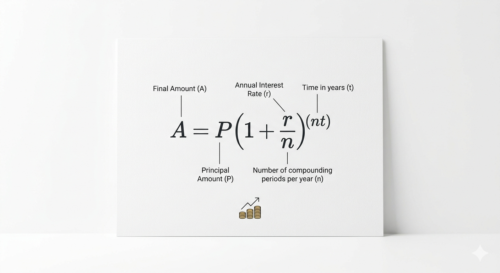
In this formula, A represents the future value of the investment. P is the principal, which is the amount of money you start with. r is the annual interest rate expressed as a decimal. n represents the number of times interest is compounded each year. t represents the number of years the money remains invested.
While financial calculators and investment apps perform these calculations automatically, understanding the formula helps explain why longer time periods create such powerful results.
The exponent portion of the equation is what drives growth. Every compounding period adds another layer of earnings, which then produces more earnings later.
A Real Example of Compound Growth Over Time

Suppose you invest $10,000 and earn an average annual return of 8%.
After one year, your investment grows to approximately $10,800.
After ten years, it grows to roughly $21,589.
After twenty years, it reaches approximately $46,610.
After thirty years, it becomes about $100,627.
Notice that the final decade adds far more value than the first decade. This happens because the account balance has become large enough that each year’s growth creates substantial dollar gains.
The investor did not need a higher return. The power came from allowing the investment to remain untouched and continuously compound.
This example helps explain why long-term investing strategies are often more effective than constantly trying to predict short-term market movements.
How Compounding Works in the Stock Market
When people hear the term compound interest, they often think about savings accounts or certificates of deposit.
In reality, compounding plays an even larger role in stock market investing.
Stocks do not pay interest in the traditional sense. Instead, they generate returns through capital appreciation, dividends, or a combination of both.
When investors leave those gains invested rather than withdrawing them, they create a compounding effect similar to traditional interest.
For example, if a stock portfolio grows by 8% during a year, the following year’s returns are calculated on the larger portfolio value. Over decades, this can produce remarkable wealth accumulation.
Historical market data from sources such as S&P Dow Jones Indices and research from Vanguard consistently demonstrate that long-term equity investing benefits significantly from the compounding of returns, especially when gains remain invested rather than being withdrawn.
Dividend Stocks and the Power of Reinvestment
Dividend stocks provide one of the clearest examples of compounding in action.
A dividend is a cash payment that some companies distribute to shareholders. Investors can either spend those payments or reinvest them.
When dividends are reinvested, they purchase additional shares. Those new shares may generate their own dividends in the future. Over time, the process repeats itself.
This creates a cycle where investments generate income, the income buys more investments, and those investments generate even more income.
Many of the most successful long-term investors view dividend reinvestment as a powerful wealth-building tool because it allows compounding to occur automatically.
Research published by S&P Dow Jones Indices has repeatedly shown that reinvested dividends have historically contributed a substantial portion of total stock market returns over long periods.
Growth Stocks Create Compounding in a Different Way
Growth stocks approach compounding from another angle.
Instead of paying significant dividends, growth companies often reinvest profits back into the business. They may develop new products, expand into new markets, or invest in technology that increases future earnings.
As profits grow, investors may assign a higher value to the company, causing the stock price to rise.
The compounding effect comes from the business itself continually reinvesting its profits.
In many cases, successful growth companies can create extraordinary long-term returns because they repeatedly turn today’s earnings into larger earnings tomorrow.
While dividend stocks and growth stocks use different methods, both rely on the same underlying principle. Earnings that remain invested have the potential to generate even more earnings in the future.
Why Long-Term Investors Focus on Consistency
One of the biggest mistakes beginners make is assuming wealth is created through a few lucky investments.
In reality, most successful investors build wealth through consistency.
Regular contributions, patient investing, and disciplined reinvestment often matter more than finding the perfect stock.
This is one reason many investment newsletters and research services place a strong emphasis on reinvestment strategies. Their goal is not simply to identify opportunities. It is to help investors develop habits that allow compound growth to work over long periods.
When gains remain invested, the compounding process continues uninterrupted. Every year becomes another opportunity for existing wealth to generate additional wealth.
The strategy may not feel exciting, but it has historically been one of the most reliable paths to long-term financial growth.
Common Misconceptions and Key Terms
One common misconception is that compound interest only applies to savings accounts. In reality, compounding influences nearly every form of investing, including stocks, mutual funds, exchange-traded funds, and retirement accounts.
Another misunderstanding is that high returns are more important than time. While strong returns certainly help, decades of steady growth often produce better results than short bursts of exceptional performance.
You may also hear the term principal. This simply refers to the original amount invested. Interest, returns, or earnings refer to the growth generated by that investment.
Compounding frequency is another term worth knowing. It describes how often earnings are added to the investment balance. Depending on the investment, compounding may occur annually, quarterly, monthly, or even daily.
Understanding these terms makes it easier to evaluate investment opportunities and recognize how compounding affects long-term results.
 Frequently Asked Questions
 Frequently Asked Questions
How long does it take compound interest to make a noticeable difference?
Compound interest becomes more powerful with time. While growth may seem slow during the first few years, the effects often become increasingly visible after ten, twenty, or thirty years of consistent investing.
Are compounded returns guaranteed in the stock market?
No. Stock market returns are not guaranteed. However, long-term investors seek to benefit from the compounding of gains over time when investments increase in value and earnings remain invested.
What is the difference between simple interest and compound interest?
Simple interest is calculated only on the original amount invested. Compound interest is calculated on both the original investment and previously earned returns, creating faster long-term growth.
Are dividend stocks better than growth stocks for compounding?
Not necessarily. Dividend stocks compound through reinvested dividend payments, while growth stocks compound through business expansion and rising company value. Both approaches can be effective depending on an investor’s goals and risk tolerance.
Why do financial experts recommend reinvesting dividends?
Reinvesting dividends allows investors to purchase additional shares that can generate future dividends and potential capital gains. This accelerates the compounding process and may increase long-term wealth accumulation.
Can small investments really benefit from compound interest?
Absolutely. Compound growth does not require a large starting balance. Even modest investments can grow significantly when given enough time and consistent contributions.
The Bottom Line on Compound Interest
Compound interest is one of the most important concepts in personal finance because it explains how wealth grows over time.
At its core, compounding means earning returns on both your original investment and the returns you’ve already accumulated. That simple process creates a snowball effect that can transform small, consistent investments into substantial wealth over decades.
Whether you’re investing in dividend stocks, growth stocks, retirement accounts, or broad market funds, the same principle applies. Money that remains invested has the opportunity to generate additional earnings, which can then generate even more earnings in the future.
The biggest advantage is not finding the perfect investment. It is giving your investments enough time to grow.
Once you understand how compound interest works, you begin to see why experienced investors place such a strong emphasis on patience, reinvestment, and long-term thinking. Those habits are often the real engine behind lasting wealth creation.

 Tags:
Tags: