


I’ve been around the block a few times now, and it’s quite obvious that the quality of any investment newsletter often comes from the experience behind it.
After all, the research structure, stock selection process, and overall strategy frequently reflect the editor’s career history.
In my reviews, I always spend ample time investigating the person behind the research when making my overall assessment.
In this case, Louis Navellier’s decades in finance, quantitative investing focus, and long publishing history help explain how Growth Investor operates and why his background plays such a large role in his credibility.
Louis Navellier’s career started with a focus on data-driven investing rather than traditional Wall Street speculation.
Early in his career, he developed a system designed to track stock market performance, which later became the foundation of his investment methodology.
That early focus on measurable characteristics shows me why his research still emphasizes structured analysis today.
Even with an extensive amount of time on Wall Street, Navellier’s unique focus on tools and process keeps him grounded in his recommendations instead of flippantly sharing bold predictions.
That difference helps explain why his research today still revolves around screening models instead of market commentary, making it really stand out in a sea of services.
 How Louis Navellier Built His Investment Reputation

Before becoming widely known as a newsletter editor, Navellier built his reputation managing capital.
His early investment fund started with minimal assets that grew into a $1 billion operation over the years.
You don’t generate those kinds of returns through happenstance or a few lucky picks.
Another notable part of his background is a 14-year stretch without a losing year while managing money.
Long periods of consistency often say more about a strategy than any individual winning year.
Stability across multiple market conditions usually reflects a structured investment process that I’m willing to listen to.
After spending time inside Growth Investor, Navellier’s investment philosophy became quite clear.
The strategy revolves around growth investing supported by quantitative screening rather than basing recommendations on headline news.
Through his proprietary stock grader, Louis and his team are able to assess companies based on measurable financial strength.
I’ve always been a fan of a more rules-based approach, as research grounded in measurable characteristics tends to look very different from macro forecasts.
Technology also plays a major role in his strategy.
Much of his research focuses on industries benefiting from long-term innovation cycles, such as artificial intelligence and infrastructure expansion.
Major Career Achievements and Track Record Highlights
Navellier’s background includes several performance milestones tied to his money management career.
Some powerful mentions include a five-year return of 324%, nearly triple the performance of the S&P 500 during the same period.
My research also located 186 stock recommendations that produced tenfold gains and 22 that reached one-hundredfold returns.
I like these stats because they indicate consistency in Navellier’s research, showing a long history of winning picks.
Plus, these examples tend to center around companies benefiting from long-term expansion rather than short-term speculation.
Additional examples tied to his grading system include companies that later delivered gains such as 708%, 828%, 1,106%, and 1,863% after receiving strong ratings.
That indicates what Navellier’s tools are capable of delivering, even if he doesn’t hit those milestones every time.
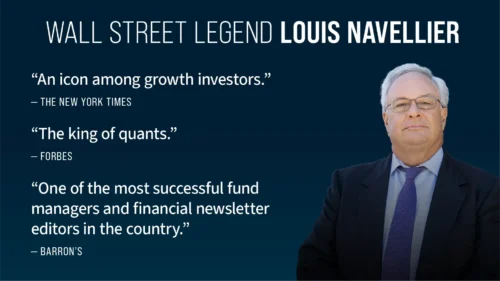
Navellier eventually expanded from money management into financial publishing. Like most editors, I assume he wanted to make his research approach accessible beyond institutional clients.
His role within Growth Investor reflects this shift. The newsletter functions as a distribution channel for the same growth-focused methodology developed earlier in his career.
From what I have seen testing the service, the research structure reflects this background.
The emphasis remains on stock selection systems rather than opinion-based commentary.
Navellier is head honcho at Navellier & Associates, the investment firm tied to his earlier portfolio management work.
References to regulatory filings show the firm holding significant exposure to growth sectors, including roughly $358 million allocated toward artificial intelligence-related positions.
The presence of an asset management firm alongside publishing work reveals the network Navellier has constructed over the years and adds to his credibility in the finance world.
I wouldn’t say it’s unique, as many long-tenured financial editors maintain connections to both research publishing and portfolio management.
Still, with so many fly-by-night services, it’s nice to see a guru with decades of experience and the financial know-how to back it up.
I did not find any specific personal controversies tied directly to Louis Navellier within the available information.
That said, the financial newsletter industry itself often attracts skepticism.
Performance marketing, large return examples, and future opportunity projections are common across the entire industry and frequently draw criticism from observers.
This scrutiny tends to apply broadly rather than to any single editor.
What matters more is whether performance discussions are paired with appropriate risk disclosures.
Growth Investor includes clear language explaining that markets involve uncertainty and that past performance does not guarantee future results.
That type of disclosure reflects standard publishing practice in regulated financial research.
Credibility usually comes down to experience, structure, and longevity.
Navellier’s background includes decades of experience in finance, institutional portfolio management, and the development of proprietary stock selection systems.
Longevity also matters. Long publishing careers usually indicate continued reader demand for the research.
Perhaps the strongest credibility factor for me, though, is the structured nature of his grading methodology.
Process-driven research tends to carry more weight than prediction-driven research because it aims for repeatability.
That focus on structure appears to be the defining feature of his credibility as a research editor.
What His Long Career Says About His Experience
Long careers in finance usually expose analysts to multiple market cycles. That type of experience often shapes how research evolves over time.
Navellier’s career spans multiple technology revolutions, market corrections, and shifts in investment leadership, showing that the guru can handle it all.
His continued focus on emerging sectors like artificial intelligence suggests the research evolves alongside market change rather than remaining static, and that adaptability is important.
Analysts who continue adjusting their research focus tend to remain relevant longer than those who rely on outdated strategies.
Most financial newsletter editors fall into two categories. Some focus on storytelling and macro predictions. Others rely on structured selection systems.
Navellier’s work clearly falls into the system-driven category. His research emphasizes screening models, grading frameworks, and measurable company characteristics rather than economic forecasting.
This places his work closer to quantitative research providers than commentary-based newsletter writers.
That distinction helps explain why his research often reads more like structured analysis than market opinion.
 Why His Background Matters When Evaluating Growth Investor

Understanding Navellier’s career history helps explain how Growth Investor is structured.
The grading systems used in the newsletter are direct extensions of the quantitative approach developed during his years in asset management.
That continuity matters because it suggests the research is built around a long-developed framework rather than temporary market themes.
When a newsletter reflects decades of research development, the strategy usually shows more consistency than services built around short-term narratives.
This connection between background and research structure is one of the more important credibility signals behind the service.
Final Assessment
Louis Navellier’s career reflects a transition from quantitative portfolio management to financial research publishing.
His background includes institutional money management, development of systematic stock selection models, and decades of involvement in growth investing.
The strongest credibility signals appear to come from his longevity in finance, his process-driven research approach, and his continued focus on innovation-driven sectors.
What stands out most is not any single performance example. It is the consistency of the methodology behind the research.
Understanding that background helps explain why Growth Investor is structured around disciplined stock selection rather than market predictions.

 Tags:
Tags: