
Seeking Alpha has become one of the first places I turn when I want to research a stock from more than one angle.
The platform brings together independent analysis, Quant Ratings, Wall Street sentiment, and active community discussion, which gives beginners a useful way to learn without relying on a single opinion.
It does take some time to understand the layout, but the learning curve feels worthwhile.
In this guide, I’ll explain whether Seeking Alpha is good for beginner investors and how new users can get the most value from it.
 Is Seeking Alpha Good for Beginner Investors?
 Is Seeking Alpha Good for Beginner Investors?
Yes, Seeking Alpha can be a strong choice for beginners who want to understand their decisions instead of following unexplained stock picks.
The platform combines financial data, independent articles, quantitative research, professional analyst sentiment, and portfolio tracking.
That mix allows someone new to study the same company from several angles before deciding whether it deserves a place on a watchlist.
I like that there’s also a foundation to stand on. Seeking Alpha has operated for more than 20 years and publishes over 5,000 articles each month.
The platform attracts more than 20 million monthly users and features work from roughly 18,000 analysts and contributors.
That amount of research creates a valuable learning environment, but you’ll still need to compare evidence and make your own decisions.
Seeking Alpha works best as a research companion, not an automatic portfolio manager.
Why Seeking Alpha Works Well for Beginners
The biggest advantage here is that you don’t need to jump between several websites to build a basic view of a stock.
A company page typically includes its current price, recent chart, market news, Wall Street Rating, contributor analysis, Factor Grades, and Quant Rating.
You can start there with this information and move into the deeper tools as your confidence improves.
The range of viewpoints you get here is also appealing.
One author may explain why a company has room to grow, while another may raise concerns about debt, margins, competition, or valuation.
Reading multiple viewpoints helps beginners understand that a good business does not always make a good stock at every price.
Over time, that process can teach you how to think through a plan, question it, and decide whether the facts still support it.
The Free Basic Plan Offers a Comfortable Starting Point
Seeking Alpha Basic gives beginners enough access to learn the platform before committing to a paid membership.
Free members can follow real-time news, receive stock analysis alerts, view prices and charts, check Wall Street Ratings, and build a portfolio with notifications.
Basic access also includes 15 newsletters, such as Wall Street Breakfast and ETF and Portfolio Strategy.
Those newsletters can help create a simple daily routine.
A morning market update introduces the main stories, while individual stock pages show how those events may affect companies and share prices.
The free account has limits, but that can help during the first few weeks.
You can focus on a small watchlist and learn how news, charts, and analyst opinions fit together before opening more advanced tools.
The Three Rating Systems Make Research Easier
Seeking Alpha separates its ratings into three different viewpoints: Quant Ratings, Author Ratings, and Wall Street Ratings.
Quant Ratings come from an algorithm that evaluates more than 100 objective data points.
Author Ratings show whether a contributor views a stock as a Strong Buy, Buy, Hold, Sell, or Strong Sell.
Wall Street Ratings bring together professional analyst forecasts, target prices, and expected performance.
This structure helps beginners avoid relying on one confident opinion.
A bullish article may present an exciting story, while the Quant Rating raises concerns about valuation or momentum.
When all three ratings lean positive, you likely have an idea worth pursuing.
If they disagree, that difference gives reason to investigate further.
Factor Grades Teach the Basics of Stock Analysis
 The Factor Scorecard grades a company across Value, Growth, Profitability, Momentum, and EPS Revisions.
Each category receives a score from A+ to F, introducing beginners to the main questions behind stock research.
Is the business expanding? Does it generate healthy profits? Has the share price become expensive? Are earnings expectations improving? Does the stock have positive momentum?
A company may have excellent Growth but weak Profitability. Another may look inexpensive while analysts continue lowering their earnings estimates.
I would never treat one strong grade as a reason to buy the real value comes from seeing how the factors work together.
That makes the scorecard a practical learning tool as well as a quick research filter.
The Community Helps Beginners Test Their Ideas
Seeking Alpha has an active community of more than 250,000 contributors and members with different strategies, opinions, and time horizons.
While these are not professional voices, the comment sections can add useful context to an article.
Readers may challenge an author’s valuation, point out company risks, or offer another interpretation of the financial data.
I find these discussions most helpful when they question an idea I already like, since it feels so easy to locate information that supports my opinion.
A thoughtful opposing view can expose weak assumptions before you bring money into the mix.
Keep in mind that you need to treat these community comments as discussion rather than verified recommendations.
Beginners should focus on the evidence behind an argument, not the confidence of the person making it.
Portfolio Monitoring Keeps Research Organized
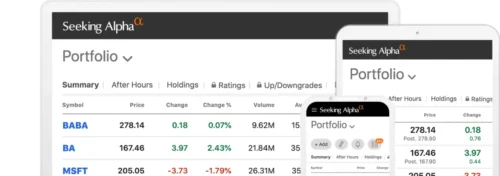 New users often spread their research across brokerage apps, news sites, bookmarks, and personal notes.
Seeking Alpha’s portfolio dashboard brings much of that activity into one place by connecting your portfolio or entering positions in manually.
The dashboard can then send alerts when new articles or breaking news relate to the stocks you follow.
That organization encourages you to focus on a manageable group of companies instead of reacting to every popular ticker in the news.
Don’t use an alert as an immediate buy or sell decision, but it should prompt you to investigate what’s going on.
That creates a calmer routine and reduces the temptation to react to every headline.
Where Beginners May Feel Overwhelmed
Seeking Alpha contains a lot of information.
Articles, ratings, charts, screeners, transcripts, alerts, comparison tools, portfolios, and community discussions can make the first few visits feel crowded.
When you’re first starting out at least, you don’t need to understand every tab. Trying to use every tool at once can create analysis paralysis instead of clarity.
A better approach is to follow a small watchlist, compare the three rating systems, read one bullish article and one bearish article, and then check the Factor Scorecard.
Once that routine feels natural, the advanced tools start falling into place.
The learning curve is real, but it becomes far more manageable when the platform is used in stages.
 A Simple Seeking Alpha Routine for Beginners
 A Simple Seeking Alpha Routine for Beginners
To kick things off, start with one company you already understand. Review its recent news and price chart before opening the ratings.
Next, compare the Quant, Author, and Wall Street views. If all three look favorable, check the Factor Scorecard for weaker areas.
A poor Value grade may show that the stock has become expensive, while weak EPS Revisions could signal falling expectations.
Next, read one article supporting the company and another questioning it, if you’re able to find them.
Strong analysis should include financial data, valuation, company guidance, or industry evidence rather than excitement alone.
As you build out your interests, the stock comparison tool becomes useful once you have several candidates.
That said, you may want to add promising companies to a watchlist instead of rushing to buy.
Watching them over time builds patience and shows how ratings, prices, and news can change.
Is Seeking Alpha Basic Enough for a Beginner?
Basic is enough for someone who wants to learn the layout, follow news, check charts, read newsletters, and view Wall Street Ratings.
It offers a sensible introduction without requiring an immediate financial commitment.
Someone who mainly wants market updates and a simple watchlist may remain satisfied with free access.
However, beginners who start researching stocks regularly may outgrow it.
Quant Ratings, Author Ratings, Factor Scorecards, full comparisons, advanced screeners, and deeper analysis sit within the paid tiers.
Premium is the practical upgrade for most beginners.
Pro is aimed at users who need professional-level intelligence, exclusive research, and a more advanced flow of ideas.
Can Beginners Rely on Seeking Alpha’s Quant Ratings?
Quant Ratings can help beginners narrow the market, but they should support judgment rather than replace it.
The system reviews more than 100 data points and evaluates Value, Growth, Profitability, Momentum, and EPS Revisions.
Alpha Picks shows how a stricter process can build on that framework.
It releases two stock ideas each month and usually carries around 20 active recommendations.
A new selection must maintain a Strong Buy Quant Rating for at least 75 consecutive days, trade above $10, and have a three-month average market capitalization above $500 million.
Its portfolio returned more than 242% from July 2022 through September 2025, compared with about 75% for the S&P 500. AppLovin and Super Micro Computer ranked among its quadruple-digit winners.
Those results do not mean every Strong Buy stock will perform the same way.
Past performance never guarantees future returns, but the figures show how a disciplined quantitative process can work in practice.
 Who May Not Be a Good Fit?
 Who May Not Be a Good Fit?
Seeking Alpha may not suit someone who wants guaranteed outcomes, automatic portfolio management, or one unquestioned source of truth.
It also requires more effort than a simple stock-pick alert.
Beginners who dislike reading analysis may find the platform demanding, and you need to be able to separate emotion from all the content here.
The best fit is a curious, patient beginner who wants to compare evidence and make independent decisions.
Those habits turn the platform’s depth into an advantage rather than a distraction.
Final Verdict: Is Seeking Alpha Worth It for Beginners?
Yes, Seeking Alpha is a strong option for beginner investors who want to become more capable and self-reliant.
Its ratings, Factor Scorecards, stock comparisons, portfolio alerts, independent analysis, and community discussions make complex research easier to approach.
The platform does not remove responsibility, but it gives new users a clearer framework for asking the right questions.
Basic offers enough access to learn the dashboard and build a simple routine.
Premium becomes the stronger choice once you want Quant Ratings, Author Ratings, complete comparisons, screeners, and deeper stock research.
No research platform can remove market risk.
Still, if you want to build better habits can start with Seeking Alpha Basic, then move to Seeking Alpha Premium when they are ready for the complete analytical toolkit.

 Tags:
Tags: