

Most of us have money tucked away in traditional banks, and let’s be honest, it really doesn’t amount to much.
Marc Lichtenfeld claims there’s a better place to put your hard-earned cash for way bigger returns, but few of us even know it exists.
The idea behind The 29% Account traces back to one of the longest-running asset structures in the country, now positioned to benefit from expanding AI infrastructure while most Americans earn next to nothing on their cash.
In this The 29% Account review, I examine Marc Lichtenfeld’s research to see if his strategy can actually deliver.
>> Get Marc Lichtenfeld’s 29% Account Today <<
What Is Oxford Income Letter?
Oxford Income Letter is an income-focused research service built for people who care more about steady cash flow than chasing the next hot trend.  The goal is straightforward: identify assets designed to generate income across different market environments, including stocks, trusts, and other yield-producing structures with long operating histories.
Subscribers receive ongoing research that highlights new income ideas, updates on existing positions, and guidance on how each recommendation fits into a broader income strategy.
The service also provides clear explanations, practical context, and timely alerts, without requiring constant monitoring or complex decision-making.
What makes this approach appealing to me is the emphasis on durability and compounding rather than short-term gains.
>> Unlock The 29% Account With Marc Lichtenfeld <<
What Is Inside Marc Lichtenfeld’s America’s Secret “29% Account” Presentation?
Banks feel like an obvious choice if you have some extra money lying around; folks have been using them for centuries.
The problem is that the meager returns we receive rarely cover the rising rate of inflation and weakening dollar.
What makes this more frustrating is that institutions don’t play by the same rules we have to follow.
They’ve relied for generations on a very different kind of asset, one designed to hold, not trade, and to compound value without constant decision-making.
That gap between how everyday savers and large financial players treat idle money sets up an opportunity most people never realize exists.
 I’ve Been Working on the Railroad

In order to understand why banks are making bank with our money, join me on a journey back in time.
As railroads started connecting the East and the West, new development sprang up along the way.
What’s interesting is that not all of these developments took hold, and a lot of land lay abandoned, eventually to be sold for pennies on the dollar.
In a genius move, Wall Street bankers organized the land into a trust fund that was able to capitalize on industrialization and the need for oil and metals under the surface.
The trust to this day still pays out royalties to members to the tune of the 29%, just like a landlord collects money from tenants.
Marc even mentions that one lost certificate from that era was worth $20 million when it resurfaced.
 Investing in the Future of Royalties

Even if this trust fund coasted for the next 50 years, 29% royalties feels much better than the few percent banks give us.
What’s even more interesting, though, is that Marc connects the trust to brand new initiatives that could increase those payouts by a significant margin.
I’m referring of course to artificial intelligence and the demand for energy and cooling that even a single data center requires to function.
Let that settle in – this trust fund owns land to build data centers on, fuel for all its power consumption, and the water needed to cool the entire thing down.
Companies using those resources regularly pay the trust fund the equivalent of rent, and just like before, that money flows as royalties to members.
How to Profit From the 29% Account
All I’m heading from Lichtenfeld is that this is the ideal time to get involved in this trust fund play, even if you’ve never heard about it before.
Data centers are rapidly coming online, and I could see those royalties getting bigger than ever.
You’ll need to own shares of the trust fund to partake, though, and that’s where things get tricky.
Fortunately, Marc has already taken the time to thoroughly research the space, so you can follow his guidance to participate.
He rolls all his findings up into his Oxford Income Letter service, and you can get immediate access the moment you become a member.
Next up, I’d like to break down everything that comes with the service so you know precisely what you’re walking into.

The 29% Account Review: What Comes With It?
Here’s everything you’ll get as part of this 29% Account bundle:
 12 Issues of Oxford Income Letter
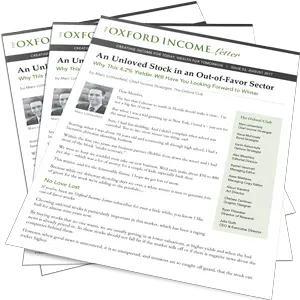
I’ll start things off with a year of Oxford Income Letter, which is the gift that keeps on giving.
You’ll get 12 monthly issues built around some kind of actionable income research, depending on whatever’s on Marc’s radar at the time.
What I like is that there’s no tie to sector or industry here that limits the service’s focus.
Every issue connects the recommendation to a specific income role, whether that’s immediate cash flow, long-term compounding, or portfolio balance.
You’re also given context on why the idea exists now, not just why it worked in the past.
Over time, the issues work together as a playbook, helping build consistent income in your portfolio.
>> Join The 29% Account Risk-Free <<
Access to All Five Model Portfolios
One of the strongest parts of the service is access to five clearly defined model portfolios, each built around a different income objective.
Instead of forcing everyone into a single strategy, Marc separates ideas based on how and when income is expected to show up.
The Instant Income Portfolio focuses on ideas designed to start producing cash flow quickly, which is useful if you’re looking to replace low-yield cash without waiting years.
The Compound Income Portfolio leans toward reinvestment and long-term growth of income streams, prioritizing durability over speed.
For those willing to accept more variability in exchange for higher payouts, the High Yield Portfolio targets income-rich opportunities with elevated yields.
On the conservative end, the Fixed Income Portfolio emphasizes stability and predictability, helping balance risk across the service.
Finally, the Strategic Growth Portfolio rounds things out by blending income with capital appreciation, showing how certain positions can grow alongside payouts.
Seeing where each recommendation fits helps remove guesswork and keeps expectations realistic.
 Customer Support and Member Access

Customer support is handled through Oxford Club’s dedicated member services team.
You can reach out for help with login problems, delivery questions, or navigating the members’ area without waiting days for a response.
I appreciate that you’re not forced to chase answers through automated loops or buried contact forms.
For a service built around long-term income planning, that reliability helps maintain continuity and keeps the focus where it belongs, on executing the strategy rather than managing logistics.
>> Claim Marc Lichtenfeld’s Income Strategy <<
Oxford Income Letter Bonuses
The bonuses bundled with the subscription open up the 29% Account and several other key initiatives you’ll want to check out right away:
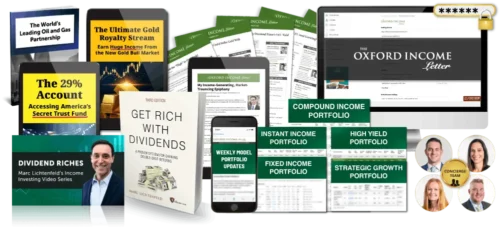
FEATURED REPORT: The 29% Account: Accessing America’s Secret Trust Fund
This report is the centerpiece of the entire offer and is your ticket to the mysterious 29% Account.
Marc reveals the exact ticker symbol of a 137-year-old trust that was deliberately structured to avoid liquidation, allowing its assets to compound intact for generations.
You’re given step-by-step buying instructions that work with any standard brokerage account, removing guesswork around access or execution.
There’s also Marc’s forward-looking analysis on why the next 25 years could be even more profitable than the last, tying future demand directly to infrastructure expansion rather than speculation.
>> Discover The 29% Account Opportunity <<
BONUS REPORT: The Ultimate Gold Royalty Stream: Earn Huge Income From the New Gold Bull Market
This bonus zeroes in on a specific gold royalty company, complete with the ticker symbol and buying instructions.
Marc explains why royalty businesses allow people to profit from rising gold prices while collecting income, without the operational risk of mining.
He contrasts this approach with owning physical gold or mining stocks, pointing out that during the last gold bull run, royalty streams outperformed gold by roughly five times, without leverage or options.
The analysis focuses on why this particular royalty setup could benefit as gold pushes toward new all-time highs, making it especially relevant for adding inflation-sensitive income to your portfolio.
 Special Bonus #1: Get Rich with Dividends

Get Rich With Dividends is Marc’s award-winning, bestselling book, with more than 110,000 copies sold.
You’ll get it sent right to your door.
The book focuses on achieving double-digit returns using dividend stocks, emphasizing sustainability and long-term income rather than chasing yields.
It was named Book of the Year by the Institute for Financial Literacy, which adds credibility beyond marketing claims.
For me, it goes back to the basics of dividend investing and setting yourself up to earn double-digit gains the right way.
I suggest reading it even if you’re familiar with the space, as Marc offers some great tips I’d never considered.
>> Get The 29% Account For $0.27 Daily <<
 Special Bonus #2: Dividend Riches Video Series
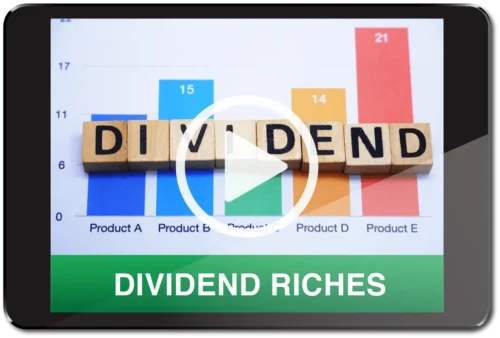
The Dividend Riches video series walks through Marc’s entire dividend philosophy in a visual, step-by-step format.
Instead of focusing on isolated ideas, the videos explain how dividends work together inside a real income strategy, including reinvestment decisions and income planning.
This series is especially helpful for folks like me who prefer learning by watching instead of reading through tons of text.
It reinforces concepts introduced in the book and newsletter while making the strategy easier to internalize and apply consistently.
Special Bonus #3: The World’s Leading Oil and Gas Partnership
This report explains how to become a partner in a company that owns more than 50,000 miles of oil and gas pipelines across the United States.
Inside, you’ll learn how pipeline partnerships generate income from volume rather than commodity prices, which helps stabilize cash flow.
As a partner, you’re entitled to a share of the profits from every barrel that moves through the system.
The report explains how these distributions work and why this type of energy infrastructure can play a role in an income-focused portfolio.
>> Follow Marc Lichtenfeld’s Income Blueprint <<
 Refund Policy

The subscription comes with a full one-year satisfaction guarantee, which gives you plenty of time to evaluate the service in real conditions.
As you test things out, you can request a refund at any point during the first 365 days if you decide the research isn’t a fit for you.
There are no hoops to jump through and no requirement to justify your decision.
Since dividend strategies often take time to materialize, having this much runway is really amazing.
You’re able to read the issues, review the portfolios, and see how the ideas align with your goals before committing long-term.
>> Secure The 29% Account Before Prices Rise <<
Pros and Cons
After reviewing the service, these are the most notable strengths and limitations.
Pros
- Income-focused, not growth dependent
- Led by industry veteran Marc Lichtenfeld
- Includes 12 monthly newsletter issues
- Five clearly defined model portfolios
- Institutional-style asset exposure
- Works with standard brokerage accounts
- 365-day satisfaction guarantee
- Multiple bonus reports
Cons
- Limited appeal for active traders
- No community chat or forum
>> Learn Marc Lichtenfeld’s Trust-Based Income <<
Track Record and Past Performance
What makes this idea compelling is that the numbers are rooted in history.
The trust at the center of The 29% Account has been operating for roughly 137 years, long before modern markets, ETFs, or online brokerages existed.
Over the last 25 years, the performance figures highlighted show that $1,000 invested grew to more than $556,000, driven by a combination of asset appreciation and ongoing income.
That works out to an average annual return of about 29%, which sharply contrasts with traditional savings vehicles that barely keep pace with inflation.
Equally important is the fact that large institutions and banks have relied on this structure for long-term capital holding, not a speculative bet.
While no future results are guaranteed, the longevity, consistency, and institutional participation give this track record far more weight than most short-term income claims.
>> Join Oxford Income Letter With Bonuses <<
How Much Does The Oxford Income Letter Cost?
There are three subscription options you can pick from, depending on your immediate need.
The Standard Subscription costs $59 and includes a full year of digital-only access to The Oxford Income Letter.
The Deluxe Subscription is priced at $129 and includes both digital and print delivery of all 12 issues, but it doesn’t compare to the platform’s best deal.
The Premium Subscription is the most comprehensive option and is currently offered at a discounted $99, compared to the regular $249 annual retail price of the flagship publication.
That breaks down to roughly $0.27 per day and includes digital and print access, all five model portfolios, the complete bonus package, and additional income and retirement reports.
After the first 12 months, it automatically renews at the same price, carrying that value forward.
>> Start Building Income With The 29% Account <<
 Is The 29% Account Worth It?
After going through everything in detail, The 29% Account review is a solid approach to an age-old strategy.
You won’t be happy if you want fast results or constant action, but that’s not what this service is designed to do.
Instead, the strength here is structure, patience, and positioning cash in assets designed to work quietly over time.
The amount of content you get here is unheard of, teaching dividend strategy from the ground up while sharing plenty of ways to take advantage of consistent income at the same time.
When you factor in the discounted pricing, year-long guarantee, and supporting research, the value proposition feels balanced.
It’s one of the best services I’ve seen for setting up investments that keep paying you back over time.
Don’t wait around until data center initiatives go mainstream, or you’ll find yourself too late to the party.

 Tags:
Tags: