


Doing hours of research only to end up with stocks that do you dirty is frustrating. That’s exactly the problem Ticker Nerd set out to solve.
It’s designed for people who want a more systematic way to choose individual stocks without spending endless hours sorting through market noise.
Instead of focusing on conventional stock-picking reports, the revamped service combines factor-based rankings, a rules-driven model portfolio, and easy-to-understand research on every holding.
In this Ticker Nerd review, I’ll look at how the service works and if it actually delivers.
>> Get Ticker Nerd for Just $5 Today <<
What is Ticker Nerd?
Professional-grade algorithmic screening combined with ex-Goldman Sachs human analysis at $29/month — two detailed monthly reports, a daily-updated Top 10 Portfolio, 150+ archived picks, and Wall Street analyst forecast pages, all in one structured research platform
The daily-updated Top 10 Portfolio driven by the proprietary Ticker Nerd Rank — rebalanced every four weeks with subscriber notifications, giving members a continuously current view of the team's highest-conviction ideas rather than a static monthly pick list
Designed exclusively for long-term, growth-oriented investing — no short-term trade alerts, no international market coverage, and only two new research reports per month, which will feel insufficient for investors who want higher-frequency signals or broader geographic reach
Ticker Nerd is a subscription-based research service created for everyday folks who want to find promising companies without spending hours digging through financial statements and stock forums.
Its current centerpiece is a growth-centric 20-stock model portfolio called the Ticker Nerd 20.
The platform scores roughly 4,600 U.S.-listed stocks every trading day, pulling from a smaller pool of roughly 1,500 liquid eligible tickers for its model portfolio.
The coverage is centered on U.S.-listed companies, making it easy to follow along. Subscribers get structured analysis, rankings, and curated insights that cut through the noise.
What I like is that the platform gives each company a rank based on a consistent set of measurable factors.
For anyone looking to save time and still keep an eye on high-quality opportunities, Ticker Nerd offers a straightforward, data-backed starting point.
How Does Ticker Nerd Work?
Ticker Nerd’s current research process is built around its proprietary ranking framework and the Ticker Nerd 20 model portfolio.
The model applies the same rules across thousands of stocks rather than relying on a researcher’s latest hunch or market headline.
Algorithmic Screening
The process begins with a proprietary algorithm that scans thousands of U.S.-listed stocks daily.
Around 4,600 stocks receive scores from 0 to 100 across nine factor families: revisions, value, momentum, quality, accruals, issuance, growth, size, and volatility. Roughly 50 individual measurements feed into those broader categories.
The individual factor scores then combine into the overall Ticker Nerd Rank.
A score near 100 means the available evidence compares favorably with other stocks in the model, while a score near zero suggests the opposite.
Human Research and Due Diligence
Aslam Ghouse remains the person behind Ticker Nerd, but the revamped service puts more emphasis on systematic stock selection than human stock picking.
Ghouse spent 14 years as a systematic foreign-exchange professional, including nine years at Goldman Sachs, and has held the CFA charter since 2015.
The model chooses the stocks, but a human touch helps explain the businesses behind those selections.
Every portfolio holding receives a simple brief covering the company, supporting evidence, relevant numbers, strengths, weaknesses, and important risks.
Dynamic Ranking System
Finally, every stock ends up with a ranking that gets updated daily.
That ranking now feeds into the Ticker Nerd 20, a portfolio of 20 growth stocks selected from approximately 1,500 of the largest and most liquid eligible U.S.-listed companies.
The portfolio starts from equal-weight positions and is formally reviewed every four weeks.
However, Ticker Nerd does not automatically sell a stock because its rank slips by a point or two.
A normal review may replace one or two holdings, and sometimes nothing changes at all.
Subscribers get a notification whenever Ticker Nerd makes changes, giving them a clear, structured view of what the research model currently considers its strongest ideas.
Is Ticker Nerd Legit?
Ticker Nerd has built a reputation as a credible research platform.
It isn’t run by anonymous bloggers; it’s led by Aslam Ghouse, a systematic market professional with 14 years of experience, including nine years at Goldman Sachs, and a CFA charter he has held since 2015.

Ghouse says he’s invested his own money in the 20 stocks shown to members, which gives me more confidence that he has some skin in the game.
The service itself is transparent, offering clear disclaimers that it provides research and education rather than financial advice, and it backs this with a 30-day money-back guarantee.
On the educational side, Ticker Nerd does a solid job of explaining its methodology and processes to connect all the dots.
The platform also publishes losing model trades alongside winners instead of showing only the strongest results, adding transparency that many other services run from.
>> Already sold on Ticker Nerd? Click HERE to sign up! <<
What You Get With Ticker Nerd: Portfolio, Briefs, Rankings, and More
Ticker Nerd has some great features that will help you improve your investing game. Keep reading our Ticker Nerd review and learn more about them.
 Holding Briefs

Instead of the old twice-monthly growth-stock reports, members now receive detailed briefs covering the stocks held in the Ticker Nerd 20.
Each brief explains the business in plain English and looks at the evidence supporting its ranking. You can also see important risks, strengths, weaknesses, and the financial numbers behind the model’s view.
They’re never the same from one stock to the next but often cover the company’s factor scores alongside the positives and negatives behind the ranking.
One holding brief arrives every Wednesday, so members can gradually work through the companies in the portfolio and understand why each position deserves a place there.
For anyone who dislikes following a quantitative model without knowing what sits underneath it, these briefs add some much-needed context.
Ticker Nerd 20 Portfolio
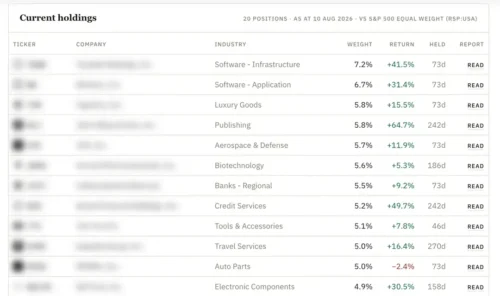 The Ticker Nerd 20 is now the centerpiece of the paid service. It contains 20 growth stocks selected using the Ticker Nerd Rank from roughly 1,500 eligible large, liquid U.S.-listed companies.
Positions begin at equal weights, so the system does not place oversized bets on one favorite company.
Every four weeks, the team reviews the portfolio based on its unique criteria, and members receive notifications explaining the changes.
Ticker Nerd deliberately uses a buffer before removing existing holdings, which helps prevent unnecessary turnover when rankings move only slightly. A typical review replaces one or two companies, although sometimes the portfolio stays unchanged.
It’s a great way to stay on the pulse of what Ticker Nerd is uncovering, and you can track how recommendations are faring for better or worse.
This structure helps create a systematic approach rather than guessing when to buy or sell.
Complete Trade Record
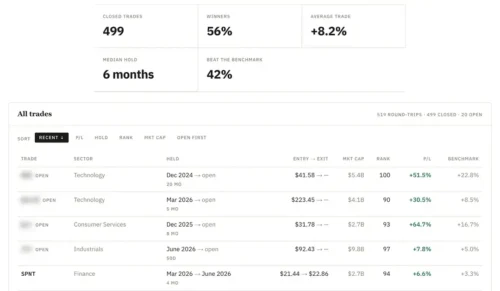 Ticker Nerd has replaced the old report archive as a core membership feature with something I find more useful: a complete trade-by-trade record.
This is where you can see every historical entry and exit from the model, including losing positions.
The last ledger I saw lists 499 closed trades, 20 open positions, a 56% winner rate, an average trade return of 8.2%, and a median holding period of six months.
Since this portfolio is new, everything landing before July 2026 is backtest data, which is worth noting.
It’s nice to see how the system would have worked if put in place sooner, but it means you have to view this data with a grain of salt.
Daily Rankings & Updates
Instead of waiting for monthly or weekly reports, you can log into their dashboard to see the complete ranking framework across the market.
Ticker Nerd refreshes these every single day, giving an up-to-date view of which companies are moving up or down in priority.
Paid members can sort stocks by individual factors, compare companies side by side, switch between the investable universe and the wider ranked market, and identify stocks currently held in the Ticker Nerd 20.
This continuous feedback loop is especially useful for those who want to monitor changes between portfolio reviews.
Weekly Market Radar Newsletter
In addition to the research, members and free subscribers receive the Market Radar Newsletter every Monday before the market opens.
The new weekly format covers where the market moved, what drove those moves, which Ticker Nerd ranks rose or fell, and how the latest news lines up with changes in the model.
It also explains one factor each week using some of the highest- and lowest-scoring examples.
That makes the newsletter more tightly connected to Ticker Nerd’s systematic framework than the older version of Market Radar.
Since Market Radar remains free, I recommend checking it out whether you become a paid Ticker Nerd member or not.
It gives you a useful feel for how the team thinks before you spend anything.
Free Stock Forecast Pages: Factor Scores Without a Subscription
Ticker Nerd still makes individual stock pages available for free, although their role within the service has changed.
The most useful part today is the Ticker Nerd Rank and the underlying factor scores.
Each stock receives a 0-to-100 score across the same factors used by the broader system, letting you see how the company compares with thousands of other U.S.-listed stocks.
It’s an excellent place to get a quick data-driven snapshot of a company without having to scour the internet.
Just keep in mind that Ticker Nerd explicitly says the Rank does not tell you when to buy, when to sell, or how much of a stock to own.
>> Like all that Ticker Nerd has to offer? Sign up HERE! <<
Is Ticker Nerd Reliable?
Ticker Nerd’s revamped approach gives us much better performance data to evaluate, but there is an important distinction between simulated and live results.
As of August 13, 2026, the Ticker Nerd 20 had gained 36.3% over the previous 12 months compared with 20.8% for the S&P 500 Equal Weight.
Going back to 2005, the same rules produced a simulated annualized return of 12.7%, compared with 10.1% for the equal-weight benchmark.
Those figures certainly caught my attention, but most of the record is hypothetical.
The model only went live on July 20, 2026, so you can’t treat the pre-July performance as a real-world track record.
The good news is that Ticker Nerd clearly labels that boundary.
I’d rather see a company acknowledge the limitations of its backtest than blur the line between simulated results and actual performance.
 Ticker Nerd 30-Day Money-Back Guarantee
 Ticker Nerd 30-Day Money-Back Guarantee
Ticker Nerd makes its cancellation policy straightforward and user-friendly. Every subscription is backed by a 30-day money-back guarantee, meaning new members can test the service with very little risk.
If it’s not the right fit, you can request a refund during those first 30 days using a simple two-click process.
The company also sends a reminder one week before a subscription renews.
There is no separate free trial, so this 30-day full-refund window is the only way to try the paid service and decide whether it fits.
This no-strings approach reflects confidence in the product’s value and lowers the barrier for anyone curious about trying the service.
How Much Does Ticker Nerd Cost?
full Premium access 50% discount
Ticker Nerd offers two straightforward subscription options to fit different preferences.
The Monthly Plan is now priced at $39 per month, giving the flexibility to try the service without committing to a full year.
The Annual Plan costs $199 per year. That works out to less than $4 per week and saves more than half compared with paying the $39 monthly rate for a full year.
Both options provide access to the same service: the Ticker Nerd 20, portfolio-change emails, research briefs on every holding, the complete Rank interface, and the full trade-by-trade record.
I like that there is no feature-based upsell between the two plans. The only real choice is whether you prefer monthly flexibility or the lower effective cost of paying annually.
The annual plan offers the best value, especially for people who expect to use the model and research throughout the year.
>> Ready to get started with Ticker Nerd? Click HERE to sign up! <<
Pros and Cons
Ticker Nerd takes a unique approach to searching for breakthrough stocks. Here in our Ticker Nerd review, you can take a look at our pros and cons before making a decision.
Pros
- Monthly reports sent straight to an email inbox
- Proprietary software that scrapes the internet for breakout stocks
- Team of expert analysts to filter through data
- Top 10 Portfolio that’s rebalanced every month
- 150+ archived stock reports
- Bi-weekly newsletter included
- 30-day money-back guarantee
- Reasonable yearly subscription fee
Cons
- Service is relatively new
- Focused only on U.S. stocks
Is Ticker Nerd Right for Me?
Ticker Nerd is now designed for people who want a consistent, systematic framework that helps them locate less-common growth stocks that aren’t yet in the public eye.
It appeals to busy professionals and everyday market participants who don’t have time to sift through endless market data but still want access to well-researched, actionable insights.
Because the service combines factor-based ranking with a rules-driven model portfolio, it is especially useful for people who want a clear process for comparing companies instead of reacting to headlines.
On the other hand, it won’t suit people looking for rapid-fire trade alerts, penny stock tips, price targets, personalized buy instructions, or high-risk strategies.
The service positions its 20-stock portfolio as a more aggressive individual-stock allocation that can sit alongside an index-fund core.
If your goal is to save time while gaining access to a disciplined framework for choosing individual stocks, Ticker Nerd is a strong match.
 Is Ticker Nerd Worth It?
In my experience, the answer is yes, but it depends on what you’re looking for. If you want a service that spoon-feeds you dozens of short-term trades, then this probably isn’t the right fit.
But if you value a systematic process, transparent methodology, and research that explains what the model owns, Ticker Nerd delivers on those fronts.
Where it shines most is the combination of quantitative discipline and transparency. Ticker Nerd does not just show the stocks that rank well.
The biggest question is live performance.
The current model only began trading live on July 20, 2026, so it needs more time before we can judge how closely its real-world results match its historical simulations.
At $39 per month or $199 per year, the service remains reasonably priced compared with many premium stock research platforms.
Add in the 30-day money-back guarantee, and you have very little to lose by giving it a try.
If you already have a diversified core and want to add individual stocks through a rules-based strategy, Ticker Nerd is well worth considering.
Ticker Nerd FAQ: Your Questions Answered
How Does the Ticker Nerd 20 Portfolio Work and How Often Does Its Composition Actually Change?
The Ticker Nerd 20 is Ticker Nerd’s model portfolio of 20 growth stocks chosen with its systematic ranking framework.
Ticker Nerd reviews the portfolio every four weeks, but that does not mean all 20 positions are reshuffled each month.
The model uses a buffer before replacing holdings, so a small decline in rank will not automatically trigger a sale.
A typical review replaces one or two stocks, and some reviews result in no changes at all. Members receive an email whenever a portfolio position changes.
How Does the Weekly Market Radar Newsletter Differ From the Holding Briefs?
The holding briefs and Market Radar now serve two distinct purposes.
Holding briefs are tied directly to the 20 growth stocks inside the paid model portfolio.
Each one explains the business, supporting evidence, risks, strengths, weaknesses, and relevant numbers. Ticker Nerd says a new brief is delivered every Wednesday.
Market Radar, on the other hand, is a free weekly email delivered every Monday before the market opens.
It looks at what happened across the broader market, what drove those moves, which Ticker Nerd ranks changed, and how current news lines up with those changes. It also uses real examples to explain one of the model’s factors.
>> Ready to save time looking for hot stocks? Sign up for Ticker Nerd TODAY! <<






 Tags:
Tags: