

Investing can be a messy pursuit, so the folks at Morningstar Investor set out to create a platform that offers clarity and removes pinch points.
Morningstar has been a trusted source thanks to powerful ratings, independent analysis, and trusted investment experts, but I had to see how it stacks up in 2026.
In this Morningstar Investor review, I’ll break down the research, data, and tools, from watchlists to portfolio tracking, so you can decide if it fits your strategy.
>> Start Your Morningstar Investor Trial <<
What is Morningstar?
Morningstar Investor gives individual investors access to the same independent research framework trusted by advisors and institutions, including analyst reports, proprietary ratings, Portfolio X-Ray, and advanced screeners. Its combination of stock, ETF, and fund analysis makes it a strong value at the discounted first-year price. Morningstar’s proprietary Star Ratings, Medalist Ratings, and fair value estimates are backed by a global team of analysts and decades of investment research. Few retail-focused platforms offer this level of independent fund and ETF analysis alongside portfolio diagnostics like Portfolio X-Ray. Morningstar Investor is built primarily for long-term investors who value deep fundamental research and portfolio analysis. Active traders seeking real-time alerts, short-term trading signals, or frequent stock recommendations may not fully utilize its research-focused toolkit.
Morningstar is an independent investment research firm founded more than four decades ago with a simple mission: give us access to the same level of analysis institutions use.  Since then, it has grown into a global research powerhouse serving millions of investors, financial advisors, and asset managers.
What makes it stand out to me is its commitment to transparency and long-term discipline over headline-based predictions.
The company is best known for its powerful ratings system, in-depth analyst reports, and data-driven evaluation of stocks, mutual funds, and ETFs, among a slew of other tools.
In tandem, these help remove guesswork and help folks like us make informed decisions.
>> Unlock Morningstar Investor Today <<
What is Morningstar Investor?
Morningstar Investor is the company’s premium subscription platform built for individuals who want deeper access to its research ecosystem.
It brings together analyst reports, fair value estimates, portfolio tracking, investment ideas, watchlists, and advanced screening tools into one centralized dashboard.
Inside, you’ll find detailed stock and fund analysis, economic moat ratings, risk assessments, and valuation metrics designed to support long-term portfolio decisions.
The service also includes powerful comparison tools and portfolio diagnostics that help you understand diversification, exposure, and overall strategy alignment.
>>>Sign Up for Morningstar Investor Now and Get a 7-Day Free Trial<<<
How Does Morningstar Investor Work?
Morningstar Investor operates as a centralized research hub designed to support long-term portfolio management.
After subscribing, you gain full access to analyst-driven reports covering stocks, ETFs, mutual funds, and other major asset classes.
I enjoy digging deep into these assessments and commentary from Morningstar’s investment experts to help frame my mindset and locate opportunities.
You can also screen thousands of securities using professional-grade filters, compare investments side by side, and build custom Watchlists to monitor potential buys.
Add in a portfolio dashboard, and you’ve got the flexibility to evaluate picks against benchmarks while making sure you’re staying balanced.
There’s no preset strategy here, but rather a powerful toolset you can use to take your investing game to the next level.
>> Join Morningstar Investor Now at $199 Only <<
Morningstar Investor Review: What Comes With It?
Next up, I wanted to break down all the tools you’ll get as a member so you can see for yourself how the platform works.
Analyst Research & Reports
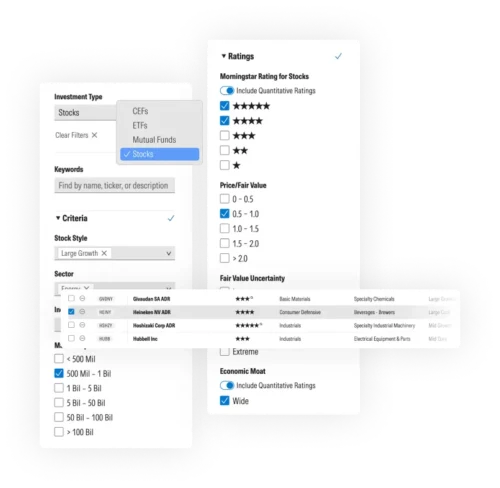 The foundation of Morningstar Investor is its full access to analyst-driven equity and fund research.
Each covered stock or fund includes a fair value estimate, economic moat assessment, uncertainty rating, and a detailed written thesis explaining the business model, competitive position, risks, and growth outlook.
Analysts update coverage when material events occur, so the research evolves with the company.
What’s cool is that you can now access these reports directly from search results, a shortcut that I’m finding saves a lot of time.
That means I have more time to unlock the mysteries of the research I’m reading and connect the dots to investments I can partake in.
Investment Picks
Morningstar Investor does not send flashy alerts or rapid-fire trade ideas. Instead, it highlights opportunities through its rating framework.
While there’s no one to hold your hand here, I typically filter for 4- and 5-star stocks trading below analyst fair value estimates.
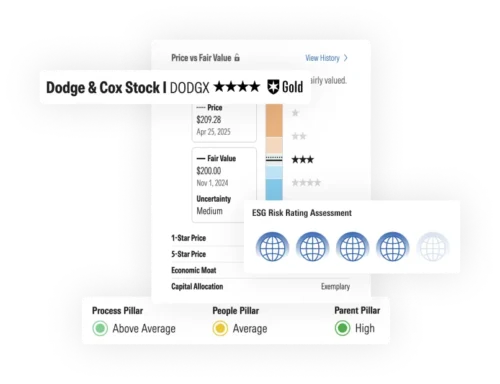 You can also tap into Best Investment lists, providing names that fall into categories such as “five-star stocks” and “wide moats”.
There are enough lists here to make your head spin, but they’re organized well so you can move through them with ease.
All picks are embedded within the research ecosystem, meaning every idea is backed by a written thesis and risk analysis.
You’re building off a firm foundation of data rather than market hype or speculation, which is where I’d rather be any day of the week.
>> Upgrade With Morningstar Investor <<
Portfolio Manager & Tracking Tools
The Morningstar Investor’s portfolio tool acts as your central command center, and I’m happy to hang out here all day.
After entering your holdings, the platform tracks total performance, benchmark comparisons, dividend income, and allocation exposure.
You can see how your portfolio is distributed across sectors, market caps, and styles in real time.
At a glance, you can see how your positions are faring and track trends over time. Not only does this make the process easy, it also removes a lot of stress behind keeping tabs on all you have going on.
I also really love the layout. For me, it clearly reveals how your plan stacks up with positioning and where you likely should make adjustments.
It’s also possible to link most portfolios from external sources so you can have Morningstar provide feedback on rebalancing or restructuring.
That said, do keep in mind that these linked accounts won’t receive performance data.
Portfolio X-Ray
Portfolio X-Ray goes deeper than surface-level allocation tracking, analyzing the underlying holdings inside your funds to uncover hidden concentrations.
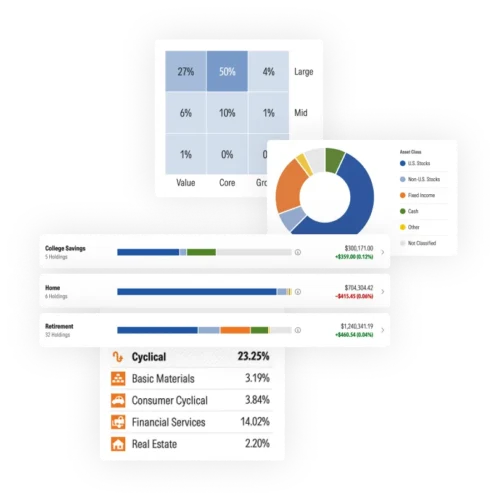 For example, if multiple ETFs hold the same top technology stocks, X-Ray reveals that overlap immediately.
It also breaks down exposure by sector weightings, style box categories, geographic distribution, and bond credit quality when applicable.
I’ve found that the X-Ray tool helps eliminate blind spots that traditional brokerage dashboards often miss. Instead of assuming you are diversified, you can measure it directly.
That level of transparency is one of Morningstar’s most practical advantages, and I suggest using it often.
>> Build Smarter With Morningstar Investor <<
 Advanced Screener & Notifications

Morningstar Investor includes a professional-grade screener built on more than 200 data points.
You can filter stocks and funds by valuation metrics, profitability, moat strength, risk ratings, star ratings, and performance characteristics.
It’s possible to adjust each parameter, allowing you to tailor results to your strategy.
As part of its newest update, Morningstar Investor lets you screen using an even more diverse data set to pinpoint recommendations.
After adding stocks to your watchlists or portfolio, you can set up notifications to go off when prices reach a certain threshold, ratings change, or an earnings report comes around that you want to know about.
Article Archive
Subscribers gain full access to Morningstar’s premium research archive, which includes market commentary, sector updates, fund insights, and strategy pieces written by in-house analysts.
The Morningstar Investor team categorizes the archive by asset class and theme, making it easy to navigate. What makes this valuable is continuity.
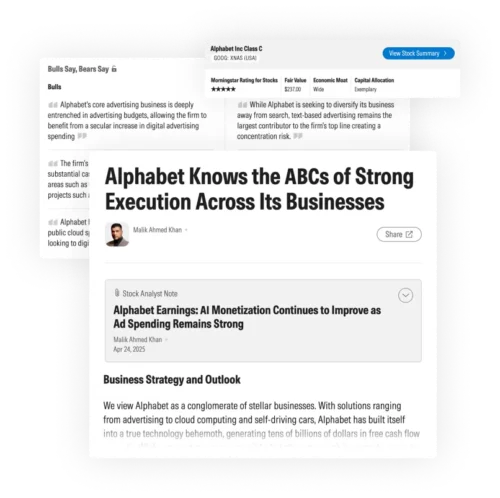 You can track how an analyst’s view evolves over time and see how macro trends impact valuations.
I look at it like research notes, not headlines. If you value perspective over urgency, this archive adds meaningful depth.
Mobile App
Morningstar’s mobile app provides streamlined access to portfolio tracking, ratings updates, research summaries, and watchlists.
While it does not replicate every desktop feature in full detail, it covers the essentials. You can check fair value changes, monitor holdings, and review analyst commentary directly from your phone.
It remains very user-friendly, in my opinion, for research and locating data, making it useful for staying informed throughout the day without needing a full workstation.
I’m not sure I’d rely on it for trade execution, but I can figure out precisely what I need to do before getting back to my desk.
>> Get Morningstar Investor Access <<
Customer Support

Customer support does a great job of being both structured and straightforward.
You can reach the support team via email or phone for technical and account-related questions.
There is also a detailed help center that explains platform navigation, billing, and feature usage.
The tone of support reflects the company’s research-first culture.
You won’t receive personalized investment advice, but you will get assistance in using the tools effectively.
Because Morningstar Investor includes advanced portfolio diagnostics, having accessible support ensures you can fully utilize the platform without frustration.
>>>Start Putting Morningstar’s Game-Changing Research Tools to Work Now<<<
What Is Morningstar’s Proprietary Ratings System?
Morningstar’s proprietary ratings system is what really makes this research platform special.
It gives you a structured way to evaluate stocks, ETFs, and mutual funds using both quantitative data and analyst-driven insight.
There’s nothing surface-level about it, either. It measures valuation, risk, competitive strength, and long-term sustainability, among a laundry list of others.
Together, these metrics create a framework that helps you quickly gauge quality and value without relying on guesswork.
I frequently use these ratings to confirm my suspicions about mispricing or build confidence about potential breakouts, even though nothing’s set in stone.
>> Access Morningstar’s Powerful Ratings <<
How Are Star Ratings Calculated?
Morningstar bases its Star Rating for funds on risk-adjusted performance compared to peers in the same category.
The calculation considers historical returns but also factors in volatility and downside risk. That distinction matters.
A fund that delivered strong returns with lower volatility will typically rank higher than one that achieved similar returns with greater swings.
Ratings get recalculated monthly for funds with at least a three-year track record. The distribution follows a bell-curve structure.
Only the top tier of funds receive five stars, while the lowest-performing group receives one star. Most funds fall in the middle.
For stocks, the system works differently. Analysts estimate a company’s intrinsic value based on projected cash flows.
The current market price is then compared to that estimate. If a stock trades meaningfully below fair value, it may earn a higher star rating.
If it trades above its estimated value, it may receive fewer stars. This approach ties ratings directly to valuation rather than popularity.
Using Star Ratings
 Star ratings are best used as a starting point, not a final decision.
With so many stocks and funds to choose from, they’re ideal for filtering out investment opportunities so you can dive deeper into what’s left.
That said, ratings should be considered alongside your portfolio allocation, investment timeline, and risk tolerance.
A five-star fund may not fit your strategy if it increases concentration in one sector. A highly rated stock may still carry industry-specific risks.
The real strength of the system lies in comparison. It allows you to assess similar investments side by side using a consistent framework.
When combined with portfolio tools and analyst research, the ratings become a practical guide rather than a shortcut.
>> Discover Morningstar’s Independent Analysis <<
Morningstar Investment Strategy
Morningstar rates its securities based on fundamental analysis, so its analysts consider revenues, earnings, and other fundamental business attributes.
They use this information to determine the stock’s ‘fair market value.’ From there, you can compare the asset’s current price with Morningstar’s fair value to decide whether it’s a buy.
Other popular research services use more technical analysis techniques to analyze securities.
Technical analysis uses mathematical and statistical measurements to identify suitable investments and buying opportunities.
Conversely, Morningstar focuses more on underlying businesses and economic trends. Neither approach is superior, but each has different strengths and weaknesses.
Morningstar Investor is best suited to investors who prefer investing based on fundamentals.
>>>Sign up for Morningstar Investor Research Service Now<<<
Morningstar Investor Free Trial Review
Morningstar Investor offers a 7-day free trial that gives full access to the platform before committing to a paid plan.
During this trial, you can explore the same independent analysis, powerful ratings, portfolio tracking tools, and screening capabilities available to paying members.
There are absolutely no restrictions here, which makes it easier to evaluate whether the research fits your investing style.
You’ll be able to review analyst reports, test the Morningstar Investor’s portfolio tool, run screens across thousands of securities, and build Watchlists to monitor potential opportunities.
The trial also allows you to see how fair value estimates and moat ratings apply to your existing holdings.
If you have any hesitation about giving Morningstar Investor a try, this is the best way to put your mind at ease before jumping in.
>> Track Your Portfolio With Morningstar <<
Cancellation/Refund Policy
Morningstar provides a clear cancellation process for Investor subscriptions.  If you purchased directly through Morningstar, you can cancel by calling customer support, canceling through the “My Account” section on Morningstar.com under “Subscription,” or by emailing cancellation@morningstar.com.
If you cancel during the 7-day free trial, you will not incur any charges.
After the trial expires, cancellations take effect at the end of your current billing cycle. Monthly subscriptions remain active until the next monthly anniversary date.
Annual subscriptions remain active until the end of the prepaid term.
>> Start Morningstar Investor Today <<
After spending time inside the platform and reviewing everything it offers, these stood out as the biggest strengths and limitations worth noting.Pros and Cons
Pros
Cons
How Much Does Morningstar Investor Cost?
Morningstar Investor currently offers both annual and monthly subscription options, giving you flexibility depending on how committed you are to the platform.
The standard annual price is $249, but Morningstar frequently offers a discounted rate of $199 for the first year, bringing the cost down to roughly $16 per month.
That discount makes the yearly plan significantly more attractive if you plan to use the research consistently.
There is also a monthly plan priced at $34.95 per month. While this option provides flexibility, it costs considerably more over a full year compared to the discounted annual plan.
Both plans include full access to analyst research, portfolio tools, watchlists, powerful ratings, screeners, and the mobile app.
That 7-day free trial is available before billing begins, allowing you to test the full suite of research, data, and tools before committing.
From a value standpoint, the annual subscription offers the strongest cost-to-benefit ratio, especially for long-term thinkers who intend to rely on the platform’s ongoing independent analysis.
>> Unlock Morningstar Research Platform <<
Is Morningstar Investor a Scam?
No, Morningstar Investor is not a scam.
It’s the premium platform of Morningstar, a firm that has been operating since 1984 and is widely recognized as one of the most established independent investment research companies in the world.
I often hear financial advisors, institutions, and major financial media outlets talk about the platform, really boosting its credibility.
Unlike many subscription services that rely on bold promises, Morningstar focuses on structured research, valuation models, and long-term portfolio discipline.
There are no claims of guaranteed returns or overnight profits. Pricing is transparent, a free trial is available, and cancellation terms are clearly outlined.
That level of transparency and institutional credibility significantly lowers the risk concerns typically associated with lesser-known financial subscriptions.
>> Join Morningstar’s Investment Experts <<
Is Morningstar Investor Right for Me?
Morningstar Investor is best suited for anyone preferring research-backed decisions over speculation.
If you like evaluating companies based on fair value, competitive advantages, and long-term fundamentals, the platform aligns well with that mindset.
It gives you structured data, independent analysis, and portfolio diagnostics that help you think strategically rather than react emotionally.
Even if you’re newer, it’s quite easy to benefit from the clear ratings system and organized research, but there is a learning curve.
The platform assumes you understand basic investing terminology and already have general goals in mind.
There’s not much hand-holding here, though, so you’ll need to know how to put these tools to use.
Morningstar Investor is built for disciplined, long-term portfolio management, not fast-paced trading.
>> Upgrade To Morningstar Investor Now <<
Is Morningstar Investor Worth It?
After putting everything together in this Morningstar Investor review, I’m still really impressed with everything Morningstar Investor has to offer.
If you’re looking for structured research, disciplined valuation models, and portfolio diagnostics that go beyond what most broker dashboards offer, I really think you’ll find that here.
Its tools point to both stocks and funds, allowing you to curate a solid investment portfolio with minimal amounts of effort.
Keep in mind that Morningstar isn’t trying to sell excitement. It’s built around independent analysis, fair value estimates, and long-term strategy alignment that goes as deep as you want it to.
If you actively manage your own investments and want research, data, and tools that support informed decisions, the annual plan is reasonably priced for what you receive, whether you snag a discount or not.
Being able to try everything out, even for just seven days, should be enough to determine if it’s worth a go.



 Tags:
Tags: