


I joined The Near Future Report when I heard about Jeff Brown’s “Cybercab” pitch and wanted to see how it lives up to expectations.
Artificial intelligence is all the rage right now, but not every initiative will pan out – but is this one of them?
This Near Future Report review covers what you actually get, what it costs, and how it fits real portfolios.
>> Jeff Brown’s Favorite Stock Picks Revealed! <<
What Near Future Report Covers (Scope and Style)
The Near Future Report is a monthly investment newsletter from Brownstone Research, focusing on fast-changing tech stories and the stocks tied to them.
Think chips, AI platforms, robots, space, energy systems, and key suppliers behind those trends.
Members receive one primary issue per month, portfolio updates, and email alerts when Brownstone posts changes.
It caters to self-directed individuals who want growth ideas backed by a simple write-up, a ticker, and trade settings.
You do not need to be a coder or an engineer to understand the content here, but you do need the stomach to hold through choppy weeks.
The service skews toward mid and large caps with the occasional smaller name during special situations.
For $179 in the first year, The Near Future Report combines Jeff Brown's emerging technology stock research with monthly recommendations, portfolio updates, and actionable trade alerts. Subscribers also receive three exclusive Elon Musk AI reports and a complimentary year of TradeStops Basic, adding practical portfolio monitoring tools to the research package.
Jeff Brown brings decades of technology industry experience at Qualcomm, NXP Semiconductors, and Juniper Networks. His highlighted historical picks include Taiwan Semiconductor (945%), Palo Alto Networks (962%), and Arista Networks (1,700%), although these selected results do not represent an independently audited portfolio track record.
The service concentrates on emerging technology and growth stocks, particularly AI, semiconductors, and robotics. Its recommendations generally favor multi-month investment horizons, making it better suited to investors comfortable with sector volatility and patient position management.
Editor Background and Expertise Signals


Jeff Brown is a veteran tech executive and newsletter editor. His past roles include senior posts at Qualcomm, NXP Semiconductors, and Juniper Networks.
He has also worked as an angel investor and has written widely read tech letters for years.
In mid-2024, he returned to lead Brownstone Research and publish The Near Future Report again. Today, he serves as the editor behind this service.
>> Access Jeff Brown’s top picks now! <<
Is Jeff Brown Legit?
From a background standpoint, yes. His industry history is real and deep.
He has been early on themes like AI chips, next-gen networking, and autonomy.
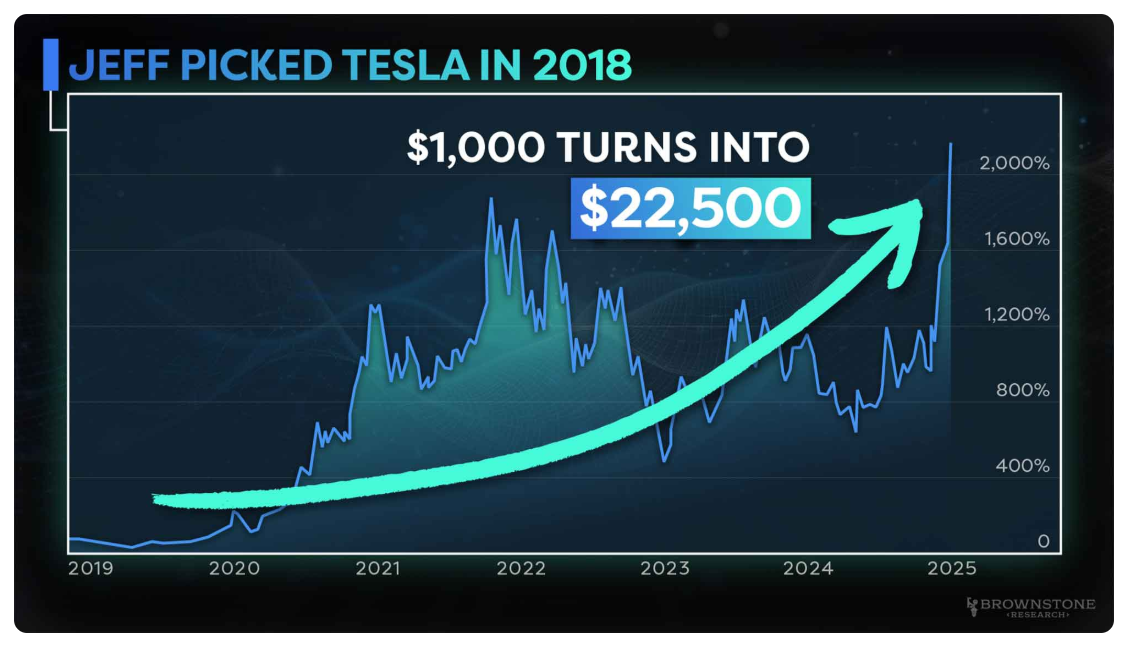
One of his biggest past calls was Tesla (2018), which Jeff says could have turned $5,000 into $114,000 over several years.
Brown also predicted the market bottom in 2020. Three days later, we saw the beginnings of a historic comeback.
A few of Jeff’s winners from that era were Taiwan Semiconductor (945%), Palo Alto Networks (962%), and Arista Networks (1,700%).
He’s also had exposure to international markets during his decades overseas, giving the guru a unique outlook on investing.
On top of all that, there are plenty of media clips and conference talks out there with his name attached that add to his credibility.
>> Get Jeff Brown’s financial insights today! <<
What Is Elon Musk’s “$320 Trillion Blueprint” Cybercab Presentation?
Elon Musk continues to disrupt the world we live in with breakthrough innovations no one thought possible.
At the turn of the millennium, PayPal’s digital payment technology reshaped how we handled transactions.
Tesla changed how we think about vehicles and is now worth more than all other automakers combined.
Even more recently, SpaceX has literally launched into the stratosphere with reusable rockets.
Each of these examples made folks who got in early very rich, and Jeff Brown believes it’s about to happen again – on a bigger scale than ever before.
Why Musk’s AI Expansion Could Change the Entire Industry
Artificial intelligence has a serious supply problem, and Musk’s plans could make it even bigger.
 Advanced AI systems require enormous computing power, but the world’s semiconductor manufacturers are already facing growing demand for their production capacity.
To reduce his dependence on outside suppliers, Musk is developing Terafab, a semiconductor manufacturing project in Austin, Texas.
The proposed facility could eventually produce 200 billion AI chips annually, around 50 times the world’s current production by the estimates used in the promotion.
Even that wouldn’t solve everything.
AI data centers consume tremendous amounts of electricity, and existing power grids could struggle to support such rapid expansion.
Musk’s proposed answer involves moving AI computing infrastructure into orbit, where solar-powered satellites could operate without relying on conventional electricity networks.
The plan calls for up to one million AI satellites.
Whether he hits those targets remains uncertain, but the scale of his proposed infrastructure is hard to ignore.
A Potential Windfall for Critical AI Suppliers
Musk can’t build Terafab, launch millions of computing systems, or manufacture humanoid robots without relying on companies that produce highly specialized technology.
That’s where the financial opportunities start to take shape.
Terafab needs advanced semiconductor equipment capable of manufacturing chips with extraordinary precision. Only a handful of businesses possess that expertise.
The same opportunity extends to space-based computing, where satellites require specialized chips capable of surviving radiation and extreme temperatures.
Tesla’s Optimus robots also depend on sophisticated motor-control technology to manage power consumption and prevent overheating.
Each of these industries could experience substantial growth if Musk achieves his production goals.
A good chunk of this sounds like science fiction to me, but I would have said the same about automated cars that drive people around – and here we are.
I don’t think anyone will stop Musk from achieving his ambitions. The real question is whether you want to profit from it.
How Can You Benefit From Musk’s AI Blueprint?
 There’s no need to depend entirely on Tesla’s stock performance to gain exposure to these developments.
Companies providing essential manufacturing equipment, computing hardware, and robotic components could benefit as Musk expands his operations.
The Terafab project looks particularly promising because of the enormous amount of specialized equipment it would require.
Elon himself is projecting $320 trillion in new wealth, but even half that figure would be colossal.
Jeff Brown realizes this and has done the research to determine companies set to explode from all that money, but he’s only sharing his insights with The Near Future Report members.
You’ll need to subscribe to access the stock picks, so let’s see what else comes with membership.
>> Access Jeff Brown’s latest picks now! <<
Near Future Report Review: What Comes With The “Cybercab” Offer?
You get the core newsletter plus extras built around Elon Musk’s ambitious AI blueprint.
Monthly Newsletter Issues

Each month you receive a full issue with one main pick or a deep update on a current position. The writeup is readable in a few pages, then jumps right into the trade plan. You see the buy range, position sizing notes, and risk guardrails.
I liked that the issues avoid long sidebars and stick to the stock, the drivers, and the plan. There is no need to wade through pages of filler.
Newer members will also find quick primers in the archive for terms you see often, like TAM, gross margin, or order book.
>> Join now for Jeff Brown’s Top Stock Picks <<
Model Portfolio And Email Alerts
The members area shows an at-a-glance portfolio with entries, ranges, and status flags.
Jeff keeps all his open positions here, giving you clear insight into what he’s most excited about.
New members start off with a list of viable opportunities, along with the reasons why they’re still on the list.
If Brownstone moves a stop or raises a target, an email alert lands the same day. The alert style is plain: action first, color second.
For busy readers, this is the part you will use the most. I pinned these alerts to a separate folder so I could scan actions in order without digging through marketing emails.
Weekly Updates And Quick Notes
Between monthly issues, Jeff posts brief updates. These cover earnings beats or misses, supply chatter, new orders, or sector news. The tone is direct. The update tells you if the news changes the plan.
If there is nothing to do, it says so. This is the guardrail that keeps newer members from trading every headline.
>> Sign up now for exclusive stock picks and market insights <<
Helpful Extras I Found Inside
The Digital Tech Vault: You can read prior issues to learn how Jeff frames themes before they are “hot.” That helps you see how a thesis evolves.
Position pages: Each open pick has a home page with the write-up, the action history, and the latest risk settings. This prevents mistakes when you are sizing new buys.
Getting-started notes: New subscribers receive a simple email series on account setup, model portfolio use, and alert cadence. It is short and clear.
Mobile-friendly portal: The site works fine on a phone. Charts and tables resize in a clean way.
TradeStops Basic: One-Year Membership
Members also receive a complimentary one-year subscription to TradeStops Basic, a portfolio monitoring tool developed by TradeSmith.
It helps you track your stock positions, monitor market movements, and identify potential exit points before losses get out of hand.
I like this addition because finding promising stocks is only part of the challenge. Knowing when to sell matters just as much.
The software also helps remove much of the emotion from investing that can get us into serious trouble along the way.
Brownstone values the membership at $299, and there’s no automatic renewal after the first year.
Professional Customer Support
Brownstone also provides dedicated customer support to help folks with subscription-related questions.
You can contact the team by phone or email for assistance with account access, newsletter delivery, billing, and other membership concerns.
Having direct access to support is useful, especially when you’re managing multiple research resources.
Keep in mind that the team handles customer service rather than personalized financial advice. They can’t recommend specific stocks based on your individual financial situation.
The Near Future Report Bonus Reports
Jeff Brown includes three special reports targeting companies that could benefit from Elon Musk’s ambitious plans for artificial intelligence.
Special Report #1: Elon Musk’s 50X Blueprint: The #1 Stock for the Terafab Project
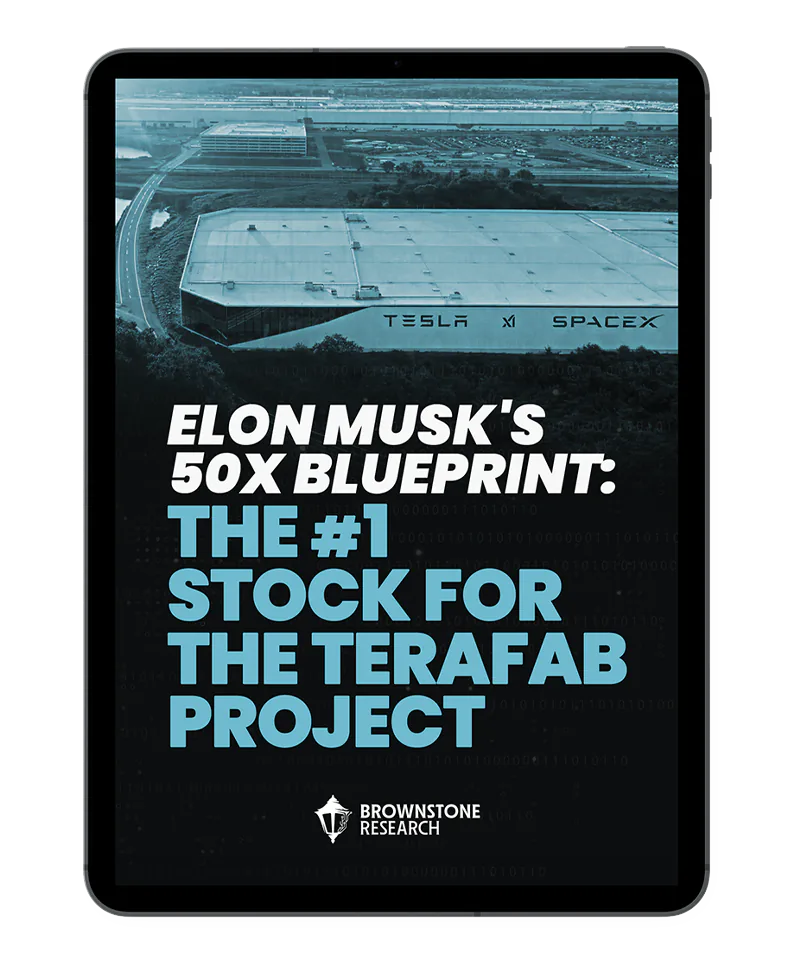 Elon Musk’s Terafab project aims to produce up to 200 billion AI chips annually, creating enormous demand for specialized semiconductor manufacturing equipment.
In this report, Jeff Brown identifies a lesser-known supplier whose precision machinery could play a critical role in this expansion.
The company has worked with Intel for decades and is building an AI laboratory near Intel’s major chip facility in Oregon.
More importantly, Brown claims Musk has already approached the business about supporting Terafab, with an official partnership announcement potentially approaching.
The report reveals the company’s name, ticker symbol, and Brown’s analysis of its potential growth.
Special Report #2: Elon’s Secret Partner Primed for SpaceX’s 100X Growth
 SpaceX’s ambitious plan to deploy one million AI data center satellites could create a substantial market for specialized chips designed to operate in space.
This report identifies an existing SpaceX partner that makes chips capable of converting, regulating, and distributing electricity in harsh orbital conditions.
The relationship reportedly stretches back more than a decade, with over five billion chips already produced for Starlink satellites and ground terminals.
Brown believes the company’s established relationship with SpaceX could position it to benefit as the orbital computing network expands.
You’ll get the full details of this secret partner inside so you know precisely how to play it.
Special Report #3: The Elon Musk Moonshot: The #1 Stock for the Manifested AGI Revolution

Tesla’s Optimus robots need sophisticated power management to move efficiently without overheating or draining their batteries too quickly.
Here, Jeff identifies a little-known semiconductor company already supplying Tesla with sensor technology.
Its specialized chips regulate electricity flowing to robotic motors, potentially improving movement, battery life, and overall performance.
Brown also notes that 39 hedge funds hold shares in the business, while Morgan Stanley has highlighted its robotics potential.
With Musk targeting eventual production of 10 million Optimus units annually, the supplier could benefit from growing demand.
Everything’s laid out in clear English, so you don’t need to be a robotics expert to understand what’s going on.
>> Get the Complete Cybercab Research Package Now! <<

Refund Policy
Jeff Brown’s The Near Future Report comes with a 30-day, ironclad 100% money-back guarantee, giving you a full month to explore the newsletter, stock recommendations, and exclusive research reports.
If you’re unsatisfied for any reason, contact Brownstone Research for a full refund, no questions asked.
Better yet, you can keep all the special reports you’ve received, even after canceling.
Pros and Cons
After reviewing Jeff Brown's The Near Future Report, here are the biggest advantages and a few minor drawbacks worth considering.
Pros
- One full year of monthly research newsletters
- Jeff Brown's expertise in breakthrough technologies
- Stock recommendations targeting AI and semiconductor growth
- Research covering Terafab, SpaceX, and humanoid robotics
- Three exclusive Elon Musk stock reports
- Complimentary one-year TradeStops Basic membership
- Portfolio monitoring tools for managing stock positions
- 30-Day Ironclad 100% money-back guarantee
Cons
- Primarily focused on technology and growth stocks
- Some recommendations may require patience to mature
- No personalized financial advice included
How Much Does The Near Future Report Cost?
after the first year
A full year of Jeff Brown’s The Near Future Report currently costs $179, a 64% discount from its regular $499 price.
That works out to less than $3.50 per week for 12 monthly research issues, ongoing stock recommendations, portfolio updates, and the exclusive Elon Musk research reports.
Membership renews automatically at $199 per year, unless you cancel at least one day before your renewal date. Applicable taxes may also apply.
I think the introductory price offers solid value, especially with the additional research and portfolio monitoring tools included.
Claims Review: What’s Verifiable vs What’s Promotional
This is where I slow things down. The new Cybercab presentation features big past winners and bold projections for AI chips, space-based data centers, and humanoid robots.
Those figures support the sales story.
Jeff Brown has identified several technology stocks that went on to deliver impressive gains, including 945% for Taiwan Semiconductor, 962% for Palo Alto Networks, 1,700% for Arista Networks, and 4,100% for Nvidia.
Brown also reports an average gain of 43% for The Near Future Report, although a complete record of all recommendations isn’t available to verify that figure.
These historical winners are encouraging, particularly given the enormous growth of the companies involved. Still, the figures represent selected results, and actual returns depend on when shares were bought and sold.
On that note, Brownstone does not provide a third-party audited track record for The Near Future Report.
If you want to know what issues subscribers have raised, see the common Near Future Report complaints before deciding.
Inside the portal, you will see current open positions and closed trades noted by date. That is useful, but it is not an audit.
Bottom line: the service gives you a plan and keeps you posted. It does not promise a specific outcome, and there is no magic line to safe gains.
 Risk And Suitability

If you want a plain index fund approach, this is not it.
The service is best for readers who can hold through swings, follow alerts, and size positions modestly.
Expect periods when the market “fights” strong themes and good companies still fall.
That is normal. Keep single-position risk small, use stops as given, and avoid chasing entries far above the posted buy range.
Taxes: Many ideas here are swing or multi-quarter holds. If you sell inside a year, gains are taxed as short-term in most cases.
Wash-sale rules can also bite if you stop and reenter within 30 days at a loss. Ask a tax pro for your exact case.
The new Cybercab pitch also comes with risks tied to the projects themselves.
Terafab, orbital AI data centers, and humanoid robots are ambitious initiatives that could face production delays, technical challenges, and uncertain commercial demand.
This review is educational content, not financial, legal, or tax advice.
Who It’s For and Who Should Skip It
There’s a lot inside The Near Future Report that caters to a variety of folks.
It takes big tech ideas and runs with them, giving you access to opportunities that you likely wouldn’t have found on your own.
Even if you’re somewhat new to investing, Brown lays a firm foundation and provides the tools to take these ideas all the way to your broker.
The platform saves me a lot of time sifting through potential leads while backing recommendations up with clear data, something I think most of us can benefit from.
Since it goes after tech stocks, you’ll need to be okay with some speculation and have the patience for topsy-turvy behavior from time to time.
If you can’t stomach that, I wouldn’t hang out here.
Jeff doesn’t typically focus on fast movers, preferring plays he can hold for several months at a time, so make sure that fits with your strategy.
> Uncover Jeff Brown’s Top Terafab Stock Pick!<<
Alternatives to Compare Before Buying
Look to these alternatives if there’s something about Near Future Report that doesn’t jive with you:
Motley Fool Rule Breakers
Rule Breakers is about finding companies that could become the giants of tomorrow. The service tends to highlight bold businesses—often tech companies—that are doing something different enough to reshape their industries. The philosophy is simple: buy great innovators and give them time to grow.
Compared with that, Near Future Report feels more like a technology-focused briefing. Jeff Brown spends a lot of time explaining where technology is heading and why certain industries might explode. The stock picks come out of those big tech themes rather than purely from the strength of the companies themselves.
Zacks Premium
Zacks Premium isn’t really a typical newsletter experience. It’s more like a research system built around stock rankings, screens, and analyst data. Members use it to filter the market and find companies whose earnings outlook is improving.
If you’re used to The Near Future Report, Zacks will feel much more analytical and less narrative-driven. Instead of reading about future technology trends, you’re mostly interacting with data and rankings to uncover opportunities.
Growth Investor focuses on companies that are already showing strong financial momentum. Navellier grades stocks based on things like earnings growth, sales growth, and analyst upgrades, then highlights the ones that score best.
Near Future Report takes a more forward-looking approach. Rather than relying heavily on financial scoring models, it spends more time exploring emerging technologies and identifying companies connected to those developments.
Near Future Report Review — FAQs
I look for clear domain expertise, a transparent research process, and whether the service distinguishes speculation from investable theses. I also prioritize disclosure around volatility and theme-cycle risk.
What should I confirm about bonuses and special reports?
Verify whether bonuses are one-time downloads, ongoing updates, or time-limited access, and whether they change the renewal price. Treat bonuses as secondary value unless they include ongoing support or updates.
How can I use theme-based picks without taking excessive risk?
Use position sizing limits, diversify across themes, and set expectations for drawdowns. If the service doesn’t provide portfolio rules, you’ll need your own guardrails (max allocation per position/theme).
Is The Near Future Report Worth It in 2026?
I think The Near Future Report is worth considering for anyone interested in emerging technologies, particularly companies that could benefit from Elon Musk’s expanding AI ambitions.
Jeff Brown’s latest research covers some ambitious projects, but the opportunities go beyond betting on Tesla or SpaceX.
Businesses supplying specialized chips, semiconductor equipment, and power-management technology could benefit as these projects move forward.
There’s also more to the membership than these three stock ideas.
Monthly newsletters, portfolio updates, and stock alerts help track new developments and reassess recommendations as circumstances change.
A complimentary year of TradeStops Basic adds practical value by helping members monitor their positions and manage exit decisions.
The combination of specialized research, ongoing guidance, and a 30-day refund guarantee makes the service appealing to anyone comfortable with technology-sector risks.
If you’re interested in the companies positioned around Terafab, SpaceX’s orbital computing plans, and Tesla’s robotics expansion, joining The Near Future Report gives you access to Brown’s latest stock recommendations and research.











 Tags: