

Louis Navellier says that an AI project connected to Elon Musk is powerful enough to make today’s AI obsolete.
Could this “ChatGPT Killer,” which Navellier calls “Project Apex”, really push ChatGPT offline and ignite a 70X investment boom as artificial intelligence enters a far more advanced stage?
In this Growth Investor review, I’ll break down what “Project Apex” really is and whether the opportunity lives up to these bold claims.
>> Join The Project Apex Opportunity TODAY! <<
Growth Investor Overview (What the Service Claims to Deliver)
Quantitative stock screening backed by 35+ years of Navellier's growth investing experience, now applied to a focused AI infrastructure and Project Apex thesis
Stock Grader — type any ticker and instantly get a letter grade based on eight fundamental factors, usable independently of Navellier's monthly picks
Heavily concentrated in AI and growth themes — not suited to conservative investors, short-term traders, or readers wanting broad sector diversification
Growth Investor is Louis Navellier’s long-running stock advisory focused on finding fundamentally strong companies before they become household names.
He uses a quantitative grading system that screens thousands of stocks based on earnings growth, sales acceleration, cash flow, and institutional buying trends.
That sounds intense, but the goal is quite simple: identify companies with the strongest financial momentum and stay ahead of major market shifts.
You get to access this content through a monthly newsletter featuring a new stock recommendation, along with clear buy ranges and ongoing portfolio guidance.
Members also get access to a model portfolio, regular updates, and timely alerts when conditions change.
The “ChatGPT Killer” idea, tied to “Project Apex”, is one of the standout opportunities inside the service, and has Navellier’s attention right now.
I had to see for myself what’s so special about it.
>> Unlock The Project Apex Stock Now <<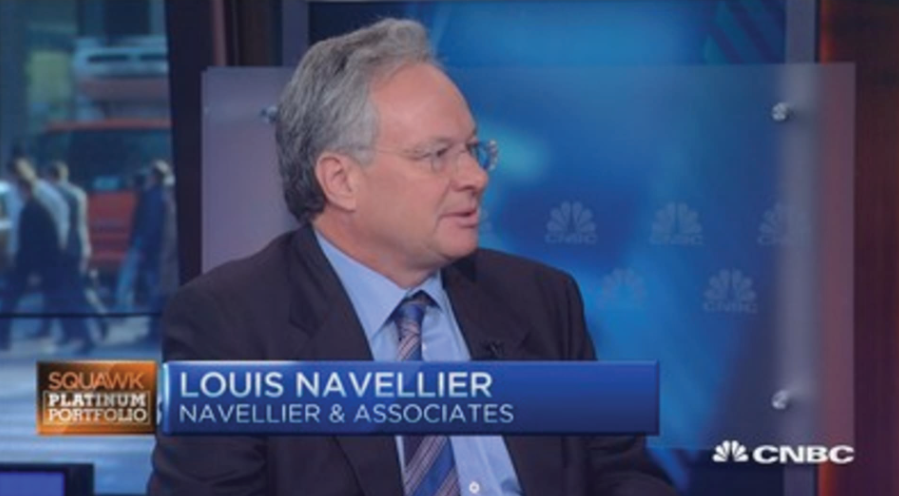
Louis Navellier is a great investment analyst, and I’m impressed with the quality of his stock market research.
Pinpointing breakthrough stocks is tricky business, so it could be a boon to have someone with his experience in your corner.
He’s a Wall Street veteran who calls himself a “1 percenter”. He once had the honor of meeting former President Ronald Reagan.
If his name sounds familiar, you might know him from his pricier newsletter, Platinum Growth Club. Some other popular services he leads are Breakthrough Stocks and Accelerated Profits.
He is also the founder and chief investment officer of Navellier & Associates Inc. The firm manages nearly $1 billion in mutual funds and institutional accounts.
I discovered in my Louis Navellier review that his track record is more established than most gurus, and he has decades of experience as a money manager. The New York Times once called him “an icon among growth stock investors.”
With more than 35 years under his belt, it’s hard to call Louis Navellier anything other than legit.
He appears regularly on CNBC and Fox Business News for his take on the markets, also appearing frequently in The Wall Street Journal, Bloomberg, and MarketWatch.
Over the years, Navellier has found 18 stocks that have returned more than 10,000% for himself and his readers.
I’ve read the newsletters about his success as an investor, and he even got to spend some time with former President Reagan.
>> Get Louis’ latest recommendations now! <<

What Is InvestorPlace Media?
InvestorPlace Media is a great publisher that backs a wide range of investment newsletters. It was founded more than 40 years ago, so it’s been in the business longer than many competitors.
It’s one of America’s largest and most respected independent financial research publishers, and several of its analysts have been featured in prominent publications like The Wall Street Journal, Bloomberg, and many more.
What Is Louis’ “Project Apex”, and Why Is It Being Called a ChatGPT Killer?
ChatGPT has been the poster child for artificial intelligence when it first came out a few years back, and now I refer to using AI as “asking Chat” just like saying “Baid-aid” or “Kleenex” for generic products.
Louis Navellier believes that could all change as Elon Musk rolls out his biggest innovation yet, a so-called OpenAI killer that forever changes how we view the technology.
It all ties to “Project Apex”, a 114-acre supercomputer complex built on the Tennessee-Mississippi state line.
What does one facility have that could have such an impact on the next phase of AI computing, and how can it trigger a massive investment boom that we can partake in?
Change Is in the Air
Artificial intelligence today relies on enormous computing clusters.
Whoever controls the fastest and most advanced processing systems gains an edge.
If Musk’s supercluster delivers materially better training speed and autonomy, it could shift dominance away from existing AI leaders.
We’re talking technology that could solve the world’s biggest mysteries in science and healthcare, and, while not as ideal, eliminate multitudes of jobs.
In theory, a supercomputer of this magnitude could help just about every industry on the planet in some way or another.
What Project Apex eventually does may still be in a dream space, but let me remind you that the complex with this supercomputer in it already exists.
This is not something happening at some obscure point in the future.
That thought has the competition running scared.
>> Get Louis Navellier’s AI Pick Today <<
The $7 Trillion Shift Behind the Headlines
Big names like Alphabet, Amazon, and Meta do not want to get left behind. In fact, they’re expected to pour hundreds of billions into AI infrastructure spending on their own projects.
Navellier doesn’t think they’ll amount to much, but the initiative alone could add $7 trillion to the global economy over the next decade.
If Project Apex represents a leap toward artificial superintelligence, the ripple effects won’t be limited to one chatbot.
The real beneficiaries may be the companies supplying high-performance hardware, specialized systems, and the massive energy capacity required to run a facility of this scale.
A 114-acre supercomputer does not operate without an ecosystem behind it. That’s where the opportunity begins to take shape.
Following the Trail to Project Apex
To the victor go the spoils, and if that’s really “Project Apex”, then move over ChatGPT.
That means all that capital conveniently moves from one place to the other, and if you’re tracking, that could mean lots of dollar signs for anyone in the know.
Even if Apex stays privately tucked away, the companies helping to make it a reality could see massive growth, and that’s where Navellier wants us to land.
He’s identified several of these companies, and he’s sharing his findings with anyone who signs up for his Growth Investor service right now.
There’s a lot more than just stock picks in here though, so I want to do a deep dive into all his offerings so you know precisely what comes with a membership.
>> Access The ChatGPT Killer Research <<

Growth Investor Review: What Comes With the Service?
If you join to access the “Project Apex” idea, you’re getting more than one AI recommendation.
A full subscription to Growth Investor comes with all of the following:
 One Year Access to the Growth Investor Newsletter
 One Year Access to the Growth Investor Newsletter
A one-year subscription gives you a new issue of the service’s namesake newsletter every month.
You can expect roughly one new stock recommendation in each of those, along with Navellier’s broader market outlook.
Each recommendation includes entry guidance and the reasoning behind the pick, grounded in earnings growth, revenue acceleration, and institutional demand.
Navellier may be a smart dude and these topics way over my head, but he finds a way to explain them clearly so I know how to react.
You also get access to the active portfolio so you can see which stocks are buys, holds, or candidates for exit.
>> Claim Your Growth Investor Discount <<
12 Months of Access to Stock Grader
Stock Grader is Navellier’s screening engine, and this is where the system becomes practical.
You can type in any ticker symbol and instantly see its letter grade based on eight fundamental factors.
It really is as straightforward as it sounds, and you can read through the reasoning behind each rating before making any sort of investment.
Between you and me, this system assigned an A-rating to the top-performing S&P 500 stock of the year for a 12 year timespan.
I want to be clear that an A or B rating is not a guarantee of a rising stock, but the system certainly helps you separate the chaff from the wheat when looking for opportunities.
Weekly Updates
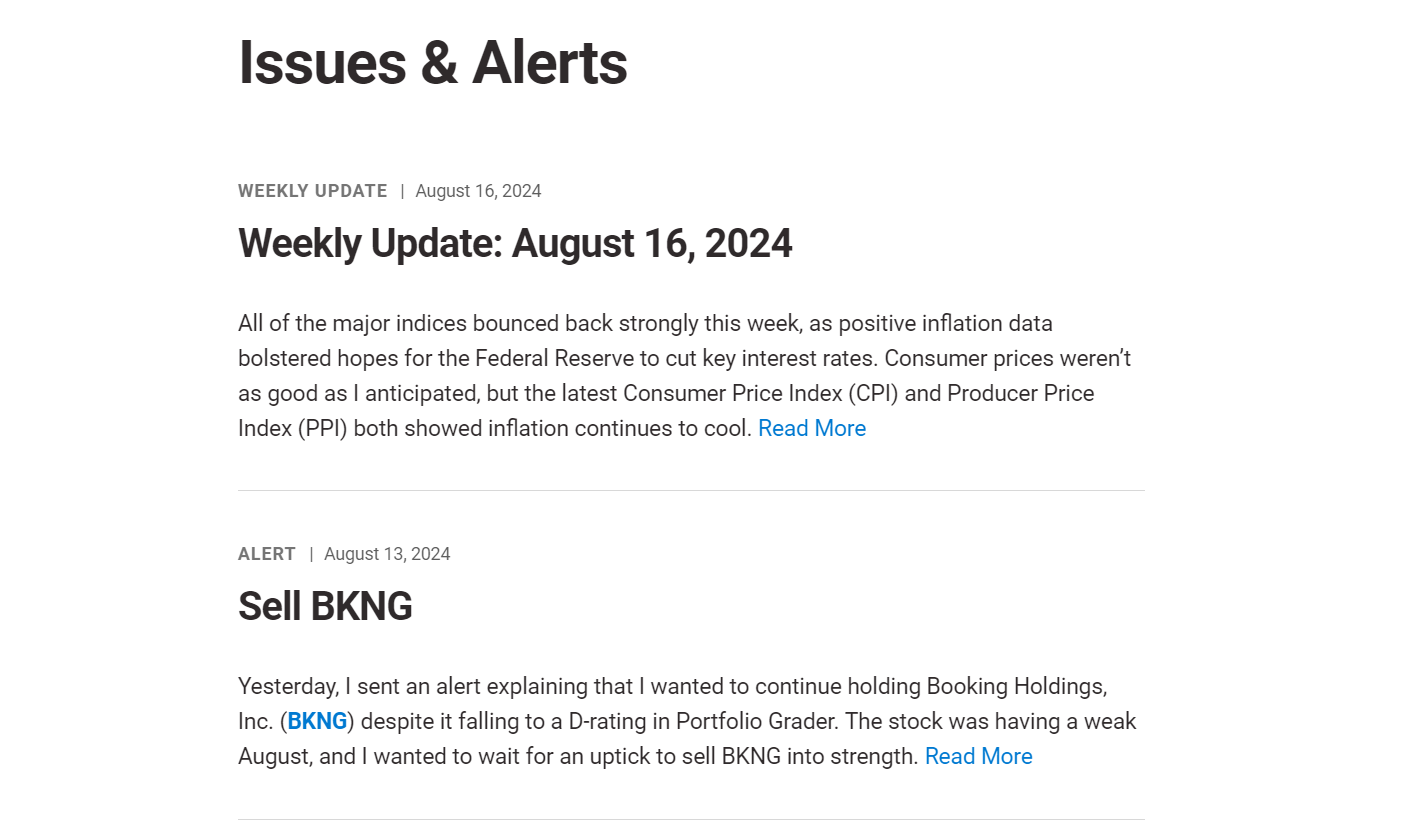
Every Friday, Navellier sends a Weekly Update covering market events, portfolio developments, and what he’s watching heading into the following week.
These aren’t vague check-ins, aiming to keep you aligned with changing conditions.
Growth investing demands responsiveness, especially in sectors like AI where sentiment can shift fast.
If a stock tied to artificial intelligence infrastructure surges or weakens, you’re not left guessing. You get commentary on whether the move changes the strategy.
The weekly cadence helps bridge the gap between monthly recommendations so you’re not operating in silence for 30 days at a time.
>> Start With Louis Navellier Today <<
Special Market Podcasts
When markets make sharp moves, Navellier releases short 5–10 minute audio briefings.
They’re specific, to the point, and help you stay ahead of what everyone else is reacting to.
The idea is to provide context quickly rather than waiting for the next written update.
In volatile environments, especially when AI stocks are moving on infrastructure news or tech spending announcements, having immediate commentary can reduce emotional decisions.
I like hearing directly from the guru. You often pick up cool insights that teach what to do in future situations when sudden news drops.

Complimentary One-Year Membership to TradeStops Basic ($299 Value)
Subscribers also receive a one-year membership to TradeStops Basic at no additional cost.
This platform syncs with your brokerage account to track positions .
It allows you to calculate position sizes based on your personal risk tolerance and uses its proprietary Volatility Quotient (VQ) to determine exit levels.
The VQ is designed to set data-driven trailing stops so you’re not reacting emotionally during pullbacks.
For growth-focused stocks, including smaller AI infrastructure companies, volatility is part of the equation.
Having predefined exit strategies based on statistical movement helps protect potential gains and limit downside without guesswork.
>> Discover The Project Apex Winner <<
Growth Investor “ChatGPT Killer” Bonus Reports
Alongside the core subscription, Navellier includes four additional reports tied directly to the “Project Apex” storyline:

Bonus Report #1: “The Next Tech Giant: The Hidden Winner of Elon’s AI Supercomputer”
This is your big entry point into what Louis calls “Project Apex”.
If artificial superintelligence requires exponentially more compute density, networking throughput, and system optimization, then suppliers embedded in those systems could experience sustained revenue acceleration.
Navellier describes the company shared here as a little-known hardware maker capturing what insiders call the “lion’s share of the gains” from the new AI era.
It supplies the core components required for hyperscale AI clusters like the 114-acre Memphis supercomputer.
He compares the setup to some of his earliest major tech calls, Adobe in 1990, IBM in 1992, Qualcomm and Cisco in 1993, and Amazon in 2004.
The positioning here is clear: instead of betting on which AI interface wins, this company sells the picks and shovels powering the entire race.
>> Activate Your AI Supercluster Play <<
 Bonus Report #2: Trump and Elon’s Preferred AI Partner: Inside the Tech Defending America’s Future

Here, Navellier highlights a software company that has already secured contracts across multiple government agencies.
It’s apparently “inked deals with virtually every single government agency,” positioning it as deeply embedded in national AI initiatives.
He also references President Trump’s public commitment to ensuring the U.S. leads in artificial intelligence.
The key angle here is policy tailwind. If federal spending accelerates in order to maintain AI dominance, this firm could benefit directly.
The boldest claim ties the company to an agreement involving Elon Musk that could influence up to $600 trillion in global wealth.
Bonus Report #3: The Perfect AI Energy: Make 10X Gains on This AI Lifeblood

I think we all can agree that AI data centers cannot scale without reliable, constant energy.
If artificial superintelligence requires exponentially more compute, energy demand rises with it.
The company featured here produces a power source that runs continuously, even during extreme weather, has no moving parts, and can be deployed within weeks.
That immediacy matters when hyperscale clusters are expanding rapidly.
He also points to signed data center deals with Oracle, American Electric Power, Equinix, and Brookfield Asset Management, making this an impressive recipe for success.
>> Secure The ChatGPT Killer Stock <<
Bonus Report #4: Sell These Stocks ASAP: Ten Ticking Timebombs That Could Blow Up Your Portfolio in 2026

Not every company will benefit from shifts in AI. In fact, several of them will get left by the wayside.
The idea is straightforward: as artificial intelligence reshapes industries, some legacy companies may struggle to adapt.
In this special report, he lists ten current stocks he believes resemble “too big to fail” darlings that may face sharp declines.
High analyst ratings and media praise don’t guarantee durability.
This list acts as a defensive complement to the aggressive AI growth ideas.
While Project Apex focuses on where capital may flow next, this report identifies where it may exit quickly.
Growth Investor Pricing: What it Costs Over Time
(regularly $499 — 90% off) Renews at the standard rate after the first year
The standard advertised price for Growth Investor is $499 per year, but the current promotion tied to the “Project Apex” research dramatically reduces that entry point.
Right now, you can lock in a full year of access for $49, cutting 90% off the sticker price.
That discounted rate includes the monthly newsletter, weekly updates, Stock Grader access (normally positioned as a $1,000 value), the special market podcasts, and the complimentary one-year TradeStops Basic membership valued at $299.
The idea is to give access to the system for a fraction of the stated retail price.
Considering the bundled tools and reports, the $49 price point lowers the barrier significantly compared to many premium advisory services in the AI space.
Interpreting Performance Claims
I looked both into the service’s track record and experiences by members to vet performance claims. Here’s what I came up with:
Growth Investor Reviews by Members
After reviewing the subscriber feedback shared alongside the offer, several individual experiences stand out.

The investment results described in these testimonials are not typical; investing in securities carries a high degree of risk; you may lose some or all of the investment.
Across all testimonials, the common thread is appreciation for a structured, rules-based growth strategy backed by ongoing communication.
Not everyone will have these same kinds of results, but it’s still encouraging that the possibility is there.
>> Get Instant Growth Investor Access <<
Interpreting Performance Claims
Navellier leans heavily on his long-term performance history, and after reviewing the numbers he highlights, it’s clear why.
He points to backtests showing his system outperforming the S&P 500 by more than 1,300% from 1998 through 2025.
That’s a sweeping claim covering multiple market cycles, including the dot-com crash, the 2008 financial crisis, COVID volatility, and the recent AI surge.
He also references 15 artificial intelligence–related stocks that gained 100% or more, with peak returns of 517%, 735%, 1,173%, 1,910%, and even 4,806%.
Beyond AI, he notes correctly identifying major turning points like the Enron collapse before its 99% crash and early calls on tech leaders such as Nvidia.
Stock Grader is another pillar of his track record, with the system reportedly assigning an A-rating to the top-performing S&P 500 stock of the year for a 12 year timespan.
Of course, these peak gains are not typical, and growth investing carries risk.
Still, the performance examples presented show a consistent focus on momentum, earnings strength, and institutional demand, the same framework now being applied to the “Project Apex” opportunity.
Growth Investor Risks to Consider
No platform is perfect, and even Louis Navellier has his share of misses when it comes to stock selection.
That’s the risk you face here, especially in more speculative plays making the framework of potentially disruptive technologies.
I’d argue there’s more reward potential here as a result, but you’ll have to weigh those costs on your own.
Growth Investor tends to pursue breakout opportunities like Project Apex, so it can feel a bit narrowly-focused at times.
Who Should Join vs. Who Should Skip
What I really enjoy about Growth Investor is how accessible it is to pretty much everyone.
Navellier never assumes you’re a tech expert, explaining the reasoning behind his recommendations in very clear English that’s easy to follow along.
To that end, even newer folks to investing could find real substance to bite into here.
Trends like the “ChatGPT Killer” often go unnoticed by the masses until they’ve breached mainstream news, so a service like this paves the way for actual gains before everyone jumps in.
You’ll just need to be on alert for sudden changes that you’ll need to react to quickly.
If you want a “safe bet”, this probably isn’t the place for you, nor are these recommendations quick flippers that you could benefit from in a few days.
Pros and Cons of Growth Investor
After reviewing the full Project Apex research and everything included inside Growth Investor, here are the pros and cons that stood out most.
Pros
- Focused on AI infrastructure and emerging trends
- One year of Growth Investor included
- Stock Grader with ticker analysis
- 90-Day Money-Back Guarantee
- Weekly market updates every Friday
- 5–10 minute rapid market podcasts
- TradeStops risk management access
Cons
- Bold return projections
- Heavy emphasis on the AI theme
- Growth stocks can be volatile
 Growth Investor Refund Policy and Cancellation Steps
One thing I always look for in any paid research service is the guarantee, and here it’s clearly stated: you’re covered by a 90-Day Money-Back Guarantee.
That means you can review the Project Apex research, explore Growth Investor, use Stock Grader, and test the system for a full three months.
If you decide it’s not a fit, you can request a refund within that 90-day window.
That reduces the upfront risk significantly and gives you time to evaluate whether Navellier’s AI-focused strategy aligns with your goals before committing long-term.
>> Follow Louis Navellier’s AI Strategy <<
Better-Fit Alternatives for Different Investment Styles
I understand that Growth Investor’s nature won’t appeal to everyone here. If that’s the case, check out some of these alternatives:
Growth Investor vs. Power Gauge Report
Navellier’s strategy is built around catching accelerating growth early — stronger earnings, rising revenue, and increasing institutional demand are the core signals.
The focus is on companies that are gaining financial momentum and can continue climbing as long as those trends stay intact.
Chaikin’s Power Gauge takes a broader scoring approach. Instead of zeroing in primarily on growth acceleration, it blends financial strength, technical trends, and analyst activity into a single rating.
The experience can feel more like using a stock-ranking system than following a growth-focused portfolio strategy.
One leans into sustained growth themes; the other prioritizes clear, model-driven signals.
Growth Investor vs. Stock Advisor
Stock Advisor is about belief in businesses. The idea is to find exceptional companies and hold them long enough for the story to play out — sometimes for many years.
Short-term weakness isn’t automatically a reason to leave.
That’s not really how Navellier operates. Growth Investor’s emphasis is on measurable financial strength right now. If the growth trends cool off, he’ll flip the stock out for something else.
It’s less about conviction over decades and more about staying aligned with improving fundamentals.
Growth Investor vs. Alpha Picks
Alpha Picks feels almost clinical. The system ranks thousands of stocks, selects the highest-rated names each month, and publishes them.
There’s very little narrative wrapped around the process — it’s the quant model, period.
Navellier’s service still leans on a formula, but it doesn’t feel impersonal.
Here you have interpretation, portfolio context, and a sense that someone is actively steering the ship.
Alpha Picks is pure model execution. Growth Investor is model-driven, but analyst-guided.
Growth Investor Review — FAQs
What’s the difference between a model portfolio and personal advice?
A model portfolio shows how the publisher would allocate ideas under their rules, but it isn’t tailored to your finances, taxes, or risk tolerance. We treat model portfolios as educational guidance and emphasize fit and risk controls.
Look for repeatable criteria, a clear sell discipline, and how often changes occur. If it’s mostly narrative without rules, results can hinge on timing and interpretation.
How do I pressure-test any “track record” claims?
Prefer full history with dates, position sizing, and transparent exits—not just a list of big winners. If the service doesn’t disclose losers or methodology, assume results could be incomplete and focus on whether the strategy matches your tolerance for drawdowns.







 Tags:
Tags: