

Most stock research services either drown you in data or hand you a ticker and wish you luck.
Marc Chaikin built something different over roughly 60 years in the market: a rating system that filters more than 5,000 stocks down to clear signals, paired with monthly research that explains what those signals mean.
His newest research takes that framework into the next phase of the AI boom by focusing on ways to win from data center rollouts..
In this Power Gauge Report review, I’ll examine the system to see whether the service still earns a place on my radar in 2026.
>> Get Marc Chaikin’s Top Stocks Now <<
 What Power Gauge Report Is, and What It Isn’t
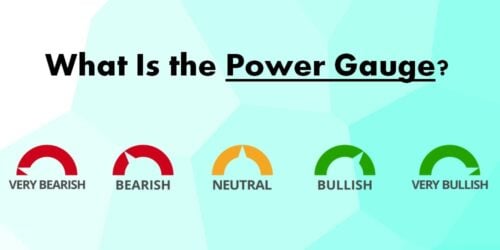
A rules-based 20-factor stock rating system backed by Marc Chaikin's 50+ years of Wall Street experience that covers 5,000+ stocks and ETFs daily — giving subscribers a clear directional signal they can apply independently beyond Chaikin's own monthly picks The Power Gauge Rating system itself — it scans more than 5,000 stocks and ETFs daily across 20 fundamental, technical, and sentiment factors and distills them into a single actionable signal, which members can use on any ticker, not just the ones Chaikin recommends The service is built for longer-term stock investors only — there is no options coverage, no crypto, and no community forum, which limits its appeal for traders who want short-term signals or peer discussion alongside their research
Power Gauge Report is Marc Chaikin’s monthly research service built around stock recommendations, model portfolio updates, and his proprietary Power Gauge Rating system.
What it isn’t is a random AI stock list or a one-off alert with no follow-through.
Each month, Marc and his team use the Power Gauge to scan more than 5,000 stocks across 20 factors, narrow the field, then select their top recommendation.
The goal is to find stocks with strong upside potential while flagging names that carry more risk than they appear to.
That means you’re not only getting impressive opportunities; you’re also protecting your wealth at the same time.
Chaikin’s current research pivots toward a network of next-generation AI supercomputers that he believes could change how major scientific breakthroughs are made.
I’ll share more on that shortly. First, let’s take a closer look at our guru.
>> Sound like a good fit? Sign up now and SAVE 70% <<
Marc Chaikin’s Background
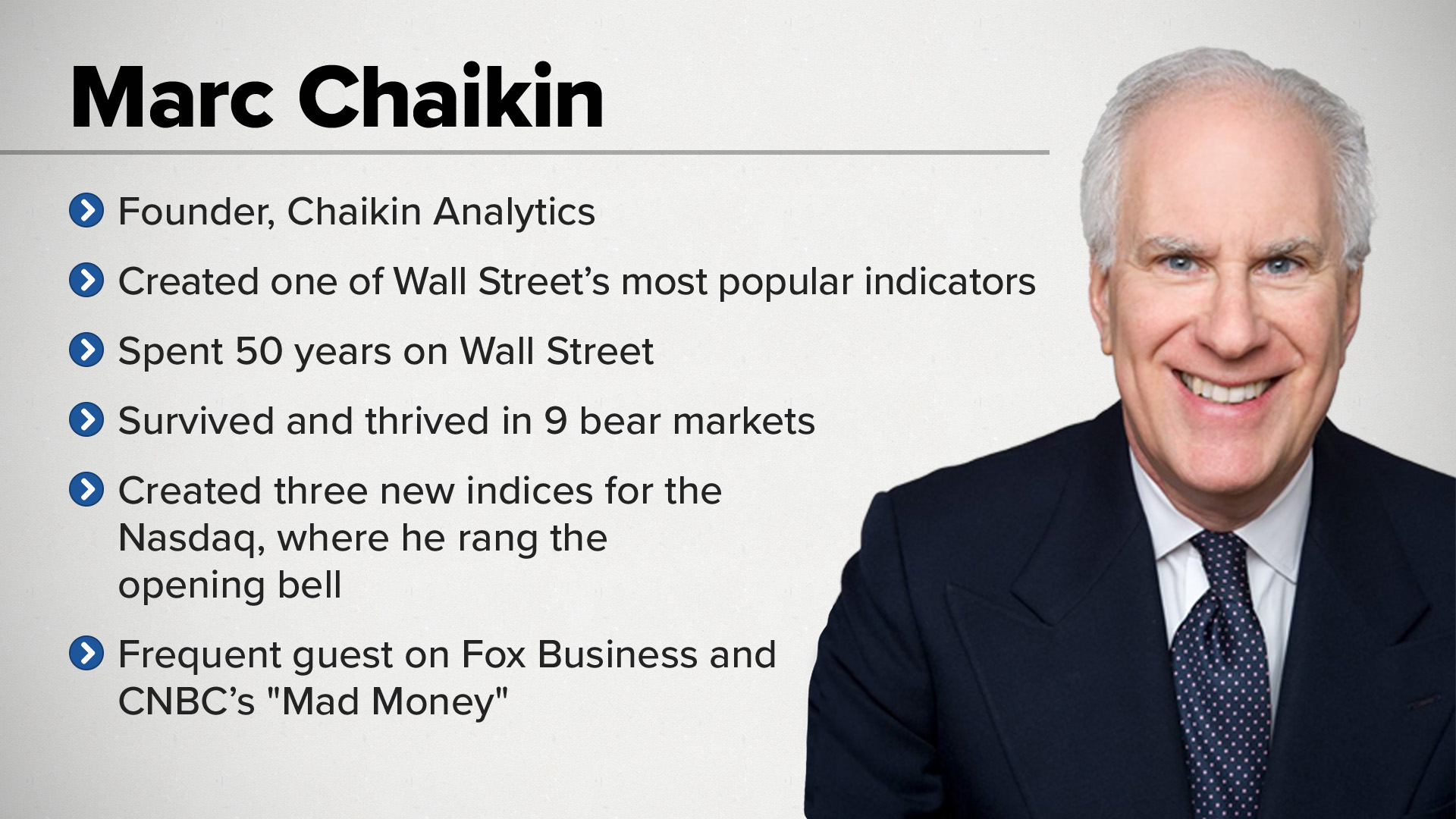
Marc Chaikin is an excellent researcher who’s renowned as a quantitative analyst (quant) and carries roughly 60 years of market experience.
In fact, he’s considered one of the world’s foremost experts in applying technical indicators.
Having begun his career in 1966, Marc created groundbreaking financial systems and indicators widely adopted by major brokerage sites.
Three of his most popular research services include Power Gauge Report, Power Gauge Investor, and the Chaikin Analytics system.
He’s also well-known on The Street for his Chaikin Money Flow indicator and Power Gauge, and he collaborated with Nasdaq to create three new indices.
Chaikin has even been given the honor of ringing the Nasdaq opening bell in 2018.
All in all, this Marc Chaikin shows that he is a solid stock picker and a living legend on Wall Street.
He’s also one of the few gurus I’ve seen whose technical indicators have seen use in professional finance circles, and that speaks volumes.
>> Discover Marc’s LATEST recommendation <<
Is Marc Chaikin Legit?
Marc Chaikin is as legitimate as it gets in this space, and the proof is institutional rather than self-reported.

He has a deep understanding of the market, and the respect he’s earned on The Street is a testament to his effectiveness.
Chaikin’s ability to develop custom indicators demonstrates a deeper understanding of the market than most gurus can muster.
Even Jim Cramer, host of CNBC’s primetime hit show Mad Money, once raved about Marc’s stock-picking prowess:
“I learned a long time ago not to be on the other side of a Chaikin trade… I want to explain why I love Marc’s stuff. It’s simple, it’s understandable, it’s rational, it’s not emotional, and I use it constantly and I almost never want to go against it.”
— Jim Cramer, host of CNBC’s Mad Money
Having reviewed many people in this space, Marc belongs to a category very few analysts ever reach.
Marc is one of the most qualified gurus I’ve encountered in the research newsletter space. You can utilize his research with confidence.
Marc Chaikin Track Record
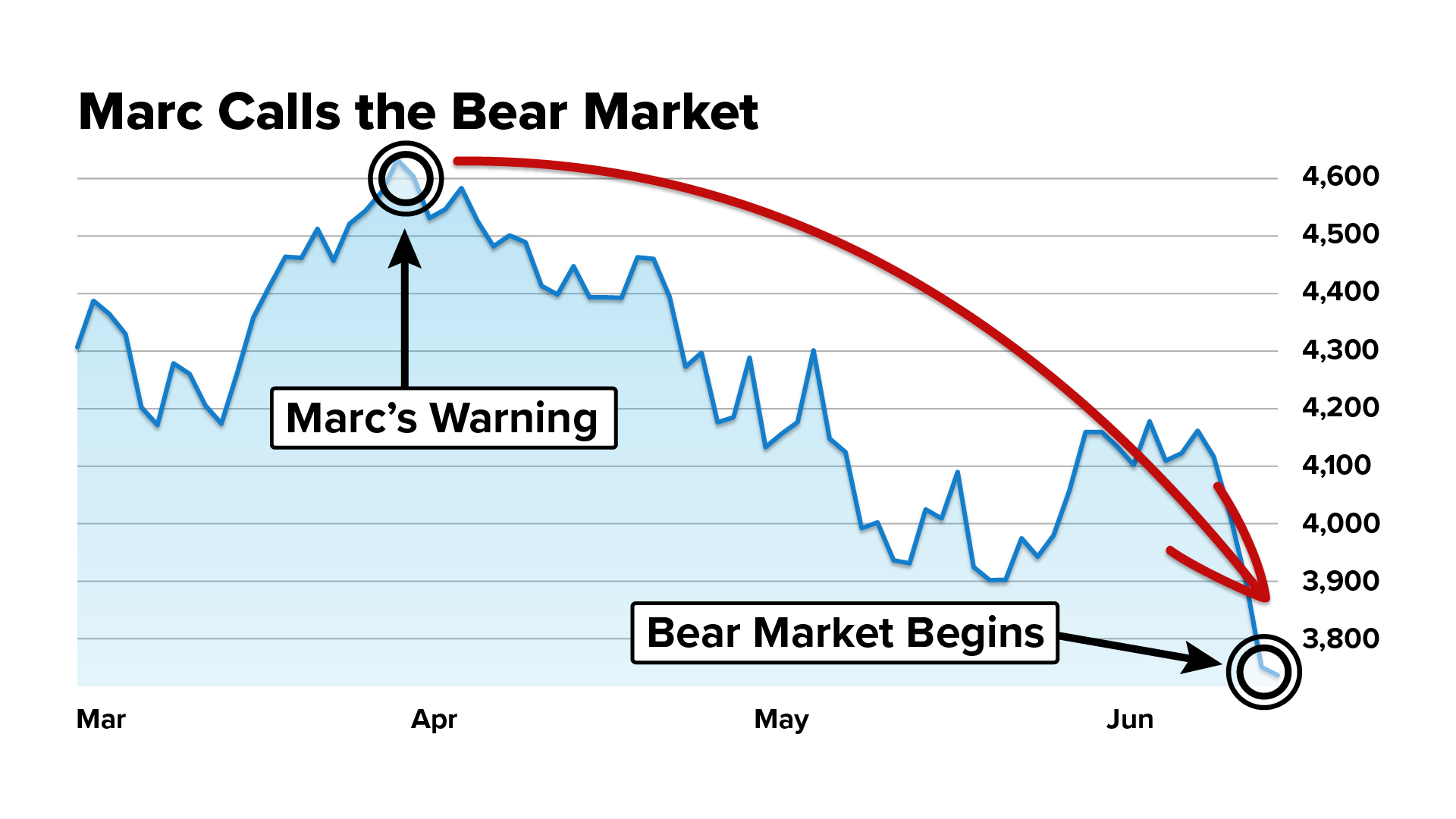
Marc’s track record runs in both directions: catching winners before they run and flagging weakness before the damage shows on the chart.
The Power Gauge turned Bullish on NVDA back in 2014 before climbing more than 50,000% from that early period.
The system also turned Bullish on Micron Technology before a 970% move and Celestica before shares gained more than 6,600%.
Fulgent Genetics climbed as much as 799% after a Bullish rating, NIO rose 884%, Vistra reached a 1,375% gain, and Alpha Metallurgical Resources advanced as much as 2,175%.
Similarly, the system turned Bearish on Boston Scientific before a 55% fall and CoStar Group before a 60% drop.
During the tariff-driven selloff in 2025, ten stocks Marc had warned against lost almost 23% on average in less than six months.
Backtesting adds another interesting data point. The Power Gauge would have rated at least seven of each year’s top 10 stocks Bullish since 2016.
Past performance does not guarantee future results, but a 60-year track record of catching these inflection points in both directions carries weight.
In all honesty, I can count on one hand the number of market experts out there who can stand shoulder to shoulder with Marc.
Inside the Chaikin Power Gauge (High-Level, No Hype)
The Chaikin Power Gauge is a proprietary stock rating system that applies 20 fundamental and technical factors to more than 5,000 stocks and produces a single clear output.
What the Ratings Try to Capture
The system looks at 20 factors across four categories (financials, earnings, technicals, and expert sentiment) and distills all of it into one of five ratings: Very Bullish, Bullish, Neutral, Bearish, or Very Bearish.
The best analogy I have for it is a report card for stocks.
Marc built it to do in seconds what institutional analysts spend weeks doing by hand: weigh multiple signals simultaneously across thousands of companies.
In my experience, the Chaikin Power Gauge is built specifically to detect institutional money flow, the kind that moves a stock before any public news breaks.
Someone always knows something early, and large positions always leave a footprint in price and volume data.
When Ratings Go Wrong
It’s important to remember that these ratings aren’t a catch-all, and they’re certainly not something you can take to the bank.
Where the Power Gauge can go wrong is when it gets treated as a buy order rather than a starting point.
The signal is useful for narrowing the field, but it does not know your account size, time horizon, or risk tolerance.
The best outcomes come from pairing a signal with Marc’s monthly research before acting.
Running a ticker through the system and seeing a Very Bearish rating on something you already own can be more valuable than finding the next winner.
It can stop a preventable loss before it compounds.
>> Explore Marc’s strategies here <<
What Is Chaikin Analytics?
Chaikin Analytics is the research firm behind the Power Gauge Report, founded by Marc Chaikin and built around quantitative analysis.

Since its inception, the company has earned a strong reputation for its stock and ETF screeners, ratings, and top-tier investment insights.
At its core, Chaikin Analytics utilizes quantitative analysis, combining fundamental, technical, and sentiment-based indicators, to evaluate stock performance and potential investment opportunities.
The platform’s hallmark, the Power Gauge Rating system, has earned acclaim for its uncanny ability to pinpoint lucrative investment opportunities.
It may sound convoluted at first glance, but I’ve found these tools extremely helpful for streamlining research, making educated decisions, and staying ahead of market happenings.
No one can provide a stock market crystal ball, but it’s clear that Chaikin Analytics’ research & indicators have earned the Street’s respect.
>> Access Chaikin Analytics tools <<
Marc Chaikin’s American Atlas Thesis: Why He’s Targeting AI Supercomputer Infrastructure
 Marc Chaikin’s very excited about artificial intelligence right now, and it has little to do with building a better chatbot.
He sees a much bigger shift taking shape inside America’s national laboratories.
Marc calls it American Atlas, a nationwide network of high-powered AI supercomputers designed for serious scientific work.
This step effectively takes AI to an entirely new level, and alongside it, the opportunity for some massive gains.
In fact, Marc estimates that the resulting disruption could touch markets worth nearly $248 trillion.
I dug into the computing problem he is trying to solve, I could see why he believes there is a major opportunity forming underneath the surface.
Bigger AI Data Centers May Not Solve the Real Problem
 Today’s AI race has focused on scale. More chips, more data centers, more power, and more cooling have become the standard formula.
Marc thinks that approach has limits.
Most popular generative AI systems rely on lower-precision computing that works well for everyday tasks.
That approach can produce text, answer questions, and analyze ordinary data with incredible speed.
Scientific research demands another level of precision.
Designing molecules, modeling nuclear reactions, or working at atomic scales requires calculations where tiny errors can ruin the result.
Simply stacking more lower-precision hardware together does not fix that weakness.
Instead, the solution looks smaller – compact data centers using a different type of computing for tasks existing AI systems were never designed to handle.
What’s even more mind-boggling is that they’ll be way more powerful than the big dogs and could allow us to achieve breakthroughs with AI that were once only dreams.
The FP64 Shift Opens a Much Larger Door
I won’t get into all the science, but our current AI engines simply aren’t precise enough to get us where we need to go.
Current AI systems often favor FP16 or even lower precision because speed matters more than perfect mathematical accuracy for many tasks.
American Atlas will use FP64 hardware that can handle far more precise calculations, which makes it better suited to advanced science.
Think about it this way – FP16 can represent around 65,000 unique values, while FP64 can handle roughly 18 quintillion.
This isn’t some futuristic concept, either. Chaikin says we’re already here, and this is coming fast.
Once up and running, FP64 data centers could revolutionize big sectors such as energy, medicine, quantum computing, and AI itself.
That’s huge impact, huge potential, and huge opportunities for wealth generation.
Power Gauge Report Turns American Atlas Into a Stock Strategy
The trick is knowing how to invest in these new data center setups before they’re commonplace, and that’s where the Power Gauge Report comes in.
Marc and his team have identified 17 companies connected to the American Atlas buildout. One name is already public: Advanced Micro Devices, ticker AMD.
AMD is supplying high-end computing hardware for this new class of systems, and the Power Gauge currently rates the stock Bullish.
Some of the other companies working behind the scenes are far smaller. Networking equipment alone becomes a huge challenge when dozens of powerful systems must communicate as one machine, and several of these picks meet that need.
Chaikin gave one recommendation for free, but you will need to subscribe to his service to hear about the rest.
Marc’s complete American Atlas strategy is inside hisPower Gauge Report, which brings me to everything included with a membership.
What You Get With Power Gauge Report: Newsletter, Ratings, Model Portfolio, and Alerts
Joining Power Gauge Report for one year gives you full access to the following features:
Annual Subscription to Power Gauge Report Newsletter
The main entrée of your membership is Chaikin’s monthly newsletter, The Power Gauge Report.

Each issue meticulously analyzes the stock market, highlighting specific sectors poised for substantial gains.
It also includes a new mid or large-cap stock recommendation, market analysis, and tons of other insights.
Marc doesn’t just list stocks; he explains precisely why each selection was chosen, providing clear, easy-to-follow reasoning backed by his proprietary Power Gauge Rating system.
What I particularly appreciated was how Marc integrates fundamental, technical, and sentiment analysis into each recommendation while keeping it grounded enough for even a beginner to follow.
Power Gauge Rating System
At the heart of this service is Marc’s acclaimed Power Gauge Rating System, a tool so powerful and intuitive that it quickly became my go-to resource for stock evaluations.
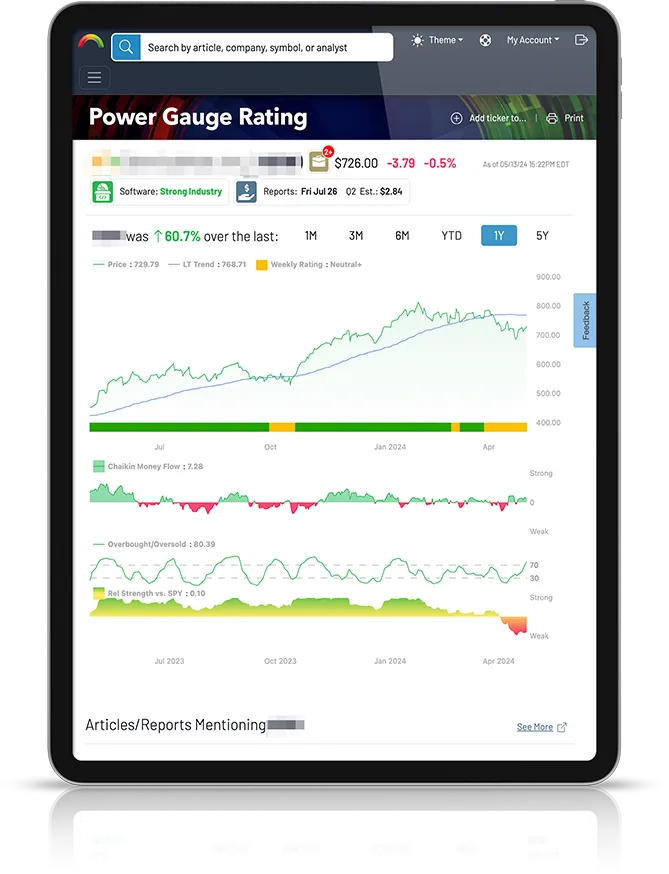
You can access ratings and other valuable information for more than 5,000 companies, and each stock’s rating is clearly explained in the simplest of terms.
This proprietary system condenses complex analytics into a straightforward rating: Bullish, Neutral, or Bearish.
What sets it apart is its comprehensive blend of fundamentals, market sentiment, insider activity, and technical indicators.
You can use this tool to evaluate your own trading ideas, so you won’t be limited to Marc’s stock picks.
It even allowed me to sidestep potential losers by identifying overvalued stocks that could soon drop.
Model Portfolio
Exclusively available to members, the model portfolio tracks every open position featured in Power Gauge Report.
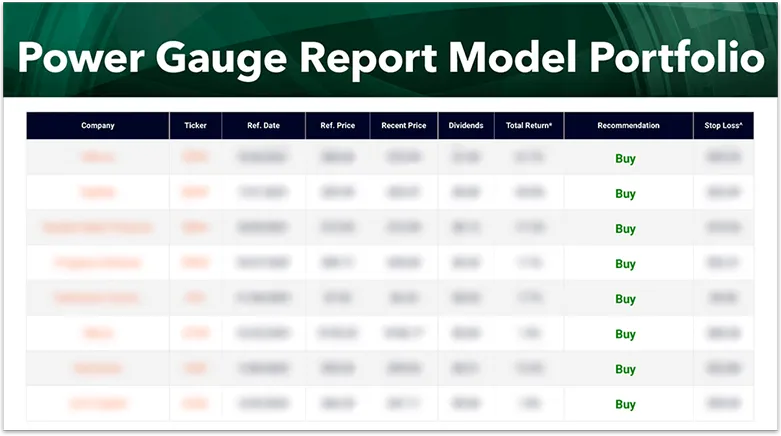
Updated regularly, this portfolio is essentially Marc’s investment roadmap, listing the exact stocks he recommends, along with target buy prices and sell alerts.
It covers the ticker, reference date, reference price, dividend yield, and much more, with updates every Wednesday.
Each position is strategically chosen based on precise data-driven indicators, ensuring you’re not merely following blind recommendations.
It’s very effective to have all of this information in one place so I don’t have to piece together old newsletter issues to figure out what’s still relevant.
Daily Email Alerts
To cover timeframes between newsletters, Marc provides daily email alerts designed to ensure you never miss critical market developments.
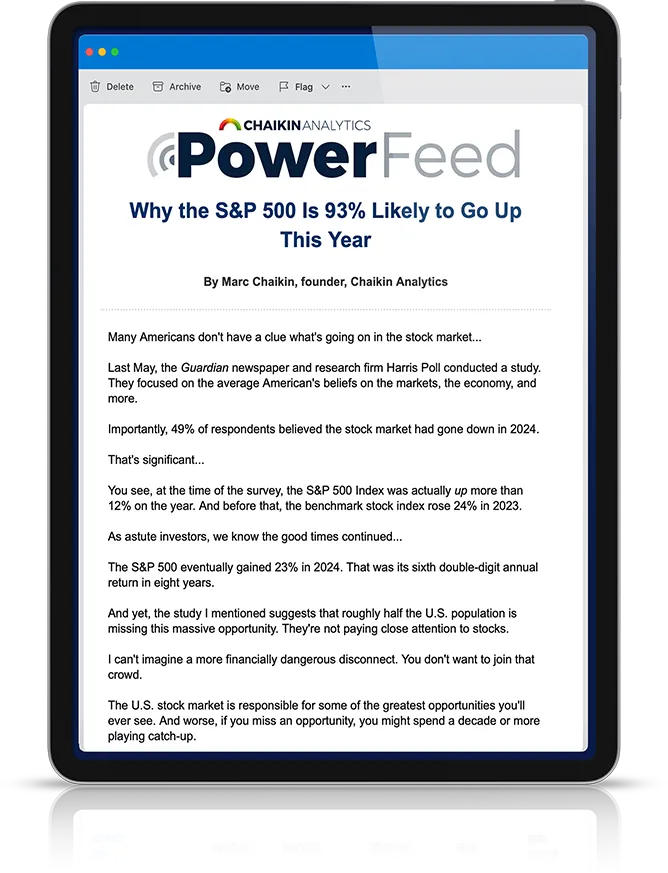
Marc personally selects key updates every trading day, highlighting changes in market trends, shifts in stock ratings, or timely investment opportunities.
These emails aren’t overwhelming or filled with jargon; instead, they offer succinct, actionable insights I can quickly digest over my morning coffee.
I appreciate how Marc carefully filters market noise, only sending relevant information that directly impacts investment decisions.
The alerts also reinforce key concepts discussed in the monthly newsletters, ensuring you’re always aligned with Marc’s latest strategy.
Market Updates
A month can be a long time when markets start moving fast, so Marc’s ongoing updates are an important companion to the main newsletter.
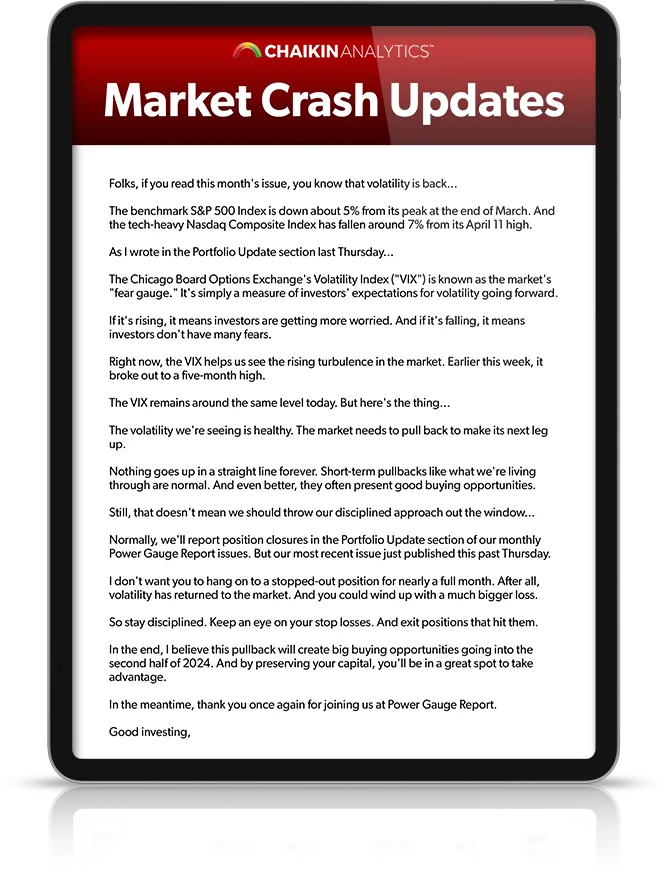
When conditions change, he can explain what the Power Gauge is detecting and whether that affects a position already sitting in the model portfolio.
I don’t want to buy a recommendation and forget about it for six months. Having Marc continue to monitor the idea gives the service much more value than a static monthly stock list.
It’s also a helpful way to stay in the know of what’s happening without having to scour the internet yourself.
Bull and Bear Updates
Bull and Bear updates focus on broader market conditions rather than individual stock picks, giving you a wide-angle lens on big shifts that drive stock changes.
In my experience, these updates zero in on sectors with big potential or areas you should completely avoid.
Marc has used similar signals around several major market swings over the years, including the COVID crash, the 2022 bear market, and the sharp tariff-related decline in 2025.
Since they come fairly often, I’m never left guessing if I missed a change or a particular industry is seeing rebirth.
I never realized how much this sector knowledge can save stress in the long run, making these updates an essential addition to your toolkit.
Special Reports Library
Finally, you’ll gain exclusive access to the Special Reports Library, an extensive resource I’ve frequently turned to for deeper investment insights.
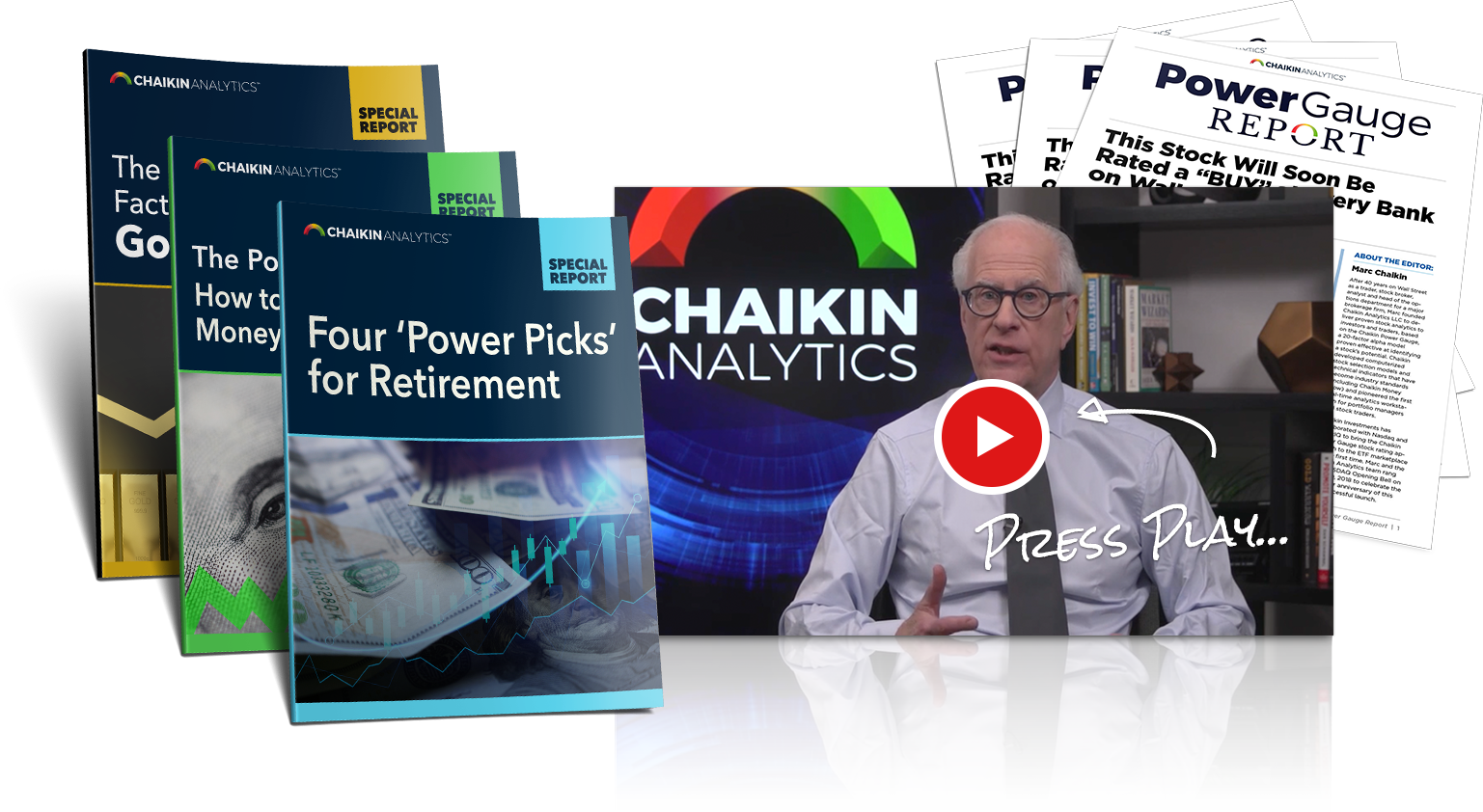
This library includes detailed special reports on topics ranging from emerging market trends to in-depth analysis of promising sectors like AI, energy, and technology.
Each report offers rigorous, data-backed analysis, complete with actionable stock recommendations so followers can stay on top of current market conditions.
I found these reports invaluable for staying ahead of mainstream investors, uncovering hidden opportunities before they become widely recognized.
Marc regularly updates the library with fresh insights, ensuring subscribers remain at the forefront of investing trends.
Whether you’re looking to diversify your holdings or explore entirely new investment opportunities, the Special Reports Library is an exceptional resource that enhances your market understanding and could boost your overall profitability.
Chaikin Power Gauge Report Bonuses
These bonuses target the American Altas strategy and the best ways to play it:
Bonus Report #1: The American Atlas Portfolio: Top Stocks to Profit from the Dawn of AI Superclusters
 Marc’s team spent months digging into the companies tied to American Atlas.
Their work uncovered 17 businesses connected to the project, including firms involved with computing hardware and the networking needed to link these machines.
AMD is one of those companies, but Marc has already revealed that name publicly.
The more interesting opportunities are the lesser-known businesses that have a direct role in the buildout. Marc uses the Power Gauge to narrow that group down to the stocks he believes offer the best combination of business strength and market momentum.
You’ll get the full scoop on all of them inside, from tickers to details.
Bonus Report #2: The Worst AI “Landmine Stocks” to Avoid Right Now
 American Atlas could make parts of today’s AI infrastructure less important for advanced scientific work.
His team used the Power Gauge to identify companies showing enough weakness to earn a place on what he calls the AI “landmine” list.
It is easy to get attached to a famous company after years of strong performance. A Bearish rating forces me to look at the numbers again instead of relying on the name.
Avoiding one steep loss can be just as valuable as finding another winner. This report adds a useful defensive element to the American Atlas strategy.
Bonus Report #3: The AI Energy Hotlist: 4 Trades for Powering the Future
 AI computing still consumes enormous amounts of electricity, so energy remains one of the clearest secondary opportunities in this trend.
This report covers three energy stocks Marc likes, along with one cheap-looking name he considers too risky.
I appreciate that distinction. Rising electricity demand does not mean every utility, nuclear company, or energy stock will automatically benefit.
The Power Gauge gives Marc another way to filter the sector instead of chasing whichever energy name happens to be in the headlines.
American Atlas may use more efficient architecture for some workloads, but an expanding national AI infrastructure network will still need reliable power. That keeps the energy angle relevant to the latest research.
Bonus Report #4: The AI Bottleneck Hotlist: 5 Companies Headed for “Infinite Value”

AI infrastructure cannot expand on chips alone. It needs copper, fiber, transformers, and other physical materials, and supply chains are already strained.
Marc’s view is that the companies unclogging those bottlenecks could become some of the strongest long-term opportunities in the market.
You get five names tied to this physical demand.
What I appreciate about this theme is that it deliberately avoids the obvious chip stocks and focuses on less-covered companies that become more valuable every time a new data center breaks ground.
If spending on American Atlas and other large-scale AI systems continues to rise, the businesses feeding those projects could enjoy sustained demand for years.
Special Bonus: Mystery Gift
The mystery gift is the one item Marc keeps intentionally under wraps until you subscribe.
Marc says others recently paid as much as $2,999 to access it in person, and subscribers get it free with this deal.
He also frames it as something useful for anyone with money in the markets right now.
Since the exact contents are not revealed upfront, I would not make this the deciding factor.
The named American Atlas reports, Power Gauge access, and research library give me enough to evaluate the membership without assigning any value to a surprise bonus.
If the Mystery Gift turns out to be useful, I see that as icing on the cake.

Chaikin Power Gauge Pricing & Subscription Options
Regularly $499 — 70% off after the first year
The Power Gauge Report is typically priced at $499 per year, reflecting its position as Marc Chaikin’s flagship research service.
The current offer brings that down to $149 for the first year, which works out to a 70% discount.
That subscription includes the monthly newsletter, the model portfolio, full use of the Power Gauge Rating system, daily email alerts, market updates, and the complete research library.
The updated package also includes the American Atlas Portfolio, the AI “Landmine Stocks” report, the AI Energy Hotlist, the AI Bottleneck Hotlist, Bull and Bear Updates, Marc’s digital research materials, and the Mystery Gift at no additional charge.
After the first year, the subscription renews at $199 annually, still well below the $499 standard list price.
Risks, Limitations, and How to Reduce Them
As with any service I’ve ever reviewed, there are risks that come with recommendations therein.
It’s never wise to invest more than you can afford to lose, even when a veteran like Marc Chaikin is behind the wheel.
He never claims that his picks are foolproof, even when his track record is superior to most others I’ve seen.
The cool thing about his Power Gauge is that it draws more than 5,000 stocks across 20 factors, but it has limits with smaller, speculative names that Marc does not typically recommend anyway.
I’d also keep Marc’s $248 trillion American Atlas forecast in perspective.
That figure represents the potential value of several enormous industries touched by advanced computing. It does not mean $248 trillion will flow into the stocks Marc recommends.
Use the thesis to identify where change may be coming. Then I rely on company fundamentals, the Power Gauge, and position sizing before putting money to work.
Who Should Use This, and Who Should Avoid It
Chaikin works hard to set his entire service up so folks with any level of experience can benefit.
From the get-go, he uses clear terminology that I feel most people can pick up on as long as you’re already far enough along to set up an investment account and know how to make a trade.
Even tools like the Power Gauge are low-hanging fruit, and all you need is a ticker symbol to get results.
That said, these features can save a lot of time for anyone in a perpetual time crunch who can’t reliably research opportunities on their own.
There’s plenty of meat for those with experience to dig into as well, as long as Chaikin’s strategy aligns.
You may not resonate with the Chaikin Power Gauge Report if you’re looking for a quick win, though.
The service aims for longer-term strategies that you’ll need to ride along with over time.
Also, even if the content here makes locating investments relatively easy, you’ll still need to put forth the effort to buy stocks and ultimately monitor your trades.
>> Sign up under Marc’s guarantee <<
I found considerably more to like than dislike after putting the updated service under the microscope. Pros and Cons of Power Gauge Report
Pros
Cons
Power Gauge Report 30-Day Money-Back Guarantee and Renewal Terms
New Power Gauge Report members receive a 30-day money-back guarantee.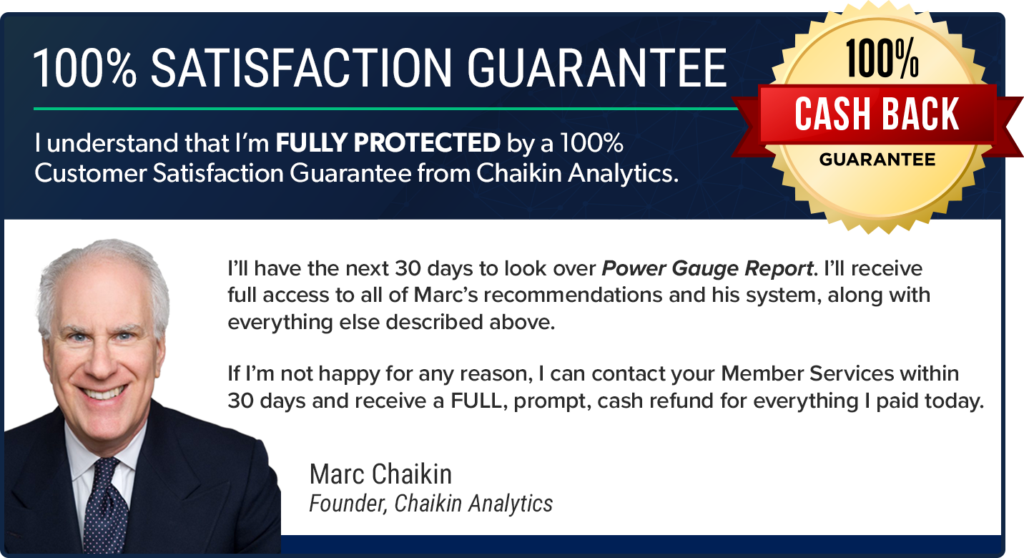
So you have about a month to test drive the service with full access to every feature — this includes the Chaikin Power Gauge.
If you decide it’s not a match, simply cancel within the first 30 days to receive a full refund on the subscription cost.
This company stands by its products, and its refund policy is a testament to its commitment to quality service.
One point I would not overlook is the automatic renewal.
Your membership continues annually unless you cancel.
Chaikin Analytics sends a reminder before renewal, and you need to cancel at least one day before the renewal date if you do not want the next charge to go through.
I appreciate having those terms spelled out.
You get a full month to decide whether the research fits your needs without being locked into the first-year purchase.
Power Gauge Report Reviews by Real Readers
Stock market veterans are no strangers to Marc Chaikin and his Power Gauge. Chaikin has become one of the most respected names on Wall Street.
Since launching the Power Gauge, countless Chaikin followers have told him about their tremendous success in the stock market by using his strategy and system.
Gary S. reports growing a portfolio from around $75,000 to more than $300,000 as of February 2026.
Benjamin Y. has an even more dramatic story. He says he recovered from a $216,000 loss and brought his portfolio back above $1 million.
Brian H. says his gains helped him retire at 57.
Frank N. reports making $207,633 after one year of using the Chaikin Analytics methodology.
Donald H. says his 401(k) more than tripled over seven years. Adam J. says an account that started at $300,000 grew to $1.5 million.
The investment results described in these testimonials are not typical; investing in securities carries a high degree of risk; you may lose some or all of the investment.
Clearly, these users were impressed by the value that Marc Chaikin’s Power Gauge Report delivers.
I’ll be the first to tell you that not everyone will have this level of success, but I did want to showcase how well the system can work.
To that end, I haven’t heard any Chaikin Power Gauge complaints that would scare me off from using this.
>> Save 70% with limited time offer! <<
Power Gauge Report Review — FAQs
It’s both.
The monthly Power Gauge Report provides Marc’s recommendations and research, while the Power Gauge Rating system lets you analyze more than 5,000 stocks on your own.
I think the combination is what separates the service from a conventional newsletter. You can follow Marc’s work, then use the same system to evaluate stocks outside the model portfolio.
What should I verify about how the Chaikin Power Gauge ratings are produced?
Check whether the factors and weighting are described at a high level, how often ratings update, and what inputs are used (fundamental/technical/sentiment, etc.).
I also recommend treating the rating as another research input rather than a stand-alone buy or sell command.
How can I judge whether a rating tool is “accurate” without relying on marketing?
Use a small watchlist and track signals prospectively, not from cherry-picked examples. Compare outcomes to a simple benchmark and record execution assumptions (entry timing, slippage, and holding period) so you’re measuring the tool’s usefulness, not just anecdotes.

Is Power Gauge Report Worth It?
I think Power Gauge Report remains one of the stronger entry-level research services I’ve reviewed from a veteran Wall Street analyst.
The renewed focus on artificial intelligence has me intrigued. There’s definitely still a lot to come from that space, and I want to capitalize on it.
Even if the technology develops as expected, there is no guarantee that every company tied to the project will become a great stock. Having Marc’s insights is a big deal.
In addition, using the Power Gauge on the large pool of stocks to compare signals and the model portfolio are a huge win.
The Power Gauge is what gives the service staying power.
I can use it on more than 5,000 stocks, compare BULLISH and Bearish signals, follow Marc’s monthly recommendations, and check his model portfolio when conditions change.
At $149 for the first year and 30 days to try things out, I think the package offers excellent value.
My verdict is positive: Power Gauge Report makes sense for readers who want a simple stock-rating framework backed by Marc Chaikin’s decades of market experience, especially if the American Atlas opportunity has caught your attention.
Join Power Gauge Report now while the introductory deal is still available and get positioned before the American Atlas buildout moves further into the spotlight.







 Tags:
Tags: